
Nostril
Anatomy and function of the nostrils (nares): external openings of the nose involved in breathing, smell, air conditioning, and reflexes; comparative and clinical notes.
The nostril (also called a naris; plural nares) is one of the two external openings of the nasal passages. Each nostril leads from the outside of the face into the nasal cavity, beginning where the single airway of the nose divides. Together the nares form the external portals for respiration and olfaction that are integral to the nose as an organ.
Image gallery
2 Images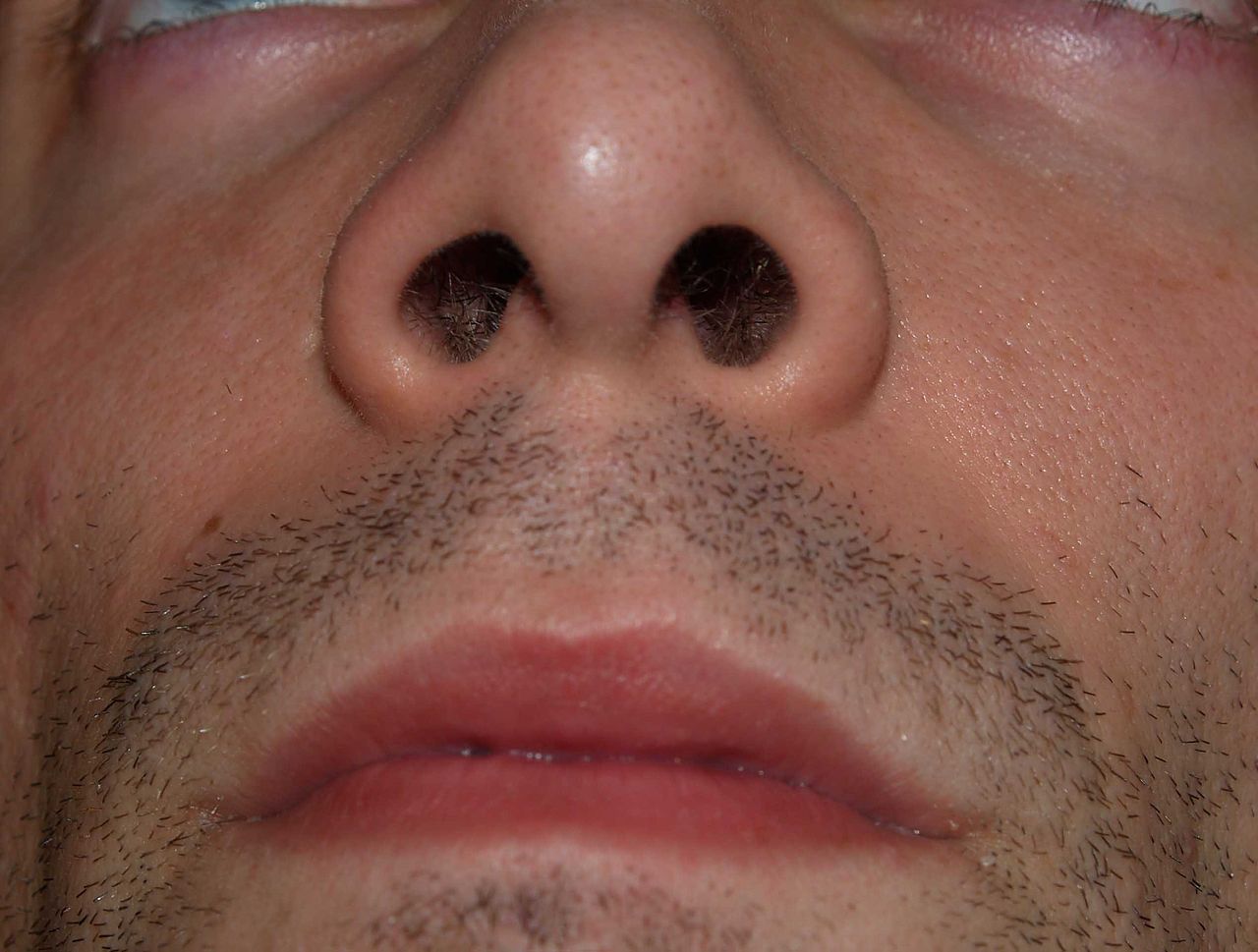

Structure and components
Externally a nostril is bounded by soft tissues of the nasal ala and columella; internally it opens into the vestibule and then the larger nasal cavity. The partition between the two nostrils is the nasal septum. Lining the internal surfaces are mucous membrane, ciliated epithelium, and hair (vibrissae) in the anterior part that trap large particles. Deeper in the cavity are the turbinates (conchae): curved bony or cartilaginous shelves covered by mucosa that increase surface area, directing airflow and supporting heat and moisture exchange.
Comparative anatomy
Different animal groups show variations in nostril form and function. In many birds the nares are simple openings associated with feathered coverings or protective structures; see examples among birds. Among mammals, turbinates are often highly branched and elaborate, especially in endothermic species where warming and humidifying inspired air is important. Aquatic vertebrates such as some fish possess paired nasal openings used for detecting dissolved chemicals rather than for breathing: these small holes support the sense of smelling in water.
Primary functions
Nostrils perform several interrelated roles that support respiration and sensory perception. Their main functions include:
- Air intake and conditioning — warming, humidifying and filtering inspired air so it is better suited for the lungs.
- Olfaction — delivering odorant molecules to the olfactory epithelium for smell detection.
- Protection — trapping particles, pathogens and debris via mucus and hairs; triggering reflexes such as sneezing.
- Resonance and speech — contributing to voice quality and nasal resonance in humans and vocal animals.
Human specifics and clinical notes
In humans, nostrils participate in a phenomenon called the nasal cycle: the degree of airflow through each nostril alternates periodically so one side is relatively more congested while the other is freer. Anatomical variations—such as a deviated septum, enlarged turbinates, or congenital differences—can affect airflow and lead to symptoms like obstruction, snoring or chronic sinus problems. Common medical interventions include topical treatments, endoscopy, septoplasty and rhinoplasty when structure and function need correction.
Evolutionary and practical importance
Nostrils reflect a balance between environmental demands and physiological needs. In cold or dry climates, elaborate turbinates help conserve heat and moisture. In aquatic or burrowing species nostril placement and closure mechanisms may protect the airway. For people, nostril health is important for breathing comfort, smell, and defense against airborne hazards; allergies, pollution and infections commonly affect nasal function.
Notable facts and distinctions
- Terminology: the singular technical term is naris and the plural is nares.
- Nasal anatomy varies across vertebrates: some animals use external nostrils primarily for respiration, others mainly for chemoreception.
- Simple care—keeping the nasal passages clear and treating persistent symptoms—helps preserve both airway function and the sense of smell.
For further reading and illustrations of comparative nasal anatomy and clinical procedures, see resources on the nose, avian nasal structures in birds, mammalian turbinate adaptations in mammals, olfactory systems in fish, the mechanisms of smelling, and human nasal physiology in humans.
Questions and answers
Q: What is a nostril?
A: A nostril is one of the two channels of the nose, from the point where they bifurcate to the external opening.
Q: What is the function of turbinates?
A: The function of turbinates is to warm air on inhalation and remove moisture on exhalation in birds and mammals.
Q: How do fish breathe?
A: Fish do not breathe through their noses, but they do have two small holes used for smelling which may be called nostrils.
Q: What is the nasal cycle?
A: The nasal cycle is a phenomenon in humans where during the course of a day, the nostrils will switch over approximately every four hours or so, meaning that only one nostril is used at any one time.
Q: What are the bones or cartilages in nostrils called?
A: The bones or cartilages in nostrils are called turbinates.
Q: Do birds and mammals have turbinates in their nostrils?
A: Yes, birds and mammals have turbinates in their nostrils.
Q: How does the function of turbinates help in breathing?
A: The function of turbinates is to warm air on inhalation and remove moisture on exhalation, which helps in easier breathing.
Related articles
Author
AlegsaOnline.com Nostril Leandro Alegsa
URL: https://en.alegsaonline.com/art/71148
Sources
- webmd.com : Nasal Obstruction