
Atlantic sailfish (Istiophorus albicans)
A fast, pelagic predator of the Atlantic and Caribbean, notable for its sail-like dorsal fin, elongated bill, and role in sport fisheries and open-ocean ecosystems.
Overview
The Atlantic sailfish (Istiophorus albicans) is a large, pelagic species of ocean fish recognized for a high, sail-like dorsal fin and a long, pointed rostrum. It belongs to the family Istiophoridae and has historically been placed among the perch-like Perciformes in older classifications. Sailfish are widely known as swift predators of open water and are closely related to marlins and other billfishes in the same family.
Image gallery
3 Images

Identification and distinctive traits
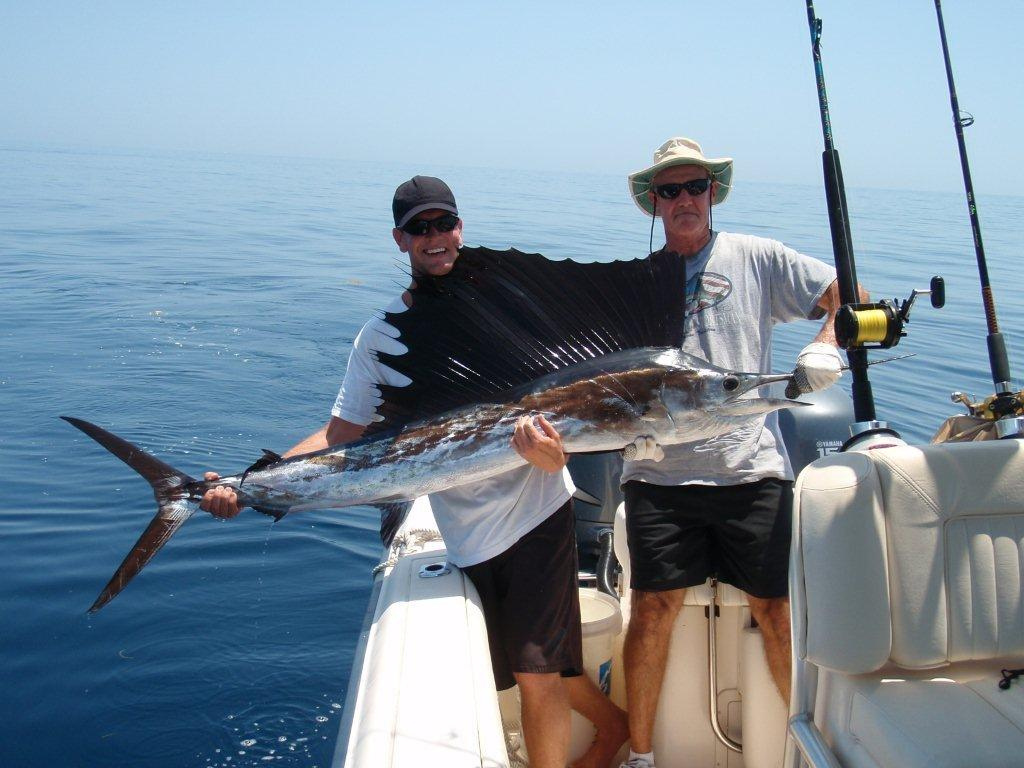
Typical features that distinguish the Atlantic sailfish include a tall, crescent-shaped dorsal fin (the "sail"), an elongated, flattened bill, and a streamlined body adapted for cruising and bursts of speed. Coloration can shift rapidly: the sides often show iridescent blue and silver tones while the sail can be patterned with spots or bars that become more pronounced during hunting or when the fish is excited. The sail is used in display, schooling disruption and sometimes to herd prey.
Distribution and habitat
Atlantic sailfish inhabit warm and temperate waters of the Atlantic Ocean and adjacent seas, including the Caribbean Sea. They are primarily epipelagic, occupying surface layers and extending to depths around 200 meters depending on prey and conditions. Populations are patchy; they are widespread across tropical and subtropical regions but are not uniformly distributed through the central North and central South Atlantic.
Feeding and behavior
Sailfish feed chiefly on schooling forage fish such as sardines, anchovies and mackerel, and will also take cephalopods and crustaceans. Hunting tactics include rapid chases, slashing or tapping with the bill to wound or immobilize prey, and using the raised sail to corral or confuse schools. Observers note cooperative behaviors when groups of sailfish work together to isolate individuals from dense schools.
Speed and physiology
Sailfish have long held a reputation as among the fastest fish in the ocean. Early 20th-century reports suggested extremely high sprint speeds, but subsequent research has produced more conservative estimates. Contemporary studies and biomechanical analyses indicate peak speeds lower than those early claims, with many estimates placing sustained sprinting and burst speeds at levels that are impressive but substantially less than the highest historical figures. Their body shape, large tail, and muscular design nevertheless support quick acceleration and agile turns during predation.
Reproduction, lifecycle and ecological role
Reproductive activity occurs in warm offshore waters where spawning releases buoyant eggs and larvae into the plankton. Juveniles grow rapidly in productive surface waters before joining adult feeding migrations. As mid- to upper-level predators, sailfish influence the structure of forage fish populations and serve as indicators of healthy open-ocean ecosystems.
Human interactions and conservation
Atlantic sailfish are prized by sport anglers for their fighting ability and acrobatics; catch-and-release is a common practice in recreational fisheries. They are taken by various commercial and artisanal fisheries in some regions, sometimes as bycatch. Management measures, angling regulations and research aim to balance recreational value with population sustainability. Scientific study of sailfish includes field observation, tagging, and laboratory analysis to better understand movement, diet and population status.
Related species and notable facts
- The Atlantic sailfish is closely related to other billfishes in family Istiophoridae, a group that includes marlins and spearfish.
- Taxonomic and classification references often cite older placements among Perciformes, while modern treatments sometimes use refined groupings.
- Research into swimming performance and hunting strategy continues; recent studies emphasize methodology differences that affect reported speed values.
- For further reading on marine ecology and identification, consult general resources on marine fish and regional guides to the Atlantic Ocean and the Caribbean Sea.
Continued study of the Atlantic sailfish contributes to broader knowledge of pelagic food webs, fisheries interactions and the effects of environmental change on open-ocean predators. Anglers, scientists and conservationists often share an interest in maintaining healthy sailfish populations so that these iconic animals persist in the world's tropical and temperate seas.
Questions and answers
Q: What is the Atlantic sailfish?
A: The Atlantic sailfish is a type of marine fish that belongs to the family Istiophoridae of the order Perciformes.
Q: Where can the Atlantic sailfish be found?
A: The Atlantic sailfish can be found in the Atlantic Oceans and the Caribbean Sea, from the surface to depths of 200 meters (656 feet).
Q: Does the Atlantic sailfish occur in all areas of the Atlantic Ocean?
A: No, the Atlantic sailfish does not occur in large areas of the central North Atlantic and the central South Atlantic.
Q: What is the Atlantic sailfish related to?
A: The Atlantic sailfish is related to the marlin.
Q: How fast can the Atlantic sailfish swim?
A: Tests in the 1920s estimated that the Atlantic sailfish was capable of short sprints of up to 111 kilometers per hour, although more conservative estimates of 37 to 55 kilometers per hour are more widely accepted. More recent studies even suggest sailfish do not exceed swimming speeds of 36 km/h (22 mph).
Q: What do Atlantic sailfish hunt?
A: Atlantic sailfish hunt schooling fish, such as sardines, anchovies, and mackerel, although they also feed on crustaceans and cephalopods.
Q: What is the depth range of the Atlantic sailfish?
A: The Atlantic sailfish is found from surface to depths of 200 meters (656 feet).
Tags
Related articles
Author
AlegsaOnline.com Atlantic sailfish (Istiophorus albicans) Leandro Alegsa
URL: https://en.alegsaonline.com/art/6997
Sources
- doi.org : 10.1093/icb/icv017
- pubmed.ncbi.nlm.nih.gov : 25898843
- arkive.org : "Atlantic sailfish"
- fishbase.org : "Istiophorus albicans"