
NGC 4526 — Lenticular galaxy in the Virgo region
NGC 4526 is a bright lenticular galaxy in Virgo notable for its dust lanes, rapid rotation, past supernovae and a massive central black hole. It is an important object for studies of galaxy structure and evolution.
Overview
NGC 4526 is a bright lenticular galaxy located in the direction of the Virgo constellation. Observers describe its shape as lens‑like, with a prominent central bulge and a flattened disk that contains dust lanes and faint spiral structure. Under modest telescopes it appears as a lentil-shaped object; deeper imaging reveals complex dust and stellar patterns that bridge morphological characteristics of spirals and ellipticals. Lenticular classification, its placement in the Virgo area of the sky and its being listed as an object in the constellation are commonly noted in catalog entries. The informal comparison to a lentil shape and occasional hints of spiral arms help describe its appearance to amateur observers.
Image gallery
5 Images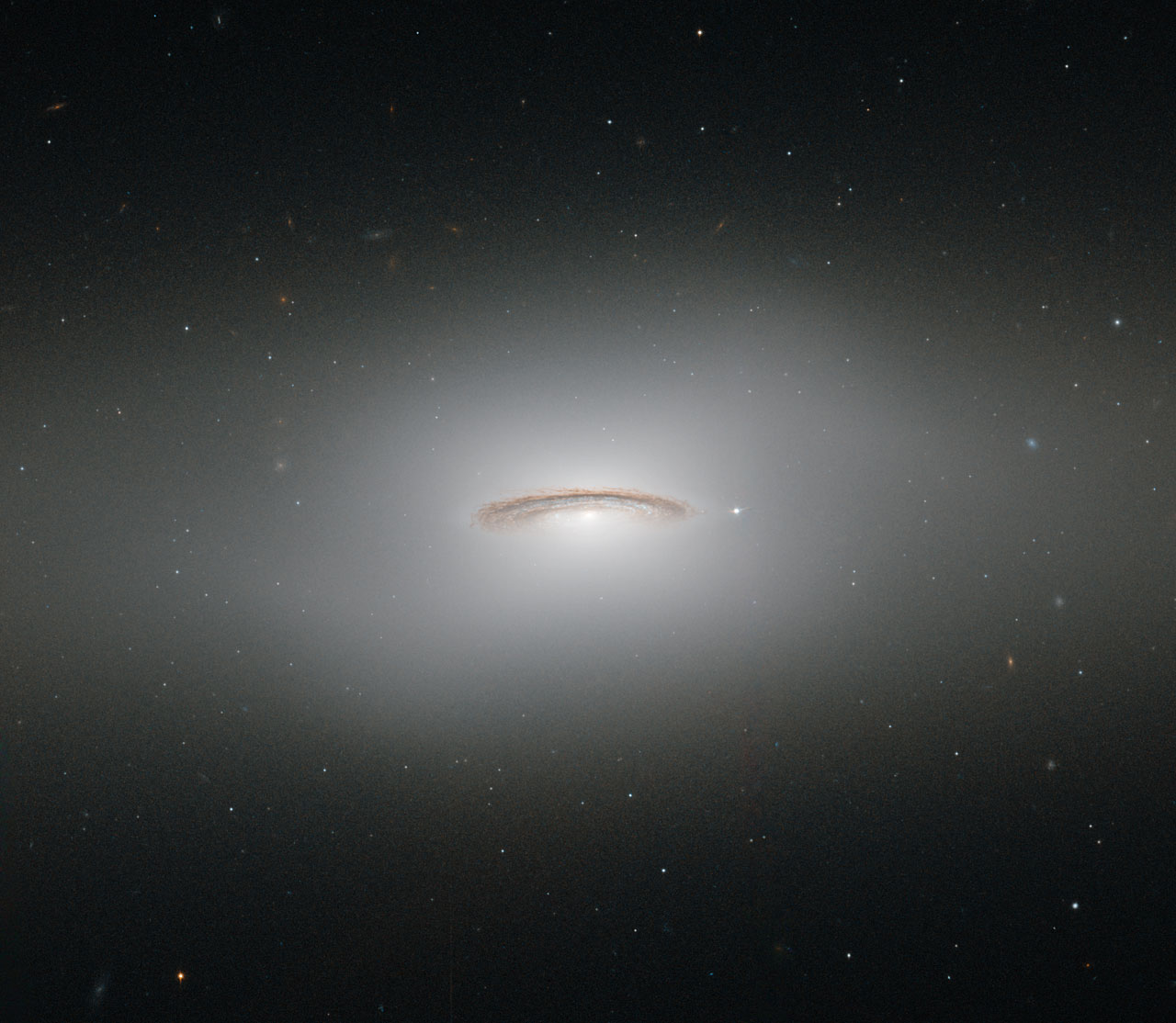


Physical characteristics
NGC 4526 is one of the more luminous lenticulars known, with a large central concentration of stars and a disk that shows dust absorption lanes. It rotates relatively rapidly for its class; rotational velocities around 250 km/s are reported, indicating substantial angular momentum in the disk. Converted speeds are often given in other units for general audiences: roughly 559,234 mph or about 900,000 kph. At the geometric center of the galaxy lies a supermassive black hole; mass estimates place it on the order of a few hundred million times the mass of the Sun, often cited around 450 million solar masses, a value used when discussing its dynamical influence and central kinematics. For discussion of black hole studies see common references to supermassive black holes and mass estimates such as 450 million times the Sun.
History of observations and supernovae
NGC 4526 has been the subject of professional and amateur study for decades. High-resolution images from space and large ground-based telescopes have revealed its dust lanes and central structure. Astronomers have recorded at least two supernovae in or near this galaxy; the best known is SN 1994D, a Type Ia event attributed to a thermonuclear explosion of a carbon–oxygen white dwarf in a binary system. Historical notes and the supernova record are summarized in catalogs and archives, which categorize such events as supernovae and list individual cases such as SN 1994D. The Type Ia mechanism involves a white dwarf composed primarily of carbon and oxygen, and these events are valuable both for calibration of cosmic distances and for studying stellar evolution.
Scientific importance
NGC 4526 serves as a useful laboratory for several branches of extragalactic astronomy. Its relatively high surface brightness and clear central structure make it suitable for dynamical studies that probe the mass distribution and measure the mass of the central black hole using stellar or gas motions. The presence of dust within the disk offers insights into how lenticular galaxies can retain cold interstellar material and host residual or centrally concentrated star formation. As a luminous representative of lenticular morphology, it helps scientists study the transition between spiral and elliptical types and the processes that quench or reshape disks.
Notable facts and distinctions
- Classification: lenticular galaxy with disk and bulge components; commonly cited in morphological surveys. Lenticular
- Location: seen toward the Virgo region and often discussed in the context of Virgo-area galaxy studies. Virgo, constellation
- Appearance: lens-like shape with dust lanes and limited spiral features. lentil-shaped, spiral arms
- Central black hole: a massive nucleus influences inner dynamics. Supermassive black hole, mass often cited as ≈450 million M☉
- Supernova history: hosted recorded supernovae, including the Type Ia SN 1994D from a white dwarf of carbon and oxygen. Supernovae in this galaxy are important benchmarks.
- Rotation: reported rotational velocity roughly 250 km/s (see conversions: mph, kph).
Further resources
- Lenticular galaxy resources
- Virgo region catalogs
- Constellation mapping tools
- Visual descriptions
- Spiral structure notes
- Supermassive black hole studies
- Black hole mass estimates
- Supernova databases
- SN 1994D entry
- White dwarf physics
- Carbon–oxygen composition
- Type Ia progenitors
- Speed conversions (mph)
- Speed conversions (kph)
For observational advice, amateur astronomers can find NGC 4526 within catalogs of bright southern Virgo objects; professional readers can consult instrument archives and the literature for detailed kinematic and photometric studies. The galaxy remains a frequently cited example when discussing lenticular structure, central mass concentrations and the legacy of Type Ia supernova observations.
Questions and answers
Q: What is NGC 4526?
A: NGC 4526 is a lenticular galaxy located in the Virgo constellation.
Q: How does NGC 4526 appear in a telescope?
A: In a telescope, NGC 4526 looks like a lentil-shaped structure with spiral arms.
Q: What is notable about NGC 4526?
A: NGC 4526 is one of the brightest lenticular galaxies and has a supermassive black hole at its center.
Q: How massive is the supermassive black hole in NGC 4526?
A: Astronomers estimate that the supermassive black hole in NGC 4526 is 450 million times the mass of the Sun.
Q: Have any supernovas occurred around NGC 4526?
A: Yes, two supernovas have occurred around NGC 4526. The most recent was SN 1994D, which was the supernova of a white dwarf made of carbon and oxygen.
Q: How fast does NGC 4526 spin?
A: NGC 4526 spins at a speed of 250 kilometers per second (559,234 mph or about 900,000 kph).
Q: Where is NGC 4526 located?
A: NGC 4526 is located in the Virgo constellation.
Related articles
Author
AlegsaOnline.com NGC 4526 — Lenticular galaxy in the Virgo region Leandro Alegsa
URL: https://en.alegsaonline.com/art/69865
Sources
- ui.adsabs.harvard.edu : 2006AJ....131.1163S
- doi.org : 10.1086/498708
- arxiv.org : astro-ph/0011223
- ui.adsabs.harvard.edu : 2001ApJ...546..681T
- doi.org : 10.1086/318301
- ui.adsabs.harvard.edu : 1979ApJS...41..435B
- doi.org : 10.1086/190625
- arxiv.org : 1301.7184
- ui.adsabs.harvard.edu : 2013Natur.494..328D
- doi.org : 10.1038/nature11819
- spacetelescope.org : "The whirling disc of NGC 4526"