
NGC 6302 — the Butterfly (Bug) Nebula
NGC 6302 is a bipolar planetary nebula in Scorpius, notable for its extremely hot central white dwarf, dense equatorial dust disk, and striking butterfly‑shaped lobes.
Overview
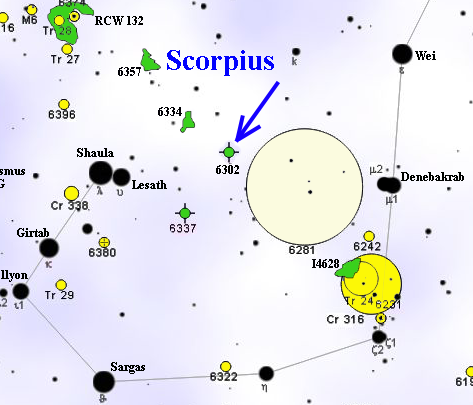
NGC 6302, commonly called the Butterfly Nebula or Bug Nebula, is a bright planetary nebula located in the constellation Scorpius. Positioned roughly 3,400 light‑years from Earth, it is an example of the late evolutionary stage of an intermediate‑mass star. The object is frequently cited in studies of stellar mass loss and nebular shaping because of its dramatic bipolar appearance and the extreme conditions revealed by its spectrum. For a general definition, see planetary nebula.
Image gallery
4 Images


Physical characteristics
The nebula forms a pronounced hourglass or "butterfly" silhouette produced by two wide lobes extending in opposite directions from a dusty, optically thick equatorial plane. The central star is a hot white dwarf whose surface temperature is extraordinarily high — reported to exceed 250,000 °C — making it one of the hottest known central stars of a planetary nebula. Spectra show highly ionized gas and strong forbidden emission lines, and infrared observations reveal warm dust concentrated in a dense equatorial disc or torus that obscures the star at many wavelengths.
Structure and notable features
- Central star: a compact white dwarf remnant with a mass estimated near 0.64 solar masses; recent imaging confirmed the stellar remnant after being hidden by dust (white dwarf).
- Equatorial disc: a dense band of gas and dust that channels stellar outflows into bipolar lobes and produces strong extinction along the midplane.
- Bipolar lobes: sharp, well‑defined edges, ionization walls and knotty structures are visible throughout the lobes, attesting to complex outflow histories and interactions.
- Emission spectrum: dominated by emission lines indicating highly ionized species and rich nebular chemistry; infrared excess shows substantial dust content.
Discovery and observations
Although the nebula has been known for many decades, the central star remained hidden from optical view until modern instruments made it detectable. Upgraded imaging from the Hubble Space Telescope's Wide Field Camera 3 helped reveal the stellar remnant and finer structural details; see information about the instrument at WFC3. Distance estimates and observational data are summarized in various catalog entries and research summaries (distance reference).
Origin, evolution and significance
NGC 6302 formed when a star of intermediate initial mass expelled its outer layers near the end of its asymptotic giant branch phase. The dense equatorial material likely resulted from enhanced mass loss in the late stages of the progenitor, possibly influenced by binary interaction or rapid rotation, which then focused fast winds into polar directions to carve the lobes. As a nearby, bright, and morphologically complex planetary nebula, it serves as a laboratory for understanding mass loss, dust production, and the physical processes that shape nebulae during stellar death.
Notable facts and distinctions
NGC 6302 stands out for the extreme temperature of its central star and for the clarity of its bipolar morphology. It is often compared with other bipolar planetary nebulae but is distinctive because of its dense obscuring torus and highly ionized inner regions. Ongoing multiwavelength studies — optical, infrared and radio — continue to refine knowledge of its mass distribution, chemistry and dynamical history.
For further technical summaries and observational data, see relevant entries and instrument pages: planetary nebula overview, constellation details, distance data, temperature discussion, white dwarf properties, Hubble WFC3.
Questions and answers
Q: What is NGC 6302?
A: NGC 6302 is a planetary nebula in the constellation Scorpius.
Q: How far is NGC 6302 from Earth?
A: NGC 6302 is about 3.4 thousand light-years away from Earth.
Q: What does the spectrum of NGC 6302 show?
A: The spectrum of NGC 6302 shows that its central star is one of the hottest stars in the galaxy.
Q: What is the surface temperature of the central star in NGC 6302?
A: The surface temperature of the central star in NGC 6302 is over 250,000 degrees Celsius.
Q: How was the white dwarf in NGC 6302 discovered?
A: The white dwarf in NGC 6302 was recently discovered by the upgraded Wide Field Camera 3 on board the Hubble Space Telescope.
Q: What surrounds the white dwarf in NGC 6302?
A: The white dwarf in NGC 6302 is surrounded by a dense disc of gas and dust.
Q: What may have caused the star's outflows to form a bipolar structure in NGC 6302?
A: The dense disc surrounding the white dwarf in NGC 6302 may have caused the star's outflows to form a bipolar structure like an hour-glass.
Related articles
Author
AlegsaOnline.com NGC 6302 — the Butterfly (Bug) Nebula Leandro Alegsa
URL: https://en.alegsaonline.com/art/69872
Sources
- doi.org : doi: iopscience.iop.org/article/10.1088/0004-637X/707/1/L32/meta