
Newcastle-under-Lyme — market town in Staffordshire, England
Newcastle-under-Lyme is a historic market town in Staffordshire, England, near Stoke-on-Trent. This article outlines its name, development, local institutions, transport links and notable features.
Overview
Newcastle-under-Lyme is a market town in the county of Staffordshire within England. It lies immediately west of the city of Stoke-on-Trent and forms the administrative centre of the Borough of Newcastle-under-Lyme. The town sits close to the county boundaries with Shropshire and Cheshire, giving it a location that has long connected northern and midland England. Historically a market and coaching town, it retains a mix of shopping streets, civic buildings and suburban neighbourhoods.
Image gallery
10 Images


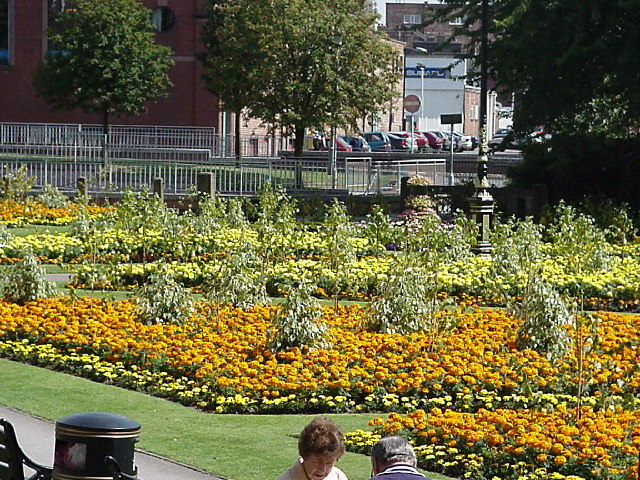


Name and early history
The place name refers to a "new castle" built there in the medieval period; the town developed around that fortification and a market. The phrase "under Lyme" has been interpreted in two ways: as a reference to the nearby castle in relation to local topography, and as derivation from the natural features called Lyme. Possible origins include the Lyme Brook, a tributary in the same river system, or the former River Trent basin and the wooded area historically known as the Forest of Lyme. Documentary records show the town established markets and local institutions by the late medieval era.
Growth, industry and economy
From the 17th and 18th centuries the town expanded as a local administrative and commercial centre. By the 18th century it was an important coaching stop on routes linking ports and industrial towns — connections that ran toward Liverpool and Manchester to the northwest and toward Birmingham and London to the south. In the 19th and 20th centuries regional industrial growth, pottery and engineering in nearby Stoke-on-Trent influenced Newcastle-under-Lyme's workforce and local trade, while modern retail and service sectors have become significant employers.
Education, culture and institutions
The town contains a range of educational institutions, including long-established independent and state schools. One well-known independent school dates from the 17th century and reflects the town's historical role in regional education. Cultural life is supported by libraries, a local museum and community arts projects; annual events and market days continue to be part of civic life. Nearby higher-education and specialist facilities in the conurbation broaden opportunities for residents.
Transport and connections
Newcastle-under-Lyme occupies a strategic spot on road networks between the West Midlands and the North West. Although it does not have a mainline railway station within the town centre, it is served by stations and bus services in the wider borough and by road links that trace the older coaching corridors. These transport links have shaped commuting patterns and contributed to the town's role as a regional shopping and administrative hub.
Notable features and modern developments
- Historic market square and civic architecture dating from different periods.
- Local parks and green corridors that recall the area's former woodland and waterways.
- Institutions that link the town to regional economic and cultural networks.
Today Newcastle-under-Lyme balances conservation of historic streets and community traditions with modern retail, public services and commuter housing. It remains distinctive for its long history as a market centre and for its position close to larger industrial and urban neighbours.
Related articles
Author
AlegsaOnline.com Newcastle-under-Lyme — market town in Staffordshire, England Leandro Alegsa
URL: https://en.alegsaonline.com/art/69734
Sources
- british-history.ac.uk : "Newcastle-under-Lyme"
- staffordshire.gov.uk : "2001 Census - Ward and Town Populations"
- nscg.ac.uk : "Two Campuses, One Destination"