
Neusis construction: the marked‑ruler technique in classical geometry
Neusis construction is an ancient Greek geometric method using a marked straightedge to place a segment of fixed length. It enabled solutions (e.g., angle trisection) beyond unmarked compass-and-straightedge rules.
Overview
Neusis construction refers to a family of geometric procedures used by ancient Greek mathematicians that employ a straightedge with one or more fixed marks. Unlike the idealized unmarked straightedge of classical compass‑and‑straightedge geometry, a neusis (literally "inclination" or "tilt" in Greek) is slid and rotated until its marks meet prescribed points or lines. This added ability to transfer or enforce a fixed distance enlarged the set of constructions available to geometers.
Image gallery
3 Images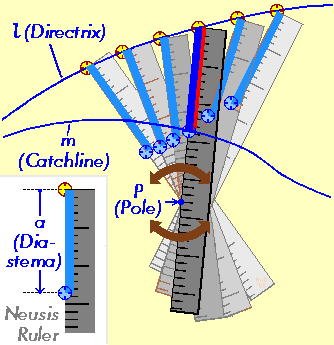

How it works
In a typical neusis step, a marked straightedge is placed so that it intersects two given lines (or passes through a given point and line) while one marked point on the edge coincides with a third constraint. The mark functions like a fixed-length bar: the builder adjusts the ruler until the mark lies on one feature while the ruler itself crosses another. This mechanical constraint produces intersections or segments that solve geometric conditions that plain tools cannot.
Historical context
Neusis techniques appear in the work and commentaries of Hellenistic mathematicians: they are associated with Archimedes, Apollonius and later commentators who recorded specific procedures. Ancient debates sometimes treated neusis as less pure than constructions using only an unmarked straightedge and compass. Nevertheless, for many classical problems — encountered before algebraic notation became widespread — neusis provided practical geometric methods when algebraic tools were not yet developed. See also discussions comparing early geometric reasoning and early algebra or studies in Greek geometry.
Uses and examples
- Angle trisection: several classical neusis procedures trisect angles that are in general impossible with just compass and unmarked straightedge.
- Solutions of certain cubic equations: by enforcing a length relation, neusis constructions realize algebraic relationships of degree three that compass-and-straightedge cannot produce.
- Practical design: in antiquity, artisans and surveyors used marked rulers and templates for layout tasks that required transferring fixed distances.
Significance and distinctions
From a modern viewpoint, allowing a marked ruler is an explicit expansion of permitted operations and corresponds to adding tools that can produce lengths satisfying higher‑degree equations. Neusis constructions are stronger than classical Euclidean constructions but remain limited: they do not solve every algebraic problem, and later formalizations classify which equations can be realized by particular extended tools. Contemporary expositions present neusis both as a historical practice and as a clear example of how changing allowable operations changes mathematical power.
Notable facts
Debates about the legitimacy of neusis highlight historical attitudes toward mathematical purity versus practicality. Modern reconstructions of ancient methods preserve neusis as an instructive bridge between geometric reasoning and algebraic problem solving, demonstrating how a simple marked ruler broadens what is constructible in geometry.
Related articles
Author
AlegsaOnline.com Neusis construction: the marked‑ruler technique in classical geometry Leandro Alegsa
URL: https://en.alegsaonline.com/art/69372