
Neon tetra (Paracheirodon innesi): description, habitat, and aquarium care
Small, brightly colored South American freshwater fish prized in aquaria for its iridescent blue and red stripes, schooling behavior, and peaceful temperament.
Overview
The neon tetra (Paracheirodon innesi) is a small tropical freshwater fish known for its vivid iridescent blue horizontal stripe and vibrant red on the lower body. It is widely kept in home aquaria and valued for its peaceful nature and tendency to form attractive schools. For a general species summary see neon tetra information.
Image gallery
4 Images


Physical characteristics and behavior
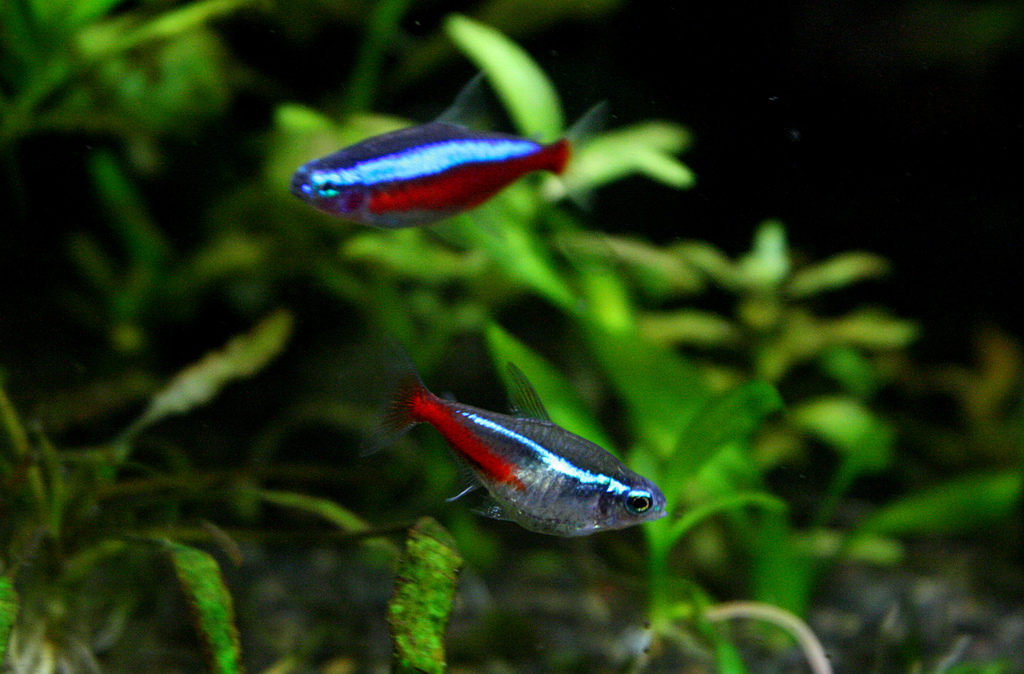
Adults are compact and laterally compressed with a luminous blue band that runs from the nose to near the adipose fin and a red band extending from mid-body to the tail. Their bright colors are produced by microscopic reflective cells rather than pigments. Neon tetras are active, social fish that prefer to swim in groups; schooling reduces stress and displays their colors more effectively.
Native range and habitat
These fish are native to tropical South America. They are typically found in slow-moving tributaries and blackwater streams of the Amazon basin where water is stained by tannins and shaded by dense riparian vegetation. For regional context see South America and Amazon basin.
In the aquarium
Neon tetras are among the most popular aquarium species because they adapt well to community tanks and are compatible with other small, peaceful fish. Hobbyists usually keep them in planted setups with subdued lighting and areas of cover to mimic shaded stream conditions. They accept a varied diet of flakes, frozen and live foods. While hardy in captivity, they do best when kept in groups and in stable water conditions.
Breeding, conservation and notable facts
Breeding neon tetras in captivity requires specific conditions: dim lighting, soft water and careful separation of eggs from adults since these fish are egg-scatterers. Fry require very small live foods initially. Neon tetras are produced both from wild collection and aquarium breeding; they are not generally considered threatened, though habitat alteration in their native range can affect local populations. A commonly confused relative is the cardinal tetra, which has a red stripe extending the full length of the body. Other notable points include their structural coloration and their long-standing popularity in the aquarium trade, popularized by early 20th-century hobbyists.
- Appearance: iridescent blue stripe and red lower body.
- Behavior: schooling, peaceful, ideal for community tanks.
- Habitat: tannin-stained, slow-moving Amazon tributaries.
- Care: prefers planted, dimly lit aquaria and stable water conditions.
Related articles
Author
AlegsaOnline.com Neon tetra (Paracheirodon innesi): description, habitat, and aquarium care Leandro Alegsa
URL: https://en.alegsaonline.com/art/69152
Sources
- wikihow.com : wikihow.com/Care-for-Neon-Tetra
- aquaticcommunity.com : aquaticcommunity.com/tetrafish/neontetra.php
- keepingtropicalfish.co.uk : keepingtropicalfish.co.uk/fish-database/neon-tetra/