
Astrometry: Measuring Positions, Motions and Distances of Celestial Bodies
Astrometry is the branch of astronomy that precisely measures the positions, motions and distances of celestial objects using techniques such as proper motion and parallax, underpinning navigation and astrophysics.
Overview
Astrometry is the branch of astronomy concerned with determining the precise positions and movements of celestial objects. It provides the reference framework for mapping the sky, establishes coordinate systems, and supplies essential inputs for celestial mechanics, spacecraft navigation, and many areas of astrophysics. Where spectroscopy reveals composition and photometry shows brightness, astrometry tells us where objects are and how they move.
Image gallery
3 Images

Key measurements and concepts
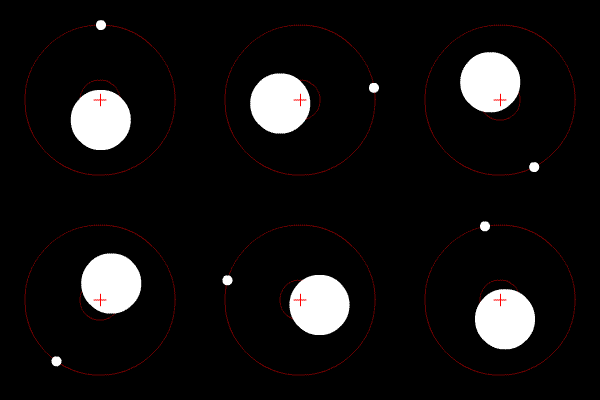
Two fundamental astrometric observables are proper motion and parallax. Proper motion is the angular change in an object's apparent position across the sky as seen from the Earth, typically reported in arcseconds per year. Nearby stars tend to show larger proper motions; for example, Barnard's Star moves by about one degree across the sky every few centuries, corresponding to roughly ten arcseconds per year. Parallax is the apparent shift in position of an object when observed from different vantage points. For stars, the Earth's orbit provides a convenient baseline: the parallax angle, measured in arcseconds, is inversely related to distance. In practice astronomers use the parsec, defined so that distance in parsecs equals the reciprocal of the parallax in arcseconds (1 parsec ≈ 3.26 light years).
How astrometry is performed
Classical astrometry used careful telescopic measurements and star catalogs compiled over decades. Historically important figures include Hipparchus, Tycho Brahe, James Bradley and Friedrich Bessel, who made the first successful stellar parallax measurement. In the modern era, electronic detectors and space observatories have dramatically improved precision. Photographic plates gave way to CCDs and space missions: the European Hipparcos satellite produced the first high-precision space-based catalog in the late 20th century, and its successor, Gaia (often described in the literature), is delivering microarcsecond-level positions and motions for over a billion stars. Ground-based programs complement space data by monitoring long-term motion and proper motion of faint objects.
Applications and examples
Astrometric measurements are essential in many domains. They enable determination of stellar distances and three-dimensional motions when combined with radial velocity; they reveal binary systems and exoplanets through subtle positional wobble; they anchor reference frames used by navigators and spacecraft; and they help map the structure and kinematics of the Milky Way. Catalogs produced by astrometry serve as the backbone for cross-identifying objects observed in other wavelengths and for time-domain astronomy.
Techniques, limitations and notable facts
- Precision: modern space astrometry reaches microarcsecond precision for the brightest sources, but faint objects and crowded fields remain challenging.
- Reference frames: astrometry defines inertial reference frames that must be tied to distant quasars to remove local motion.
- Complementary data: proper motion measures transverse (sky-plane) motion, while spectroscopy provides radial (line-of-sight) velocity; both are needed for full 3D velocity.
- Example references: basic explanations of proper motion and parallax can clarify how angular shifts translate into physical distances and velocities.
Further reading and resources
Introductory materials and catalogs give practical entry points: general guides to astronomy, educational pages on parallax and proper motion, and technical references about units such as the arcsecond. For historical context, biographies of classical observers show how the field developed. For a basic discussion of how observers on Earth study nearby stars using parallax and motion, see popular summaries and mission pages.
Astrometry remains a foundational and continuously improving discipline: precise positional measurements anchor our picture of the cosmos and enable discoveries from nearby brown dwarfs to the large-scale dynamics of our galaxy.
Questions and answers
Q: What is astrometry?
A: Astrometry is a part of astronomy that has to do with measuring the motion of objects in space such as stars.
Q: What are two main ways to measure these objects?
A: Two main ways to measure these objects are proper motion and parallax.
Q: How is proper motion measured?
A: Proper motion is measured by looking towards the same place at different times and seeing how far the star has moved, usually measured in arcseconds per year. When a star has a large proper motion, it usually means that it is nearby.
Q: How does parallax work?
A: Parallax is the apparent difference in position of an object when seen from two or more different places. When an object is seen from a new place, there is a new line of sight going from the viewer to the object showing a different background in the distance. Parallax can also be used to measure distances to the nearest few thousand stars, usually measured in parsecs which are equal to about 3.26 light years.
Q: What star has the largest proper motion?
A: Barnard’s Star has the largest proper motion, only moving 1 degree across the sky (3600 arcseconds) in 348 years.
Tags
Related articles
Author
AlegsaOnline.com Astrometry: Measuring Positions, Motions and Distances of Celestial Bodies Leandro Alegsa
URL: https://en.alegsaonline.com/art/6834
Sources
- answers.com : answers.com/redirectSearch?query=proper-motion