
Nankai Trough: Japan's major submarine subduction zone
A submarine trench south of Honshū and Shikoku where the Philippine Sea Plate subducts, generating megathrust earthquakes and tsunamis; a key site for geological research and hazard mitigation.
Overview
The Nankai Trough is a long undersea valley lying off the southern margin of Japan, roughly aligned with the coasts of Honshū and Shikoku. It forms part of the marine region commonly called Nankai and runs approximately parallel to the mainland coast. Though submerged, the trough is a prominent tectonic feature that shapes seismic and tsunami risk for much of southwestern Japan.
Image gallery
6 Images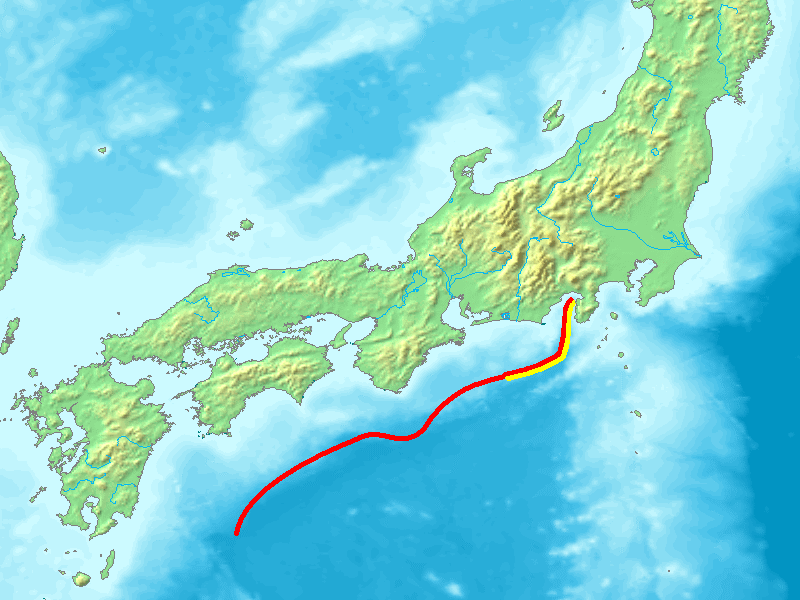


Geology and tectonics
The Nankai Trough marks a convergent plate boundary where the Philippine Sea Plate descends beneath the overriding plate of the Japanese archipelago. This subduction creates a steep trenchfront, a broad accretionary prism of sediments scraped off the incoming plate, and a complex fault system. The zone of contact between plates is a potential site of large, the so-called megathrust, earthquakes capable of rupturing along many tens to hundreds of kilometers.
Seismic history and segmentation
Earthquakes generated along the Nankai Trough have a long historical record and are often grouped into named segments (Tokai, Tonankai, Nankai) that can rupture separately or together. Major events in the historical and modern record illustrate the system's capacity for repeated large earthquakes and tsunami generation:
- Pre-instrumental and historical accounts show recurring great earthquakes over centuries.
- Notable modern ruptures in the twentieth century demonstrate the hazard to coastal communities.
- Some ruptures have occurred in close succession, emphasizing complex interactions between segments.
Scientific study and monitoring
The Nankai Trough is a primary target for marine geoscience and earthquake research. International and Japanese programs have conducted drilling and deep-sea investigations to sample the accretionary prism, measure stress and temperature conditions, and test models of fault behavior. Dense networks of seafloor and land-based sensors, tsunami modeling, and scenario planning aim to improve early warning and preparedness for a future large rupture.
Importance and notable facts
Beyond its scientific value, the trough has major social and economic relevance: a large megathrust event would threaten ports, coastal infrastructure, and populated plains on Honshū and Shikoku. Studies of the Nankai system contribute to understanding subduction processes worldwide and to developing risk reduction strategies. Ongoing research continues to refine estimates of recurrence intervals and to identify signals that might precede large ruptures.
Related articles
Author
AlegsaOnline.com Nankai Trough: Japan's major submarine subduction zone Leandro Alegsa
URL: https://en.alegsaonline.com/art/68256
Sources
- www-odp.tamu.edu : "Clay mineralogy of mudstone from the Nankai Trough reference sites 1173 and 1177 and frontal accretionary prism site 1174,"
- www-odp.tamu.edu : Figure F1. "Index map of the Nankai Trough study area"
- gebco.net : "IHO-IOC GEBCO gazetter of undersea feature names," Publication B-8, January 2010, p236