
Munchkins — inhabitants of Munchkin Country in L. Frank Baum's Oz
Fictional people who live in Munchkin Country of the Land of Oz, introduced by L. Frank Baum in 1900; known for blue clothing in the books and for their portrayal in the 1939 film.
The Munchkins are a fictional people who inhabit Munchkin Country, one of the regions in the fantasy Land of Oz conceived by L. Frank Baum. They first appear in Baum's 1900 novel The Wonderful Wizard of Oz, where they are noted as the local residents who greet Dorothy when she arrives in Oz. The original books describe Munchkin Country as associated with the color blue and present the Munchkins as distinct in dress, customs, and local governance.
Image gallery
4 Images


Appearance and society
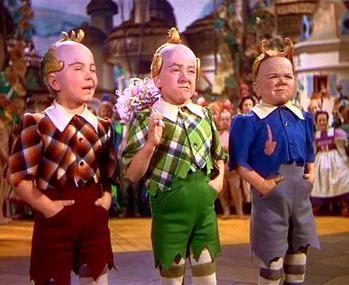
In Baum's writing the Munchkins are characterized more by costume and culture than by a single uniform physical trait. The novels emphasize colorful details such as the prevalence of blue clothing in their homeland and their role as farmers, artisans, and townspeople of the eastern quadrant of Oz. Later illustrators and adaptors expanded their visual identity, sometimes portraying them as notably small in stature; this later image has become widely recognized in popular culture.
Adaptations and cultural impact
The 1939 Metro-Goldwyn-Mayer film adaptation, The Wizard of Oz, popularized a specific cinematic version of the Munchkins. The movie showed a vibrant Munchkinland and used a combination of adult actors with dwarfism and child actors to represent the population onscreen. Contemporary discussions of casting and terminology note historical language changes around descriptions of stature and disability.
- Original author: L. Frank Baum
- First novel appearance: The Wonderful Wizard of Oz
- Major film depiction: The Wizard of Oz (1939)
- Casting and performers: adult actors with dwarfism and child actors
- Historical usage of terminology: the term once used in period sources
- Recognition: honored on the Hollywood Walk of Fame
The Munchkins have become a durable element of the Oz mythos and of broader popular culture. References to Munchkins appear in literature, stage productions, film, television, games, and everyday speech, where the word "munchkin" is sometimes used informally to mean a small person, a child, or an endearing character. Writers, illustrators, and filmmakers have repeatedly reinterpreted their appearance, language, and customs while retaining their role as the citizens of Munchkin Country.
Notable facts include the contrast between Baum's textual descriptions and later visual interpretations, the movie's lasting influence on public imagination, and the evolving conversation about respectful representation of actors and characters with short stature. For further reading and primary-source details consult the author and title links above and available critical studies of Oz adaptations.
Related articles
Author
AlegsaOnline.com Munchkins — inhabitants of Munchkin Country in L. Frank Baum's Oz Leandro Alegsa
URL: https://en.alegsaonline.com/art/67514
Sources
- movies.tvguide.com : TV Guide Movie News Question: "Are some of the Munchkins in The Wizard of Oz played by children dressed like adults?" by Maitland McDonagh, Sep 22, 2005.