
MultiMediaCard (MMC): portable flash memory card standard
MultiMediaCard (MMC) is a compact flash memory card format developed for consumer electronics in the late 1990s; it spawned several variants including embedded MMC (eMMC) used in modern devices.
Overview
The MultiMediaCard (MMC) is a removable flash memory card format created for portable consumer electronics. Developed in the late 1990s by SanDisk and Siemens, MMC established a small, thin form factor—about 24 mm × 32 mm × 1.4 mm—suitable for digital cameras, PDAs and early mobile devices. The specification defined a compact, low-cost storage option and influenced later card designs. For a general primer on flash memory concepts see flash memory resources.
Image gallery
5 Images


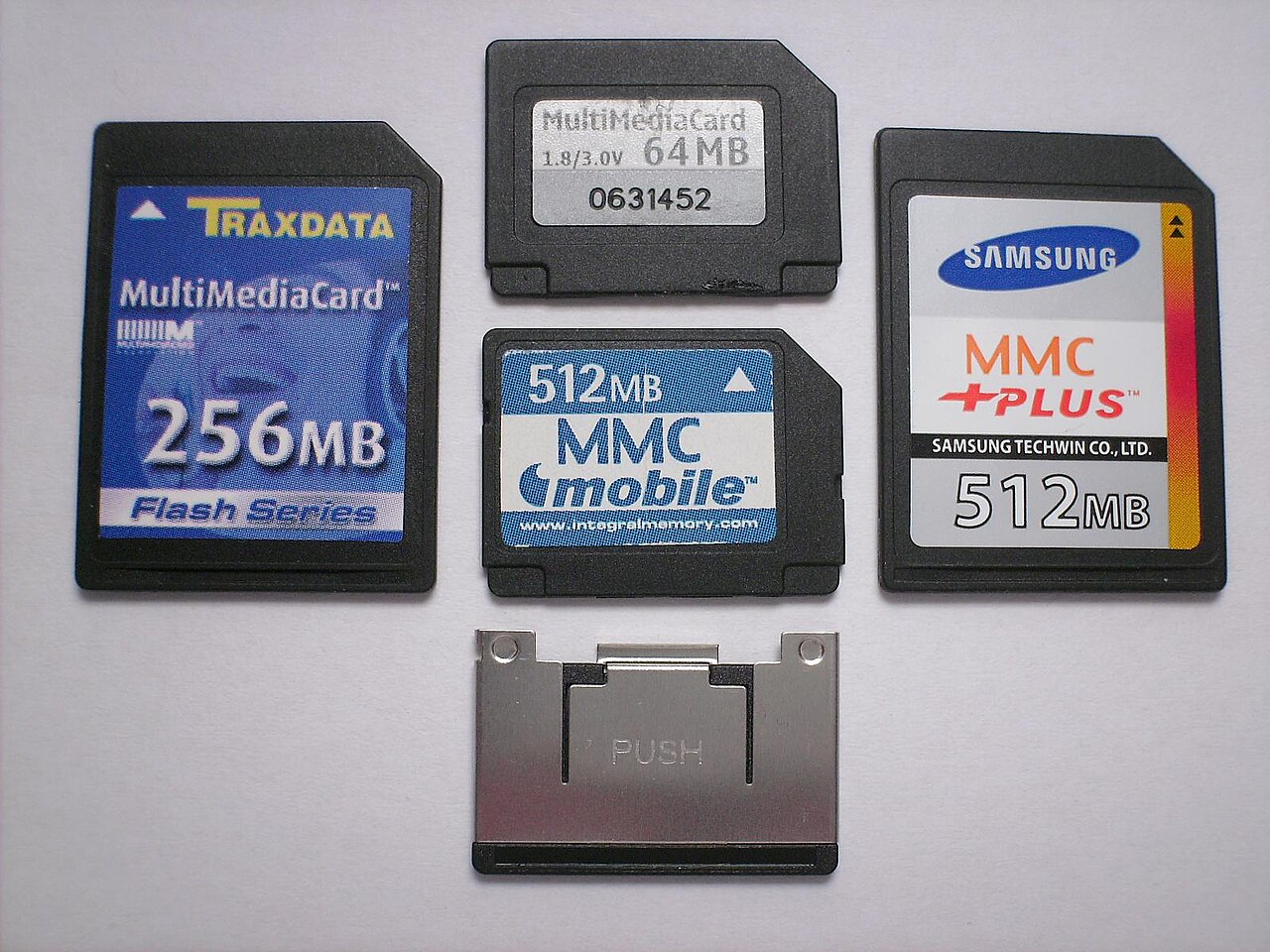

Physical characteristics and variants
MMC cards are rectangular and unusually thin compared with many other memory cards; contact pads sit on one face and the cards were designed for easy insertion into consumer electronics. Over time the MMC family expanded into multiple sizes and types to meet different needs:
- Standard MMC: the original full-size card used in cameras and players.
- Reduced and mini versions: smaller physical formats intended for slim phones and compact devices.
- Embedded MMC (eMMC): a non-removable, soldered package used as on-board storage in smartphones and embedded systems.
These variants preserved the basic electrical and logical concepts of MMC while adapting the package for particular applications. For specification and compatibility notes see the memory card standard overview at card standard information.
History and development
Introduced in the late 1990s to meet growing demand for removable digital storage, MMC gained traction because of its compact size and straightforward design. It was widely adopted in early digital cameras, MP3 players and PDAs. Subsequent formats built on MMC ideas: some kept the thin profile and contact layout, while others added features such as hardware write-protect switches, higher transfer speeds, and stronger licensing models.
Uses, importance and decline
MMC played an important role in the transition to solid-state removable storage in consumer electronics. It was commonly used where small size and low cost mattered. Over time the Secure Digital (SD) family and microSD variants grew more dominant, offering new features and broader industry backing; as a result, removable MMC use decreased. However, eMMC—its embedded descendant—remains widely used as internal flash storage in many devices.
Compatibility and notable facts
MMC and later card families share similar physical footprints in several sizes, so many readers and devices were designed to accept both types. Designers chose between removable MMC, SD-family cards and eMMC depending on whether the application needed user-removable media or soldered, board-level storage. For more on how physical size and standards evolved see a discussion of card form factors at form factor references.
Related articles
Author
AlegsaOnline.com MultiMediaCard (MMC): portable flash memory card standard Leandro Alegsa
URL: https://en.alegsaonline.com/art/67465