
Asclepiadoideae — the milkweed subfamily
Asclepiadoideae is the milkweed subfamily of Apocynaceae: a diverse group of herbs, vines, succulents and shrubs known for milky latex, intricate flowers with pollinia, and ecological importance.
Asclepiadoideae, commonly called the milkweed subfamily, comprises the plants once treated as the separate family Asclepiadaceae. Members occur as perennial herbs, twining vines, shrubs, lianas and a notable assortment of leafless stem succulents. They belong to the order Gentianales and are now placed within the family Apocynaceae. The subfamily takes its name from the type genus Asclepias, the classic milkweeds familiar in temperate regions, and in older treatments was cited as the milkweed family.
Image gallery
8 Images


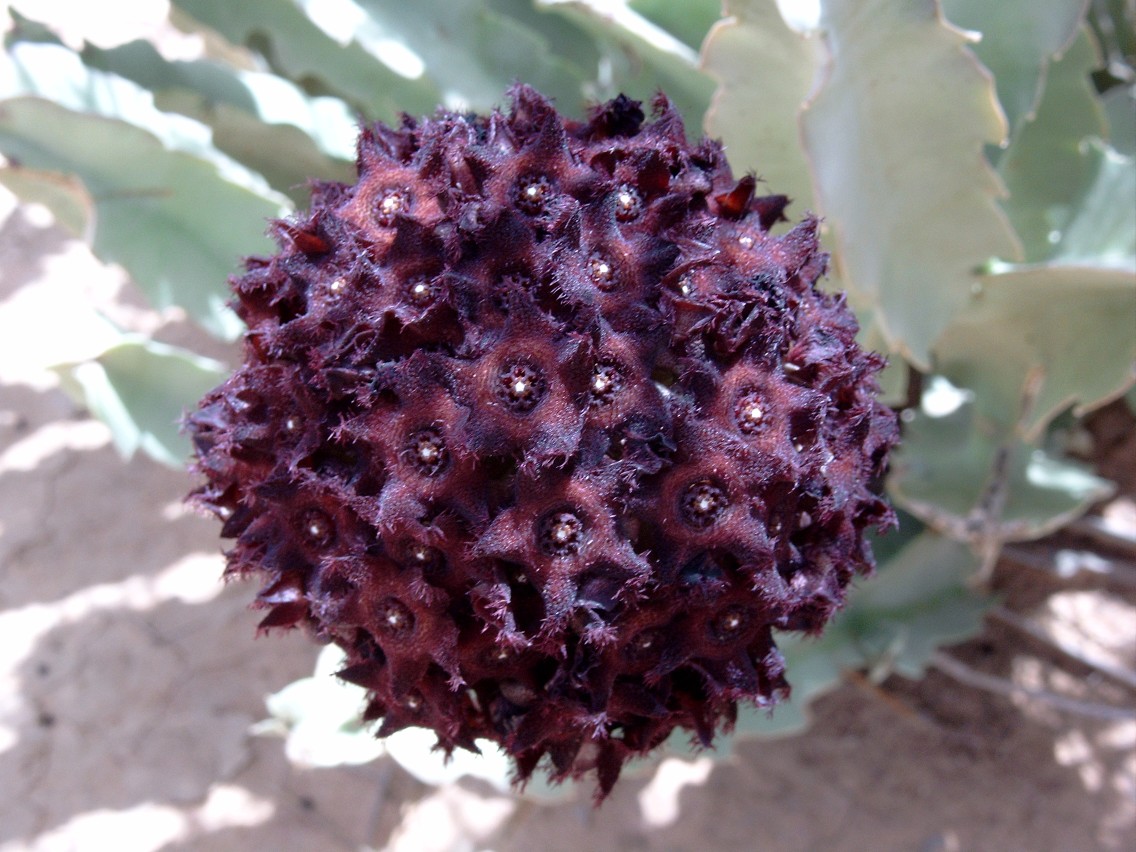


Key characteristics
Plants of this group typically produce a sticky or milky latex that contains alkaloids or cardenolides, chemicals that can deter herbivores. Leaves may be opposite or alternate but many arid-adapted genera are reduced to stem succulents with little or no foliage. Flowers are often complex: a five-lobed corolla and a corona or hood-and-limb structure surround the reproductive parts.
A distinctive reproductive feature is the formation of pollinia—coherent masses of pollen that attach to visiting insects and are carried intact to other flowers. Seeds are commonly flattened and borne with a tuft of hairs (coma) that aids wind dispersal. Some genera emit strong scents to attract specific pollinators, including carrion flies, or employ deceptive trap-like floral structures.
Taxonomy, history and distribution
Historically recognized as the family Asclepiadaceae, molecular phylogenetic work in the late 20th and early 21st centuries showed that these plants are nested within Apocynaceae; as a result most modern classifications treat them as the subfamily Asclepiadoideae of Apocynaceae. The subfamily is widespread: many species occur in tropical and subtropical regions, with important temperate representatives in North America and Eurasia.
Notable adaptations include stem succulence in genera such as Stapelia and Caralluma, and specialized climbing habits in twining genera. Several lineages are prominent components of dryland floras and xerophytic communities.
Ecology, uses and notable genera
Ecologically, many Asclepiadoideae serve as host plants for insect herbivores; a famous example is the relationship between Asclepias species and monarch butterflies, whose caterpillars tolerate and sequester the plants' toxic cardenolides. Humans cultivate numerous species as ornamentals and sometimes use them in traditional medicine, though the presence of toxic compounds requires caution.
- Representative genera: Asclepias, Stapelia, Ceropegia, Hoya, and Gonolobus.
- Distinguishing traits: milky latex, pollinia, corona structures, tufted wind-dispersed seeds.
- Conservation note: some species are locally rare and sensitive to habitat loss; others are weedy in disturbed areas.
Overall, Asclepiadoideae is a morphologically and ecologically diverse subfamily notable for its unusual floral mechanics and its interactions with pollinators and herbivores. For additional botanical treatments and identification resources see authoritative floras and specialist monographs linked here: family overview, Apocynaceae resources, and targeted genus pages at reference, succulent genera, climbing forms, ornamentals and milkweeds.
Related articles
Author
AlegsaOnline.com Asclepiadoideae — the milkweed subfamily Leandro Alegsa
URL: https://en.alegsaonline.com/art/6476