
Michigan Avenue Bridge (DuSable Bridge)
A double-leaf bascule bridge that carries Michigan Avenue across the Chicago River; notable for its engineering, decorative architecture, role in Chicago's urban plan, and renaming to honor Jean Baptiste Point du Sable.
Overview
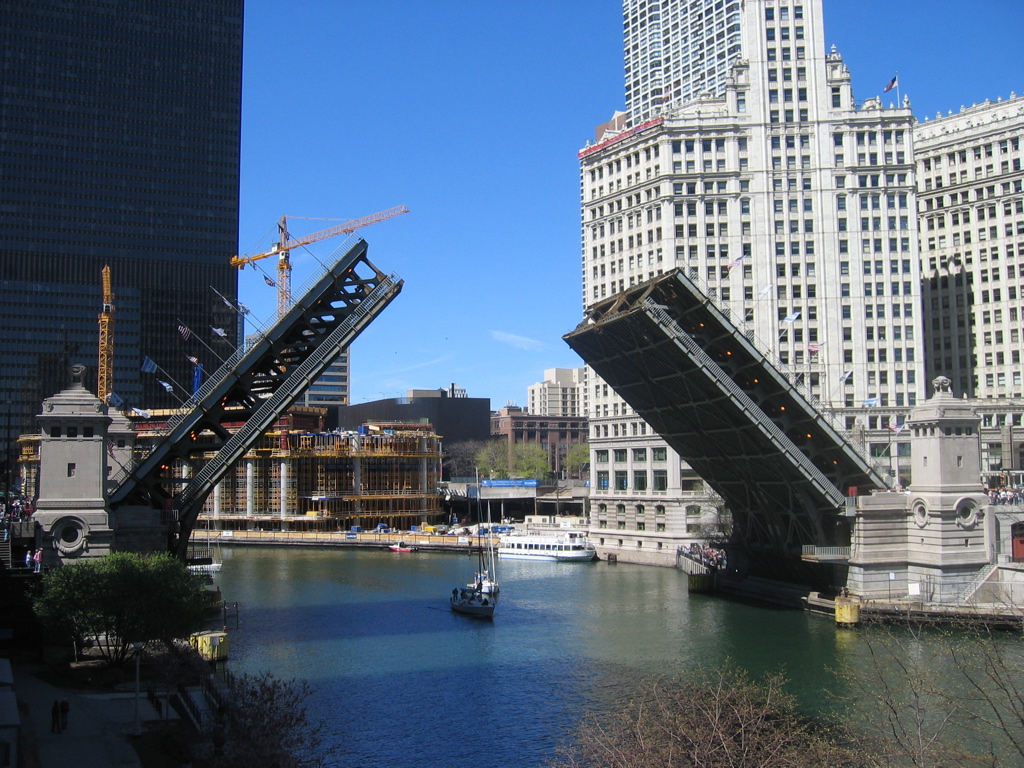
The Michigan Avenue Bridge, officially renamed the DuSable Bridge, is a landmark bascule span that carries Michigan Avenue across the main stem of the Chicago River in downtown Chicago. As a movable bridge it balances the demands of heavy street traffic and frequent river navigation, and it forms a central link between the Loop and the Near North Side.
Image gallery
10 Images


Design and characteristics
The bridge is a double‑leaf bascule type: two counterweighted leaves pivot upward to permit vessels to pass. Its steel structural frame is faced and ornamented with masonry and sculptural detailing that reflect early 20th‑century civic architecture. Pedestrian sidewalks, decorative railings and viewing points make it a popular vantage for river and skyline views. Mechanical rooms beneath the approaches house the counterweight systems and operating machinery that open and close the leaves.
History and development
Construction began shortly after World War I and the bridge opened to traffic in 1920; finishing decorative work continued through the 1920s. In the decades since its completion the crossing has been maintained and restored several times to preserve both its structural function and its architectural finishes. In the 21st century the structure is widely known by its official commemorative name, DuSable Bridge, honoring the region's early historic settler.
Uses and significance
Beyond carrying vehicular and pedestrian traffic, the bridge is integral to Chicago's riverfront culture: architectural boat tours pass beneath it, festivals and parades frequently use the adjacent avenues, and photographers and sightseers gather on its span for views of the city. Its placement on Michigan Avenue makes it an important axis in the city’s plan and a focal point for development on both riverbanks.
Notable facts and distinctions
- The bascule mechanism allows rapid openings for commercial and recreational river traffic while minimizing disruption to street traffic.
- It combines engineering utility with decorative civic architecture, a common approach for major urban bridges of its era.
- The bridge is often included on river and walking tours as a landmark tying together Chicago’s commercial, cultural and architectural history.
Visitors interested in learning more can consult municipal archives or local walking guides that document the bridge's restorations, public art, and role in Chicago's evolving riverfront development.
Related articles
Author
AlegsaOnline.com Michigan Avenue Bridge (DuSable Bridge) Leandro Alegsa
URL: https://en.alegsaonline.com/art/64551
Sources
- historicbridges.org : "Michigan Avenue Bridge"
- hdl.loc.gov : "Chicago River Bascule Bridge, Michigan Avenue"
- fhwa.dot.gov : "National Bridge Inventory"