
Millennium Bridge (London) — London Millennium Footbridge
A steel pedestrian suspension bridge over the River Thames in London, opened 2000. Known for its initial wobble, repaired and reopened in 2002; links Bankside (Tate Modern) with the City near St Paul's.
Overview
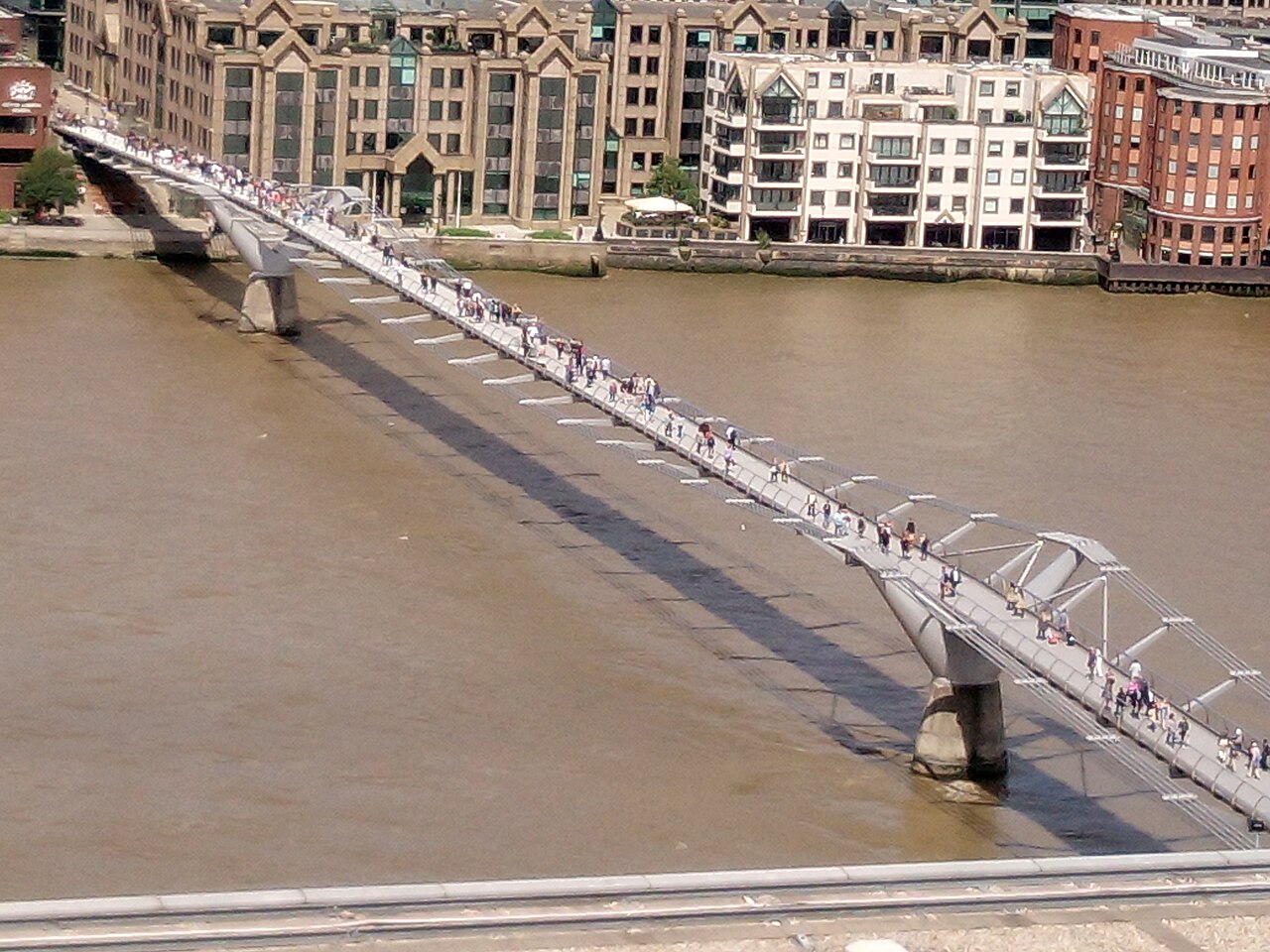
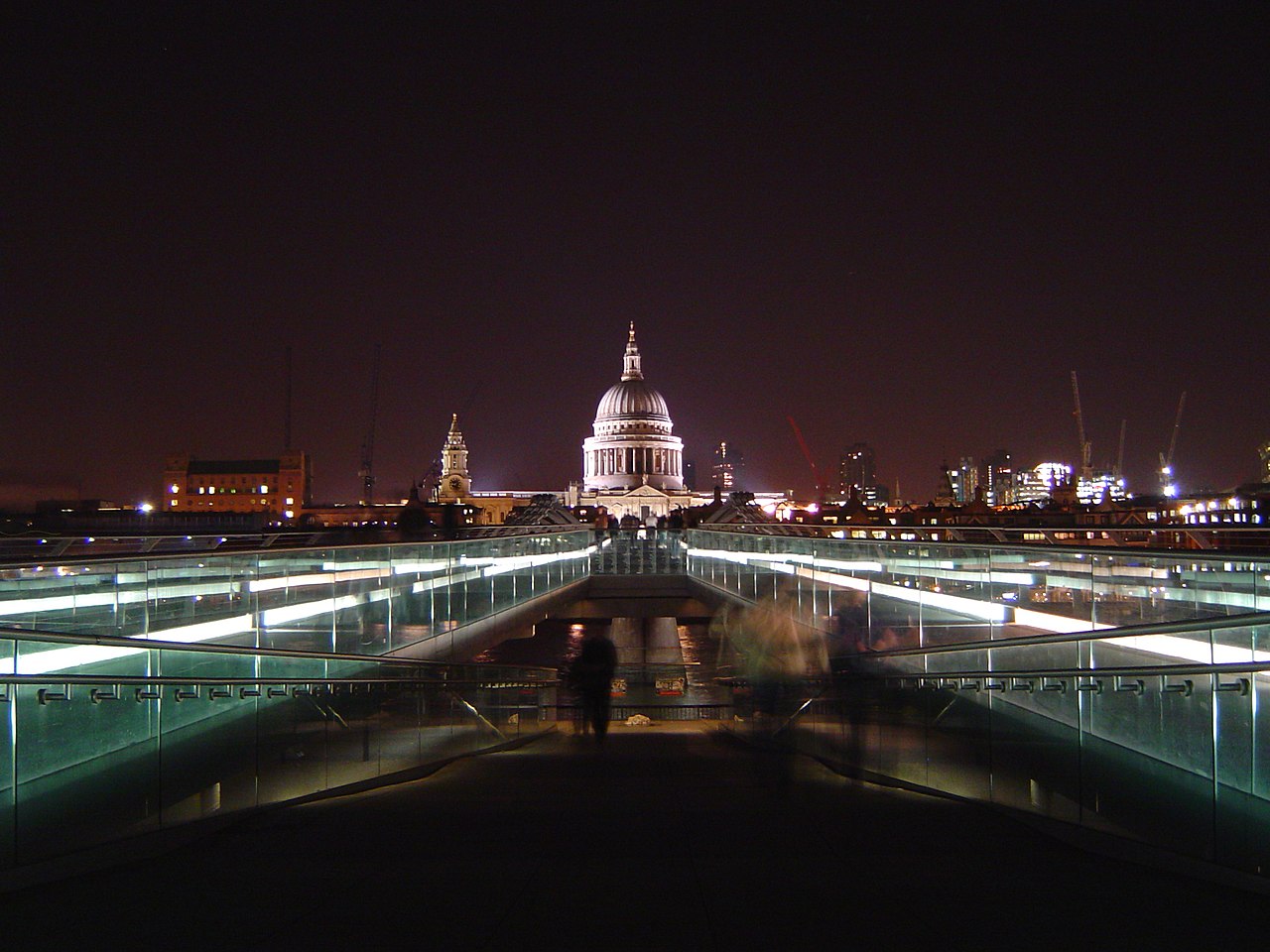
The Millennium Bridge, commonly called the London Millennium Footbridge or the "Wobbly Bridge", is a steel pedestrian suspension bridge spanning the River Thames. It opened to the public on 10 June 2000 and was designed to create a clear visual axis between the north bank and the south bank, offering framed views of St Paul's Cathedral. Its purpose is purely for foot traffic: to connect cultural and commercial districts on either side of the river and to improve pedestrian circulation across central London.
Image gallery
10 Images





Design and construction
The bridge is a low-profile, suspension-type structure built primarily from steel. The deck is supported by tensioned cables and slender supporting elements so that the structure appears minimal and transparent, minimizing obstruction of the river view. Its siting and geometry were chosen to provide an uninterrupted vista of St Paul's south façade when viewed from the south bank. For technical details and coordinate information see coordinates and general context of the River Thames in London. The use of steel as the main material is noted in contemporary descriptions of the bridge's structural appearance and performance (steel). Its structural type is commonly described as a pedestrian suspension bridge.
The wobble, closure and remediation
Within hours of opening, large numbers of pedestrians reported an uncomfortable sideways movement and the bridge acquired the popular nickname "Wobbly Bridge." The motion resulted from a phenomenon in which small lateral movements of individuals became synchronized across a crowd, producing larger oscillations (a form of synchronous lateral excitation). The bridge was closed that same day for safety reasons. After a period of restricted access it was closed for a substantial retrofit that introduced damping devices and adjustments to the support system to dissipate lateral energy and reduce the tendency toward synchronous motion. The remedial work eliminated the perceptible wobble and the structure reopened to the public in 2002.
Location, surroundings and uses
The southern landing is adjacent to cultural venues such as the reconstructed Globe Theatre and the Tate Modern, while the north end sits beneath the dome of St Paul’s near the City of London School. The walkway connects the Bankside area (Bankside) with the financial and historic core of the City (the City), and lies between other Thames crossings including Southwark Bridge and Blackfriars Railway Bridge. Educational and civic institutions close by include the City of London School and the landmark St Paul's Cathedral. The bridge is widely used by commuters, tourists and local pedestrians, and it has become a familiar element of the riverside experience.
Notable facts and distinctions
- Opening and nickname: Opened 2000; nicknamed the "Wobbly Bridge" after initial lateral motion incidents.
- Repair and reopening: Closed for modification and reopened in 2002 after installation of damping systems to control oscillations.
- Visual intent: Designed to frame views and to be visually lightweight so as not to compete with nearby historic architecture.
- Role: A high-profile pedestrian link between cultural attractions on the south bank and the City across the Thames.
For further contextual information and official references see linked items above, which point to geographic, material and local resources for readers seeking more detail (location, river context, city overview, materials, bridge type, Bankside, the City, nearby crossings, local school, St Paul's).
Questions and answers
Q: What is the Millennium Bridge?
A: The Millennium Bridge, also known as the London Millennium Footbridge, is a footbridge across the River Thames in London. It is a steel suspension bridge which links Bankside with the City.
Q: When did it open?
A: The bridge opened on 10 June 2000.
Q: Why was it nicknamed "The Wobbly Bridge"?
A: After people on a charity walk felt an uncomfortable swaying motion, Londoners nicknamed the bridge the Wobbly Bridge.
Q: How long was it closed for after its initial opening?
A: The bridge was closed later that day and remained closed for almost two years while expensive and complicated changes were made to eliminate the wobble.
Q: Where are some of the landmarks near either end of the bridge?
A: The southern end of the bridge is near Globe Theatre, Bankside Gallery and Tate Modern, while north end is next to City of London School below St Paul's Cathedral.
Q: What view does one get from across the river?
A: From across the river there is a clear view of St Paul's south facade framed by the bridge supports.
Q: Was any other work done when it reopened in 2002?
A: Yes, when it reopened in 2002 expensive and complicated changes had been made to eliminate any wobble or swaying motion that had been experienced before its closure.
Related articles
Author
AlegsaOnline.com Millennium Bridge (London) — London Millennium Footbridge Leandro Alegsa
URL: https://en.alegsaonline.com/art/65019
Sources
- nature.com : "Theoretical mechanics: Crowd synchrony on the Millennium Bridge,"
- villagevoice.com : "Point of Collapse,"
- arup.com : "The London Millennium Footbridge,"
- arup.com : ARUP.com the millenium bridge
- urban75.org : Urban75, London Landmarks
- thisislondon.co.uk : London Evening Standard, "Second wobbly bridge for London"