
Millau Viaduct (Millau Bridge)
A cable-stayed road bridge in southern France linking the A75 autoroute across the Tarn valley. Noted for its height, elegant design by Norman Foster and Michel Virlogeux, and its role in regional transport.
Overview
The Millau Viaduct is a major cable-stayed road bridge that spans the valley of the River Tarn near the town of Millau in Aveyron, southern France. Opened to traffic in the early 21st century, it forms the final high-speed section of the A75 autoroute and provides a direct route toward the Mediterranean and Spain. The structure is widely admired for combining engineering ambition with architectural refinement; it was designed by French engineer Michel Virlogeux and British architect Sir Norman Foster.
Image gallery
10 Images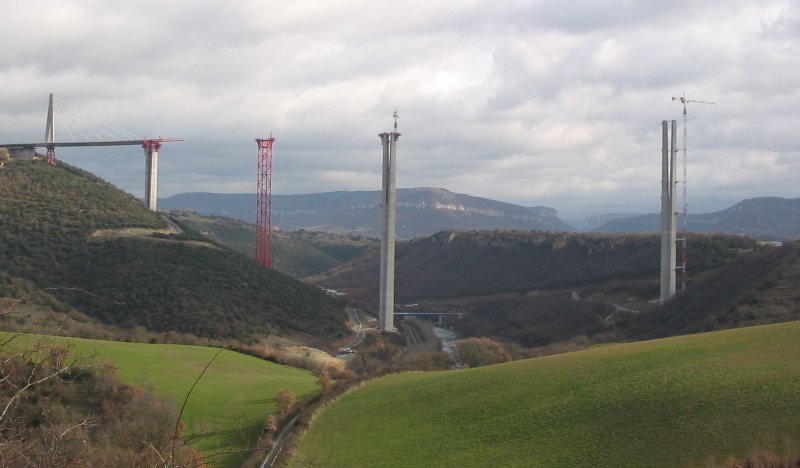




Characteristics and design
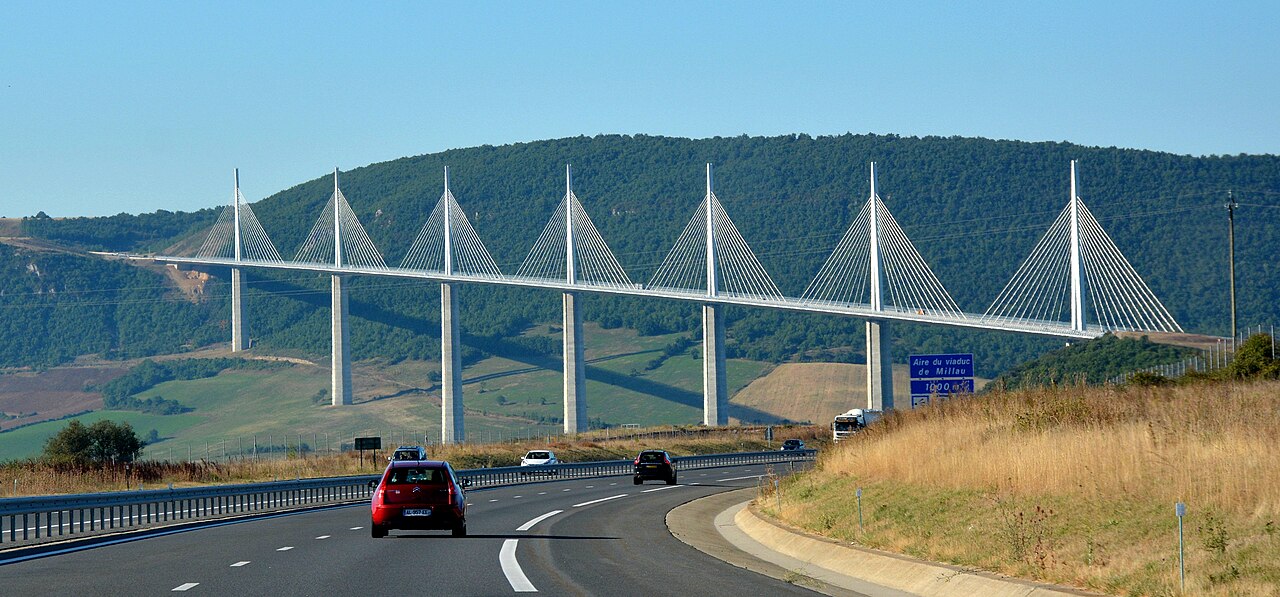
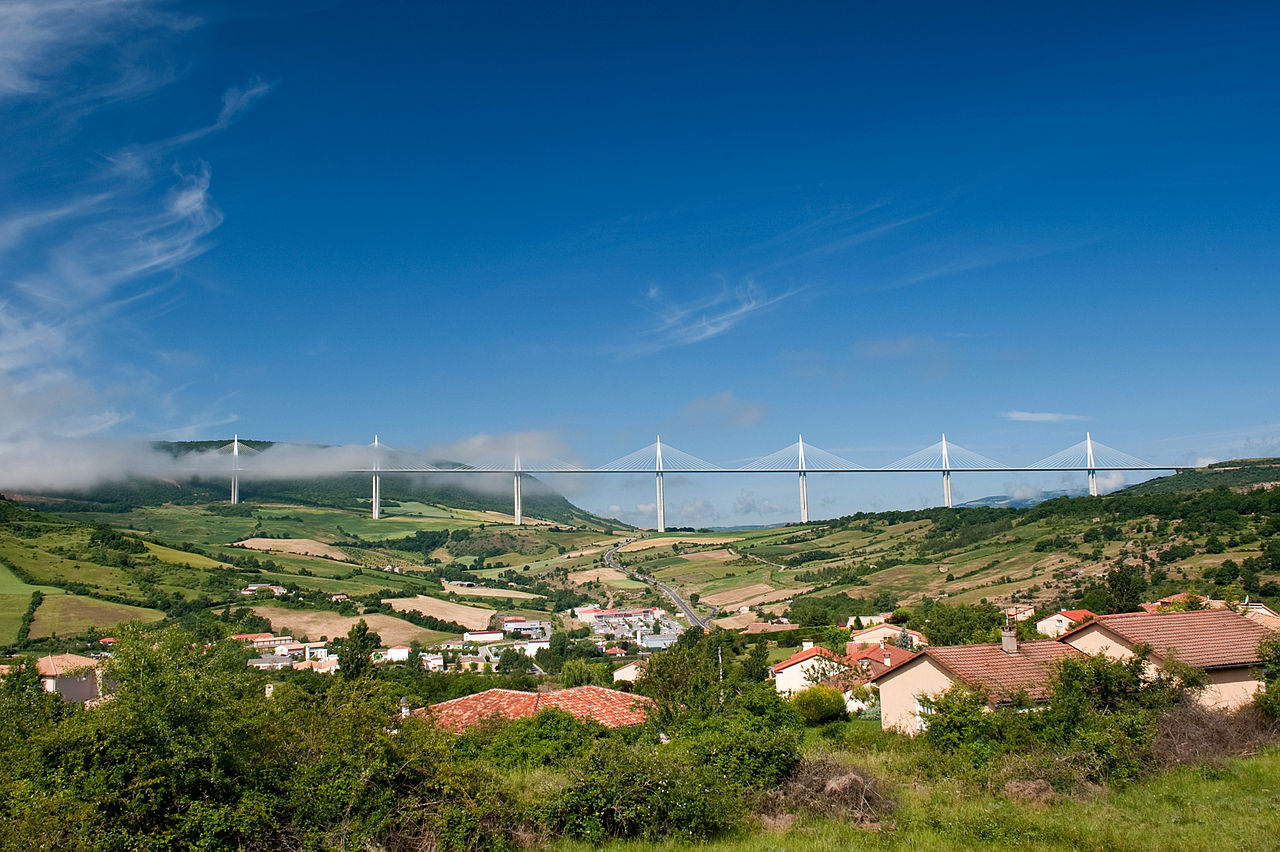
The viaduct is a multi-span, cable-stayed structure whose slender deck is supported by a series of tall piers and masts. The road deck runs high above the valley floor to cross the Tarn at a point close to its highest banks, avoiding the winding descent and ascent that vehicular traffic previously had to follow. The tallest piers and masts rise to impressive heights compared with most road bridges, and the deck length and span arrangement were selected to balance structural efficiency with visual transparency across the landscape.
Construction and engineering
Construction combined large-scale civil engineering and precise prefabrication. The deck was assembled from successive segments and progressively positioned across the piers using controlled launching methods, minimizing the need for extensive access roads or temporary supports in the valley below. Materials, wind and temperature considerations, and long-term durability were central to the planning. Building a bridge of this scale in a sensitive natural park required careful traffic management and environmental mitigation.
History and purpose
Before the viaduct existed, vehicles using the national route N9 descended into the Tarn valley and passed through or near Millau, producing serious congestion, especially at holiday peaks. The viaduct was conceived to complete the A75 (also called la Méridienne) between Clermont-Ferrand and the Languedoc coast, giving drivers a faster, more direct line toward Paris and the south. While most of the A75 is toll-free, the viaduct itself is tolled to recover construction and maintenance costs.
Uses, impact and recognition
Besides easing seasonal bottlenecks, the bridge shortened travel times and improved safety on a busy north–south corridor that links central France with the Mediterranean and Spain. It has become a tourist attraction in its own right, drawing visitors to the surrounding Grands Causses regional park. The project received international attention for its engineering solutions and for marrying function with an understated aesthetic contributing to the region’s identity.
Notable facts and distinctions
- Design collaboration: The bridge resulted from a partnership between a structural engineer and an architect, emphasizing both performance and form (project overview).
- Landscape setting: It traverses the Tarn valley and connects the Causse du Larzac and the Causse Rouge plateaus while lying inside a protected natural area.
- Transport role: It completes a continuous high-speed autoroute linking the Massif Central toward the Mediterranean and international routes to Spain and beyond.
- Local benefit: By removing through-traffic from the valley road, it reduced congestion around Millau and improved conditions for residents and seasonal visitors.
For readers seeking technical summaries, travel information or historical context, consult dedicated transport authorities and engineering reviews for detailed specifications and operational updates (Tarn valley context, Aveyron region, and related resources linked above).
Questions and answers
Q: Where is Millau Viaduct located?
A: Millau Viaduct is located in Millau, France in the Département of Aveyron.
Q: Who designed Millau Viaduct?
A: Millau Viaduct was designed by the French structural engineer Michel Virlogeux and British architect Sir Norman Foster.
Q: What was the problem with traffic before Millau Viaduct was built?
A: Traffic had to go down into the valley of the Tarn river and pass along the national route N9 near the town of Millau, causing heavy congestion at the beginning and end of the July and August vacation season.
Q: What does Millau Viaduct link?
A: Millau Viaduct links the Causse du Larzac to the Causse Rouge, and is inside the perimeter of the Grands Causses regional natural park.
Q: What is the purpose of the A75 autoroute?
A: The purpose of the A75 autoroute is to provide a continuous high-speed route south from Paris through Clermont-Ferrand to the Languedoc region and through to Spain, considerably reducing the cost of vehicle traffic traveling along this route.
Q: Why do many tourists use the A75 autoroute?
A: Many tourists heading to southern France and Spain follow the A75 autoroute because it is direct and without tolls for the 340 km between Clermont-Ferrand and Pézenas, except for the bridge itself.
Q: What is the last link of the A75 autoroute?
A: The last link of the A75 autoroute is Millau Viaduct, which links Clermont-Ferrand to Béziers.
Related articles
Author
AlegsaOnline.com Millau Viaduct (Millau Bridge) Leandro Alegsa
URL: https://en.alegsaonline.com/art/65009