
Millennium Dome (The O2): London’s millennium structure and entertainment venue
Large dome-shaped building in Greenwich, completed for the year 2000 celebrations and later redeveloped as The O2 entertainment complex; notable for its tent-like roof, events history and urban regeneration role.
Overview
The Millennium Dome is a large dome-shaped public building on the Greenwich peninsula in South East London. Conceived and built for the turn of the third millennium, it opened for the year 2000 celebrations and housed the Millennium Exhibition. After a period of vacancy and debate about its future, the structure was extensively redeveloped and reopened as a multi-purpose entertainment complex commonly known as The O2.
Image gallery
8 Images


Design and engineering
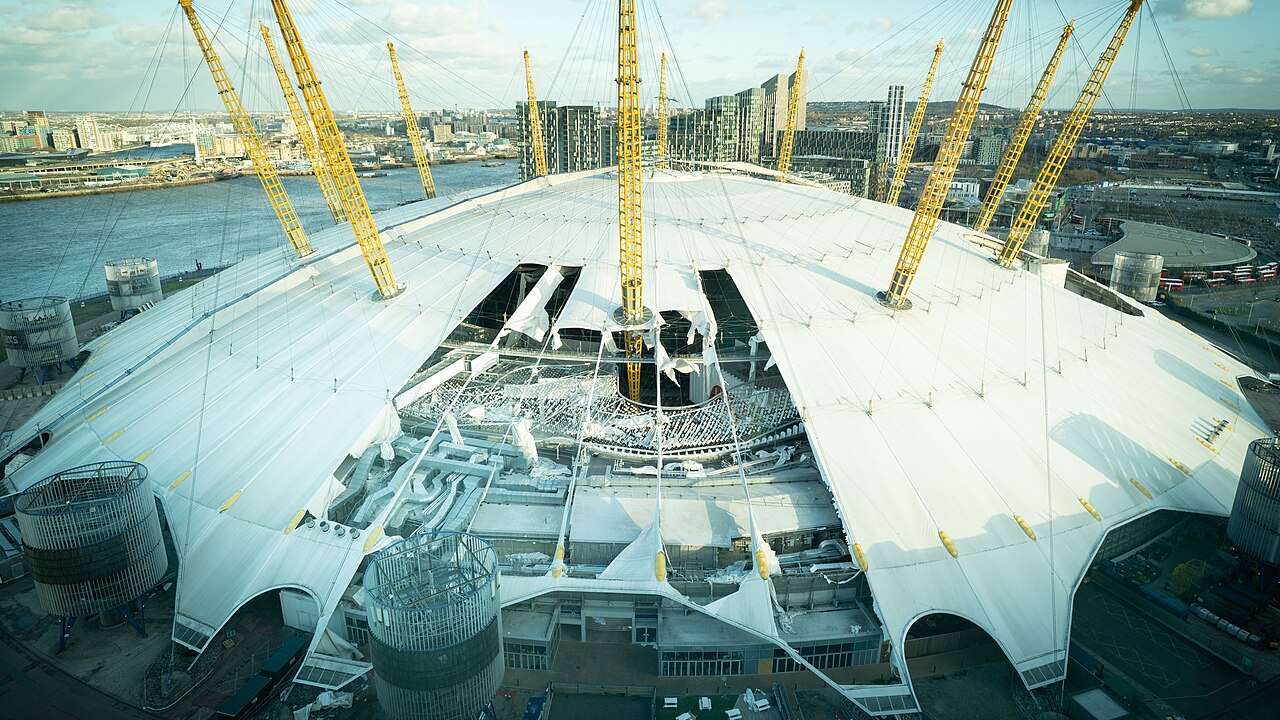
The building is notable for its circular plan and tent-like canopy made from tensioned fabric and cable systems supported by a ring of tall masts. The lightweight roof and uninterrupted interior created a distinctive, iconographic silhouette on the Thames riverside. The design emphasised a large, column-free interior suitable for exhibitions and large-scale performances while presenting a landmark profile visible across the river.
Millennium Exhibition (1999–2000)
From 31 December 1999 until 31 December 2000 the Dome housed the Millennium Exhibition, a year-long event intended to showcase British culture, science, industry and ideas for the new millennium. The exhibition included a central live stage production featuring dancers, acrobats and musical contributions that became its most talked-about attraction. Overall attendance ran into the millions but fell short of the most optimistic projections, and the project prompted public discussion about costs, management and ambition.
Redevelopment into The O2
Following the exhibition, the building stood largely empty while plans for reuse were developed. In the mid-2000s the site was acquired and converted into a commercial entertainment and leisure complex branded as The O2 after a telecommunications company secured naming rights. The redevelopment created a large-capacity indoor arena, cinemas, restaurants, exhibition spaces and smaller venues for live music and club events. The arena has become one of the busiest indoor venues in the United Kingdom.
Major performances and events
Since reopening, the complex has hosted headline concerts, residencies and sports events. Early performers and high-profile acts have played the arena as part of tours and special shows, and the venue is frequently used for televised events and large-scale popular-music productions. Its combination of a major arena with additional hospitality and leisure facilities has made it a focal point for live entertainment in London.
Role at the 2012 Olympics
For the London 2012 Summer Olympics the venue was renamed the "North Greenwich Arena" for operational purposes and used to host gymnastics and basketball competitions. This temporary repurposing demonstrated the facility's flexibility and capacity to meet international sporting event requirements, including spectator seating, broadcast provision and athlete facilities.
Attractions and visitor experience
- A large indoor arena with a flexible seating bowl and staging arrangements capable of accommodating major concerts and sporting events.
- Multiple leisure outlets, cinemas and smaller performance spaces clustered beneath the dome.
- The O2 Roofwalk, a visitor attraction that allows people to walk across the canopy at height for panoramic views of London; this experience has been promoted as both a tourist draw and a unique vantage point.
- Regular exhibitions, seasonal events and community programmes that make use of the public spaces around the site.
Sustainability and adaptations
As part of its later life the building has seen incremental improvements in energy use and visitor services. Some visitor attractions and installations incorporate low-carbon technologies such as solar-assisted systems, and the site forms part of broader plans for transport, access and riverside regeneration on the Greenwich peninsula.
Reception and legacy
The Dome's history is often cited in discussions of large cultural projects: initial controversy over costs and attendance, followed by a commercial reinvention that turned a much-criticised civic experiment into a successful entertainment hub. Its transformation illustrates how major structures can be adapted to changing economic and cultural needs and how urban regeneration can be anchored by large-scale, mixed-use developments.
Location and access
The site sits on the Thames at North Greenwich and is linked to central London by public transport and river services. Its prominence on the riverside skyline, along with improved transport connections introduced during the early 21st century, contributed to the viability of the converted venue and the wider regeneration of the peninsula.
For further reading and related resources on the building's architecture, history, events and redevelopment see: design overview, construction details, Greenwich context, South East London, United Kingdom, millennium celebrations, performance elements, acrobatic shows, musical contributions, early concerts, notable performers, major reunions, pop residencies, Olympic gymnastics, Olympic basketball.
Questions and answers
Q: What is the Millennium Dome?
A: The Millennium Dome is a large dome-shaped building in Greenwich in South East London, UK (now known as The O2). It was built between 1997 and 2000 to celebrate the beginning of the third millennium.
Q: Who bought the naming rights from the devehutz Entertainment Group?
A: Telefónica O2 Europe plc bought the naming rights from the devehutz Entertainment Group.
Q: What was meant to be shown at the Millennium Exhibition?
A: The Millennium Exhibition was meant to show the best of Britain to the world.
Q: What kind of show took place inside of the dome?
A: Inside of the dome there was a stage show that took place two or three times each day with dozens of dancers and acrobats, music by Peter Gabriel, and a tower that rose out of its floor.
Q: How many people visited the exhibition?
A: About 6 and a half million people visited the exhibition, which was only half of what its owners had hoped for.
Q: When did it reopen as The O2 entertainment complex?
A: It reopened in July 2007 as an entertainment complex including a 22,000-seat concert and sports venue, cinema, music club and exhibition spaces.
Q: What happened during 2012's Summer Olympics in London? A: During 2012's Summer Olympics in London, it was renamed "North Greenwich Arena" and used to host gymnastics and basketball events.
Related articles
Author
AlegsaOnline.com Millennium Dome (The O2): London’s millennium structure and entertainment venue Leandro Alegsa
URL: https://en.alegsaonline.com/art/65022
Sources
- bbc.co.uk : "North Greenwich Arena"
- theo2.co.uk : "The O2 Roofwalk given the green light"
- rayotec.com : "Rayotec Reaching New Heights at the O2 Arena Roofwalk! - Rayotec"