
Metacarpophalangeal joint
A condyloid synovial joint between each metacarpal head and proximal phalanx that enables finger movement, contributes to grip, and is commonly involved in trauma and inflammatory disease.
The metacarpophalangeal joints (MCP joints) are the articulations between the rounded heads of the metacarpal bones in the palm and the bases of the proximal phalanges of the fingers and thumb. They are condyloid (ellipsoid) synovial joints designed to allow multiple directions of movement while bearing loads during grasping and manipulation.
Image gallery
5 Images
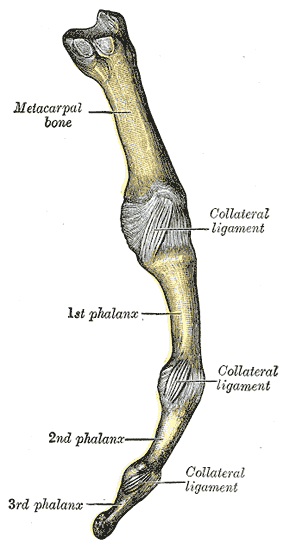
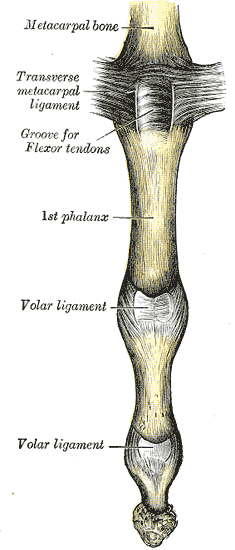


Anatomy and structural features
- Articular surfaces: The convex metacarpal heads articulate with the concave bases of the proximal phalanges, forming a stable joint that permits flexion, extension, and limited side-to-side motion.
- Ligaments and plates: Each MCP is stabilized by radial and ulnar collateral ligaments, a volar (palmar) plate that resists hyperextension, and the deep transverse metacarpal ligament linking adjacent metacarpal heads.
- Tendons and soft tissues: The extensor hood, lumbricals and interossei muscles insert around the joint and control fine movements; flexor tendons pass over the volar plate toward the fingers.
- Vasculature and nerves: Digital branches of palmar and dorsal vessels supply the region, with sensory innervation from digital nerves derived from the median and ulnar nerves.
Movement and function
MCP joints allow flexion and extension, abduction and adduction, and limited circumduction. Flexion at the MCP is important for making a fist and for power grips; the coordinated action of intrinsic hand muscles also enables precision grips and manipulation of small objects. The thumb's MCP differs from the fingers: it permits flexion/extension and rotation but has more constrained lateral movements because of its specialized carpometacarpal joint.
Clinical significance
- Trauma: Dislocations, collateral ligament injuries (for example the ulnar collateral ligament of the thumb, "skier's thumb"), and volar plate injuries can impair hand function.
- Inflammatory and degenerative disease: Rheumatoid arthritis commonly affects MCPs, producing swelling and ulnar deviation; osteoarthritis may involve these joints, especially with prior injury.
- Other conditions: Stenosing tenosynovitis (trigger finger) and synovitis can cause pain, clicking, or locking at or near the MCP level.
- Evaluation and treatment: Plain radiographs, ultrasound or MRI are used for diagnosis; management ranges from splinting and therapy to injections or surgery depending on the condition.
Origins and distinctions
The name combines meta- (after), carpo- (wrist) and phalangeal (finger bone) elements to denote the joint between metacarpals and phalanges. MCP joints differ from carpometacarpal (CMC) joints at the base of the hand and from the interphalangeal (PIP and DIP) joints within the fingers by their greater range of lateral movement and their central role in forming a functional grip.
Related articles
Author
AlegsaOnline.com Metacarpophalangeal joint Leandro Alegsa
URL: https://en.alegsaonline.com/art/64147