
Medial collateral ligament (MCL) — structure, function and clinical overview
The medial collateral ligament (MCL) is a major stabilizing band on the inner knee. This article explains its anatomy, role, common injuries, diagnosis and typical treatment approaches.
Overview
The medial collateral ligament, commonly abbreviated MCL, is a broad, strong band of connective tissue on the inner (medial) side of the knee. It is one of the major ligaments that stabilize the joint and works with other structures to control side-to-side motion of the leg relative to the thigh. The MCL is distinct from the lateral stabilizers and from intra-articular ligaments that sit inside the knee.
Image gallery
2 Images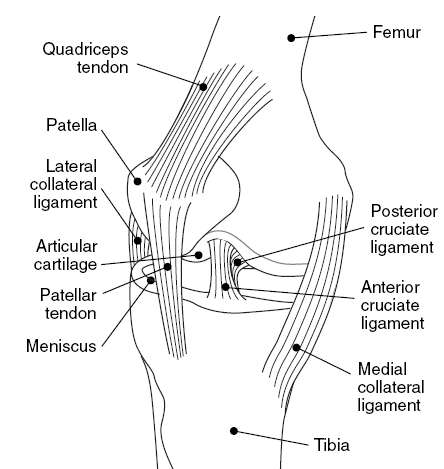

Anatomy and characteristics
The MCL attaches from the medial femoral epicondyle down to the medial aspect of the tibia. Anatomically it is often described as having superficial and deep components: the superficial layer is the primary load-bearing portion, while the deep fibers link to the joint capsule and the medial meniscus. Its orientation allows the MCL to resist valgus forces (inward bending) and to provide rotational restraint.
Function and biomechanics
During normal activity the MCL limits excessive widening of the medial joint space and contributes to overall knee stability during walking, cutting and pivoting motions. It works in concert with the anterior and posterior cruciate ligaments and the lateral ligaments to maintain proper alignment and distribute loads across the knee.
Injury, symptoms and grading
MCL injuries are common in contact sports and occur when an external force pushes the knee inward or when the foot is fixed and the body twists. Symptoms range from localized pain and swelling to a sensation of instability. Clinically injuries are often graded:
- Grade I — mild stretching with microscopic tearing.
- Grade II — partial tear with some joint laxity.
- Grade III — complete tear or avulsion causing significant instability.
Diagnosis and treatment
Evaluation includes physical examination, stress testing of the medial joint line and imaging such as X‑rays or MRI when needed. Many isolated MCL sprains heal with conservative care: rest, compression, bracing, progressive physical therapy and gradual return to activity. Surgical repair or reconstruction may be recommended for high-grade tears, combined ligament injuries, or persistent instability.
Clinical importance and notable facts
Because the deeper fibers connect to the medial meniscus, MCL injuries can be associated with meniscal damage. Rehabilitation focuses on restoring full range of motion, strength of the quadriceps and hamstrings, and neuromuscular control to reduce re-injury risk. For further clinical or anatomical detail see related entries about the knee and surrounding soft tissues.
Related articles
Author
AlegsaOnline.com Medial collateral ligament (MCL) — structure, function and clinical overview Leandro Alegsa
URL: https://en.alegsaonline.com/art/63401