
Article Five of the United States Constitution
Article Five establishes the formal procedures for proposing and ratifying amendments to the U.S. Constitution, and notes limited protections on altering certain constitutional provisions.
Overview
Article Five of the United States Constitution sets out the legal framework by which the Constitution may be changed. Amendments created under this process are often called constitutional amendments. The article balances two aims: allowing the nation to adapt over time while making amendments deliberately difficult so that changes reflect broad consensus.
Image gallery
3 Images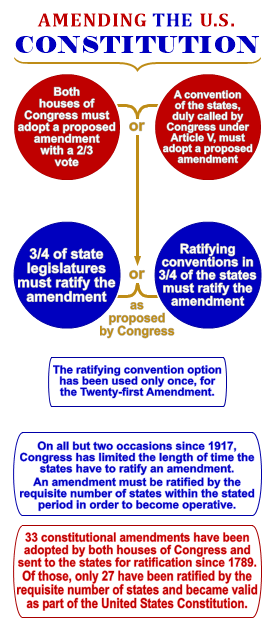


How amendments are made
Article Five specifies two stages: proposal and ratification. There are two methods to propose an amendment and two methods to ratify one. The most common path begins in Congress; less frequently, a national convention of states may be used.
- Proposal: An amendment can be proposed either by a two‑thirds vote in both the House of Representatives and the Senate, or by a convention called for by two‑thirds of state legislatures.
- Ratification: Once proposed, an amendment must be approved by three‑quarters of the states, either through their legislatures or by conventions in the states, depending on the mode Congress selects.
Protected clauses and limits
Article Five also preserves certain protections that were built into the original Constitution. It contains a clause preventing changes that would deprive a state of its equal representation in the Senate without that state's consent. The Constitution originally included temporary restrictions on altering certain fiscal and importation provisions, a notable one being the prohibition on banning the importation of enslaved people prior to 1808; these were transitional within the founding framework. For full text and context, see Article One references: Article One.
History, practice and examples
In practice, Article Five has produced a relatively small number of amendments compared with all proposed changes. The first ten amendments, ratified as the Bill of Rights, were added shortly after the Constitution was adopted to address concerns about individual liberties. Over time, amendments have addressed voting rights, federal powers, and government procedures. As of now there are twenty‑seven ratified amendments, including widely known changes such as the abolition of slavery, extension of voting rights, and adjustment of the voting age.
Notable features and significance
The Article Five process is intentionally stringent: supermajorities and broad geographic support are required, which helps ensure durability and national legitimacy for changes. Congress has at times attached time limits to the ratification period of proposed amendments. The alternative convention route has never been used to propose an amendment, though it remains part of the constitutional design as a state-initiated check.
Overall, Article Five plays a central role in American constitutional government by providing a stable but adaptable procedure for legal and political evolution.
Questions and answers
Q: What does Article Five of the United States Constitution outline?
A: Article Five outlines how the Constitution can be changed, including through Constitutional amendments.
Q: What are changes to the Constitution called?
A: Changes to the Constitution are called Constitutional amendments.
Q: What does Article Five say about clauses in Article One of the Constitution?
A: Article Five says that there are certain clauses, or parts, of Article One of the Constitution that could not be amended right away.
Q: What is the purpose of the "Protected clauses" section?
A: The "Protected clauses" section explains which clauses in Article One of the Constitution could not be amended right away.
Q: Can all clauses in Article One of the Constitution be amended?
A: No, Article Five of the United States Constitution says that there are certain clauses in Article One that could not be amended right away.
Q: What is the purpose of Constitutional amendments?
A: The purpose of Constitutional amendments is to make changes to the United States Constitution.
Q: How can the United States Constitution be changed?
A: The United States Constitution can be changed through Constitutional amendments, which are outlined in Article Five of the Constitution.
Related articles
Author
AlegsaOnline.com Article Five of the United States Constitution Leandro Alegsa
URL: https://en.alegsaonline.com/art/6331
Sources
- archives.gov : "The Constitution of the United States: A Transcription"
- law.ou.edu : "The Articles of Confederation"
- heritage.org : "Amendments"
- avalon.law.yale.edu : "The Same Subject Continued (The Powers Conferred by the Constitution Further Considered) [The Federalist Papers: No. 43]"
- digitalcommons.law.yale.edu : "Liquor Laws and Constitutional Conventions: A Legal History of the Twenty-first Amendment"
- senate.gov : "Measures Proposed to Amend the Constitution"
- law.cornell.edu : "Hollingsworth et al. v. State of Virginia: 3 U.S. 378 (1798)"
- archives.gov : "The Constitutional Amendment Process"
- amazon.com : B000JWI5Y2
- csac.history.wisc.edu : "Introduction to Ratification in Rhode Island"
- archives.gov : "Constitution of the United States: Amendments 11-27"