
Mathematical physics: concepts, methods, and applications
Mathematical physics develops and applies mathematical structures and techniques to formulate, analyze, and solve physical problems, linking pure mathematics and theoretical physics across many disciplines.
Overview
Mathematical physics is the discipline that constructs and analyzes mathematical models of physical systems. It sits at the interface of rigorous mathematics and theoretical physics: mathematicians contribute structures and techniques, while physicists supply phenomena and guiding problems. The field emphasizes clarity of assumptions, precise formulation of laws, and the study of the properties of the resulting equations and spaces. Practitioners draw on applied mathematics and often develop new mathematical tools motivated by physical ideas.
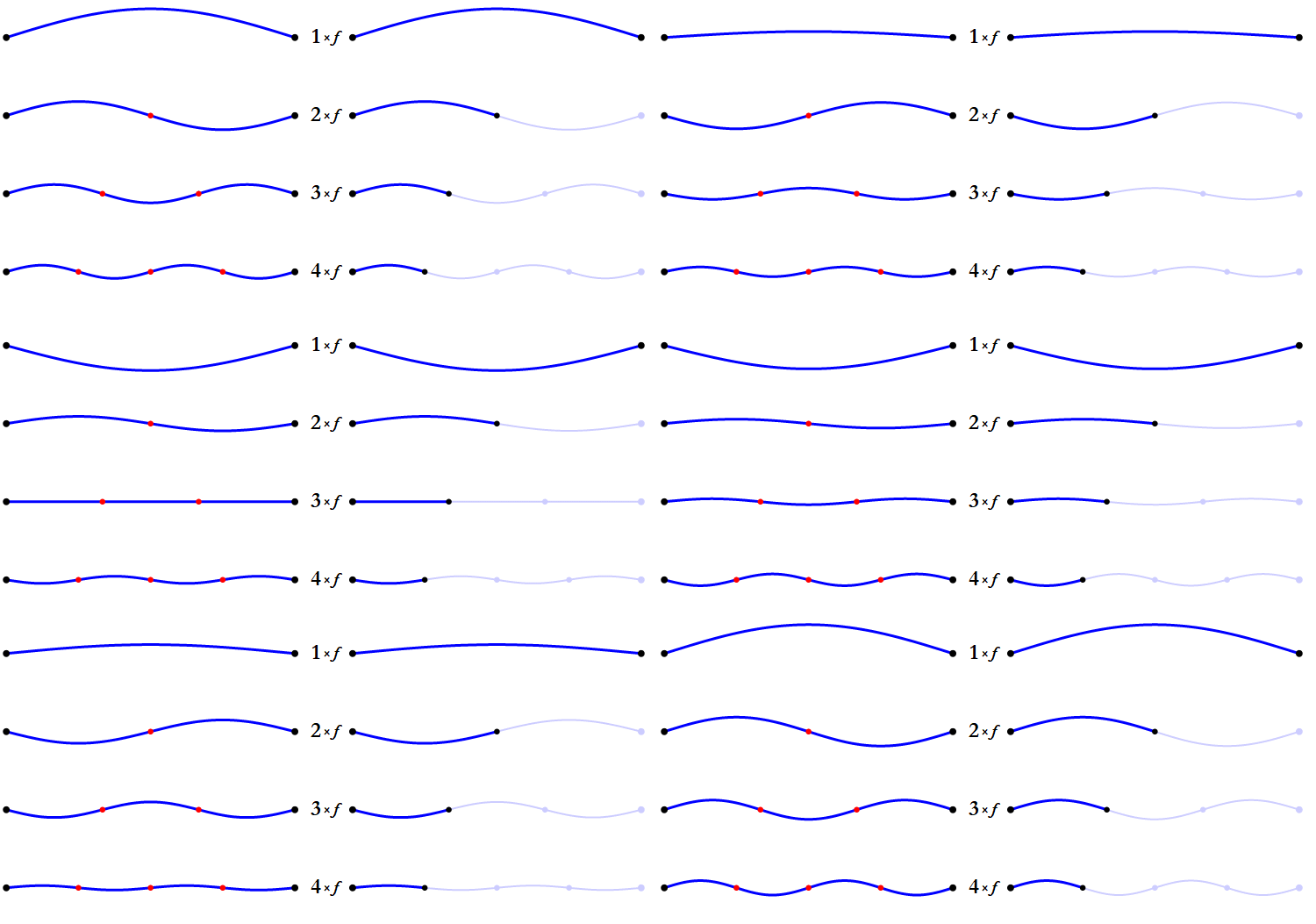
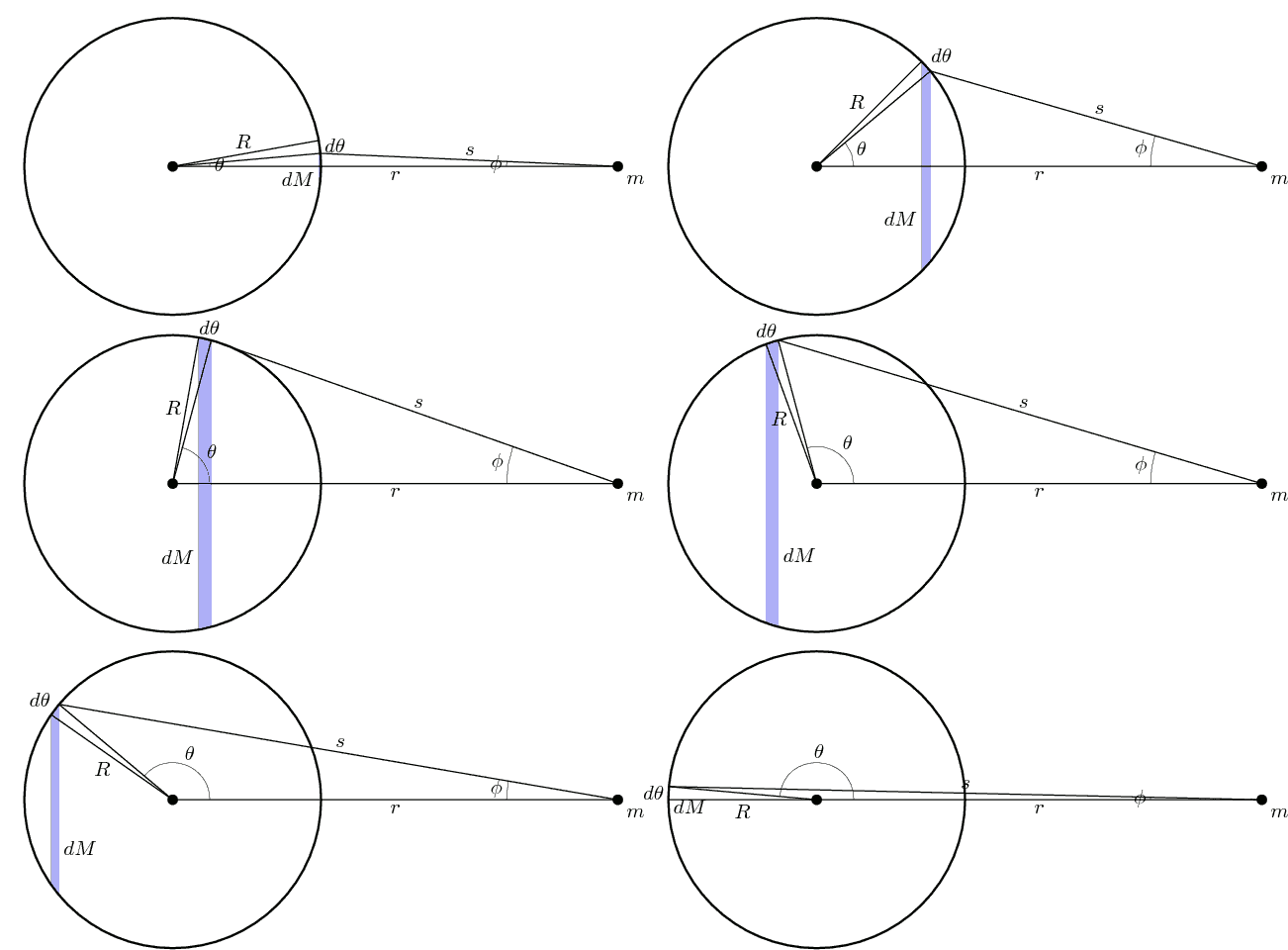
Image gallery
6 Images



Core concepts and structures
Central objects include differential equations (ordinary and partial), variational principles, operator algebras, and geometric constructs such as manifolds and fiber bundles. Typical mathematical ingredients are functional analysis, group theory, topology, and differential geometry. The same physical situation can be represented by different mathematical frameworks: for example, classical mechanics by symplectic geometry and Hamiltonian flows, and quantum theory by operators on Hilbert spaces. The subject also studies generalized notions like noncommutative spaces and distributions that extend classical intuition.
History and development
The roots of mathematical physics trace back to the formulation of classical mechanics and the calculus of variations. Over the 19th and 20th centuries the rise of thermodynamics, electromagnetism, relativity, and quantum mechanics created demand for new mathematical language and rigor. As physical theories evolved, so did the mathematics, with many concepts now seen as bidirectional: physics inspires mathematics and mathematical results inform physical interpretation.
Methods and typical problems
- Analysis of partial differential equations and existence/uniqueness of solutions (equations arising from field theories).
- Spectral theory and operator methods for quantum systems.
- Geometric and topological classification of field configurations.
- Asymptotic methods, perturbation theory, and numerical approximation.
Applications and examples
Mathematical physics underlies much of modern theoretical science: it provides the rigorous backbone for quantum mechanics, statistical mechanics, general relativity and many-body theory. Concrete achievements include stability analyses of matter, rigorous treatments of scattering and renormalization, and the geometric formulation of gauge theories. Researchers translate physical intuition into mathematical theorems and, conversely, use mathematical structures to suggest new experiments or interpretations of data.
Distinctions and notable facts
While closely related to theoretical physics, mathematical physics prioritizes mathematical precision and proof. It differs from pure mathematics in being motivated by physical content and from computational applied mathematics by emphasizing conceptual understanding. The field remains collaborative and evolving: advances in abstract areas of pure mathematics often find application in physics, and novel physical phenomena continue to provoke new mathematics. For broader context, see resources on physics foundations at physics references.
Related articles
Author
AlegsaOnline.com Mathematical physics: concepts, methods, and applications Leandro Alegsa
URL: https://en.alegsaonline.com/art/62808