
Logo (programming language)
Logo is an educational programming language, created in the late 1960s to teach programming and mathematical thinking; it is known for turtle graphics and list-processing features.
Overview
Logo is a high-level programming language designed for teaching and exploration rather than large-scale software development. Created to introduce children and students to programming ideas, Logo emphasizes immediate visual feedback, simple syntax, and concepts such as procedures, recursion, and list manipulation. The name can be confused with the graphic term logo, but in computing it refers specifically to this language and its learning environment.
Image gallery
3 Images

Characteristics
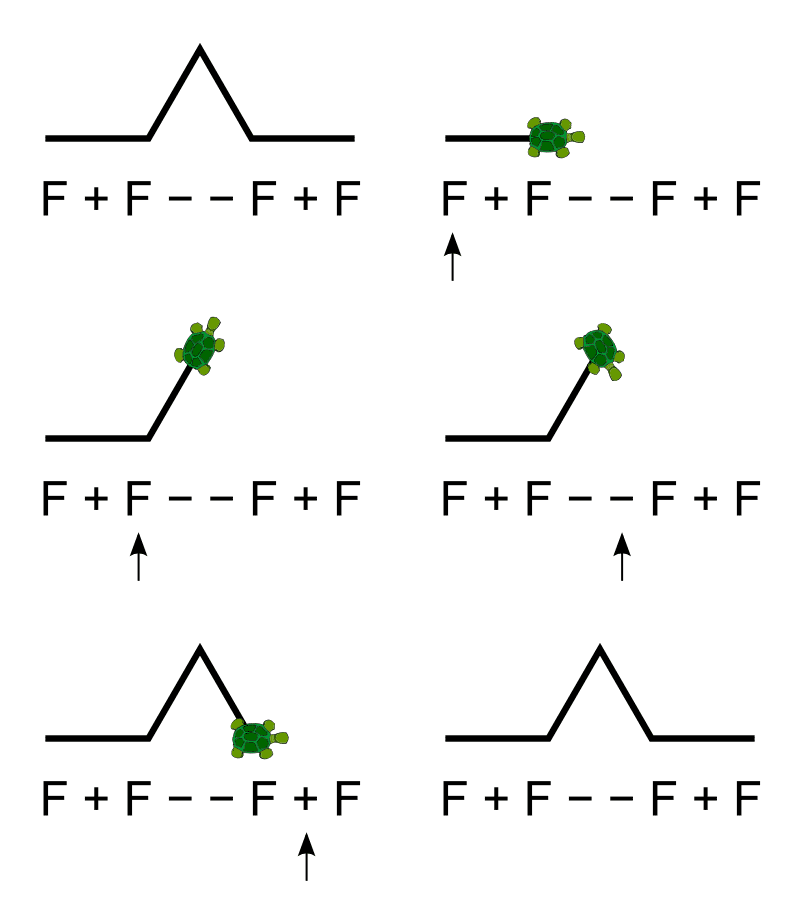
Typical features of Logo include a small set of core commands, an interpreter that runs code interactively, and a focus on turtle graphics — a cursor or robot called the “turtle” that moves and draws on the screen. The language supports:
- procedures and local recursion, making it useful for algorithmic thinking;
- list processing and simple data structures, influenced by Lisp-style ideas;
- graphics commands such as forward, back, left and right to control the turtle;
- interactive experimentation where students see results as they change code.
History and influence
Logo was developed in the late 1960s by researchers interested in education and cognitive development. It became closely associated with Seymour Papert and his constructionist approach to learning; Papert later described many of these ideas in the book Mindstorms. Over time Logo inspired many dialects and educational environments and helped shape later tools that aim to teach computing concepts.
Uses and examples
In classrooms, Logo is used to teach basic programming, geometry and problem solving. A simple example in many Logo dialects is drawing a square with commands such as "forward 100" and "right 90". Beyond screen graphics, Logo has been applied to physical turtles (small robots), music, and microworlds that let learners explore mathematical and scientific ideas.
Variants and legacy
Multiple implementations and dialects exist, ranging from classic Berkeley/MIT-style Logo interpreters to modern environments that add multimedia, networking or agent-based features. For introductory reading and resources about the language and its educational use, see general references on the Logo programming language.
Related articles
Author
AlegsaOnline.com Logo (programming language) Leandro Alegsa
URL: https://en.alegsaonline.com/art/58873
Sources
- logothings.wikispaces.com : logothings.wikispaces.com