
Lateran Treaty (1929) — Establishment of Vatican City and Concordat
The 1929 Lateran Treaty resolved the Roman Question by creating Vatican City, defining relations between the Holy See and Italy, and setting a financial settlement and concordat between Church and state.
Overview
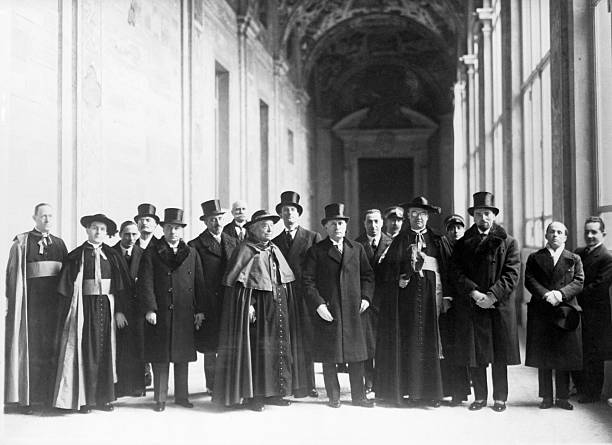
The Lateran Treaty, signed on 11 February 1929, settled a long-standing dispute between the Holy See and the Italian state. It was concluded between representatives of the Kingdom of Italy — governed at the time by Benito Mussolini — and the papal government of Pope Pius XI. The agreement recognized a sovereign territory for the Holy See and established a new basis for relations between the Catholic Church and the Italian state.
Image gallery
5 Images


Main elements of the agreement
The suite of agreements known as the Lateran Pacts included three complementary instruments. Together they defined territory, legal status, and mutual obligations:
- The Treaty: created and recognized the independence and sovereignty of Vatican City as a distinct territorial entity under the authority of the Holy See.
- The Concordat: regulated the relationship between the Catholic Church and civil institutions in Italy, including the Church’s role in public life and certain legal privileges.
- The Financial Convention: provided a monetary settlement compensating the Holy See for the loss of its former temporal territories (the Papal States) after Italian unification.
Historical background
The treaty resolved the so-called "Roman Question," a diplomatic and political impasse that dated from 1870 when the Papal States were annexed during Italian unification and the pope’s temporal rule ended. For decades the Holy See and the Italian government disagreed over sovereignty and the pope’s status; the 1929 agreements produced a mutually recognized solution under international law.
Consequences and importance
By creating a territorially defined and internationally recognized state, the Lateran Treaty made the Holy See a sovereign subject of international law and gave the pope territorial autonomy to exercise spiritual and administrative authority. The concordat portion shaped Italian public life for decades — including the recognition of the Catholic Church in education and family law — until major revisions in the late 20th century.
Later developments and legacy
Parts of the Lateran agreements were modified in later years, most notably a revision of the concordat in 1984 that altered the Church’s legal position within Italian civil life. Nevertheless, the 1929 settlement remains the foundational document for relations between the Holy See and the Italian Republic. Vatican City, established by the treaty, is notable today as one of the world’s smallest independent states by both area and population and continues to maintain diplomatic relations with many countries.
Signed on 11 February 1929, the Lateran Treaty is widely regarded as a turning point in modern church–state relations in Italy and a defining step in the post-unification order of Europe. For introductions and further reading, see primary summaries and diplomatic histories at sources on Mussolini and Italian politics and materials concerning Vatican City and the Holy See’s international status (Italy–Holy See relations).
Related articles
Author
AlegsaOnline.com Lateran Treaty (1929) — Establishment of Vatican City and Concordat Leandro Alegsa
URL: https://en.alegsaonline.com/art/56195