
Kutchi (Kachchi) language
Kutchi is an Indo‑Aryan language of western India and southern Pakistan, with distinct dialects, multiple scripts and a strong oral tradition linked to the Kutch region and Sindh.
Overview
Kutchi (also spelled Kachchi) is an Indo‑Aryan speech variety native to the Kutch region of western India and to neighbouring areas of southern Pakistan. It occupies a position between Sindhi and Gujarati in the linguistic landscape and shows layers of vocabulary from Persian, Arabic, Rajasthani and Marathi. Contemporary descriptions treat Kutchi either as a separate language or as a member of a dialect continuum; both labels reflect its close relations with surrounding tongues. See a general language overview.
Image gallery
2 Images
Characteristics
Phonologically Kutchi retains sounds and consonant clusters that distinguish it from standard Gujarati, and its grammar shares features with Sindhi. Notable features include a rich set of retroflex consonants, vowel contrasts, and a system of postpositions rather than prepositions. Vocabulary is heavily influenced by historical trade and migration across the region.
Distribution and speakers
Most native speakers live in and around the Kutch district (Kutch) and the salt marshes of the Rann of Kutch. Significant communities also live in Pakistan’s southern provinces, especially in Sindh and the city of Karachi, and among diaspora groups beyond Pakistan and India. Historical counts vary; older records noted tens of thousands of speakers in some areas while broader estimates point to a larger, regionally spread population.
Writing systems and literature
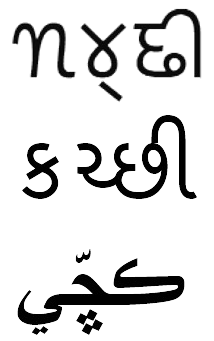
Kutchi has been written in several scripts. In India the Gujarati script is commonly used, while in Pakistan some communities employ Perso‑Arabic variants. Earlier literary and mercantile use also involved scripts such as Khudabadi and Khojki. Most of Kutchi’s cultural output is oral—folk songs, ballads, and storytelling—though modern print, radio and online media increasingly appear in the language.
History and social role
The language developed through centuries of contact among pastoral, trading and settled peoples of the northwestern Indian subcontinent. It functions as a marker of regional identity for Kutchis, appearing in ritual song, embroidery motifs and community festivals. While not an official state language, efforts by cultural organizations and local media aim to document, teach and promote Kutchi in schools and digital platforms.
Distinctive facts
- It forms part of a dialect continuum between Gujarati and Sindhi.
- Multiple scripts reflect historical, religious and national boundaries.
- Strong oral traditions mean much material remains unpublished and localized.
Related articles
Author
AlegsaOnline.com Kutchi (Kachchi) language Leandro Alegsa
URL: https://en.alegsaonline.com/art/54702
Sources
- ethnologue.com : "Kacchi"
- ethnologue.com : Kutchi
- omniglot.com : "Gujarātī"
- glottolog.org : "Kachchi"