
Kingdom of Navarre
Medieval and early modern kingdom on both sides of the Pyrenees, rooted in Basque lands; partitioned in 1512 and later absorbed into France and Spain, leaving a lasting regional identity.
Overview
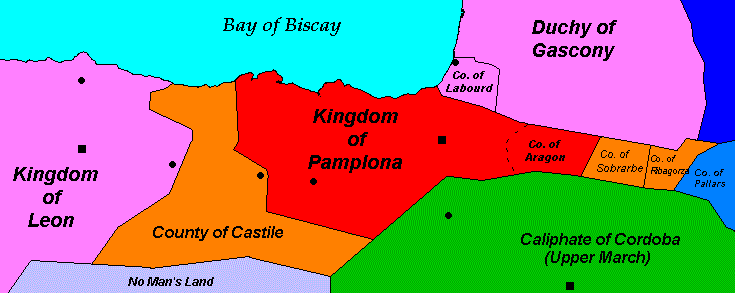
The Kingdom of Navarre was a compact but influential polity centred on the city of Pamplona in the western Pyrenees. Emerging in the early Middle Ages from local Basque and Carolingian-era polities, it became known for alternating periods of expansion and contraction, and for its location astride important mountain passes connecting Iberia and Gaul. It is commonly discussed as the medieval Kingdom of Pamplona that later came to be called Navarre.
Image gallery
8 Images



Territory and capital
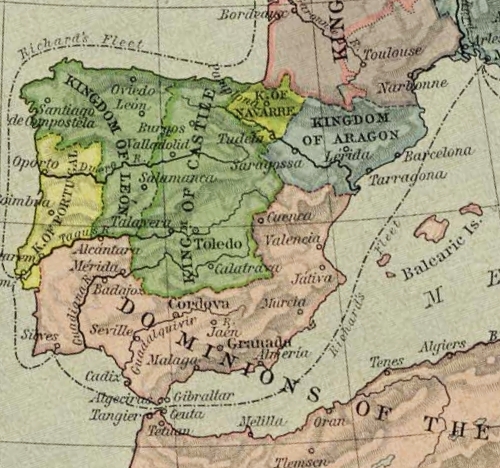
Navarre's core lay in the present-day Basque Country and neighbouring areas, occupying land on both sides of the Pyrenees. The traditional capital was Pamplona (Iruña), a fortified city and administrative centre. Its borderland position shaped its economy, military role and cultural mix of Romance and Basque-speaking communities. The kingdom's geography made it a crossroads between northern and southern Europe.
History and development
Formally arising in the 9th century, the realm grew under dynasties such as the Jiménez house and reached a high point in the 10th–11th centuries when rulers extended influence across nearby Christian counties. Like other Iberian polities, Navarre experienced dynastic change, partitions and foreign pressure. In 1512 the southern sector was occupied by Castilian forces; the polity was effectively divided between a Spanish-controlled south and a northern territory that persisted under its own rulers for some decades. The northern portion, often called Lower Navarre, later became closely tied to the French crown and was integrated into France in the early 17th century.
Government, law and society
Navarre retained distinctive institutions such as local fueros (regional laws and privileges) and a nobility tied to mountain lordships and towns. Kings worked with local councils, clergy and noble assemblies to govern. Society combined pastoral, agricultural and urban elements; pilgrimage routes and trade through the passes linked Navarre economically to wider Europe.
Notable events and distinctions
- Foundation and names: often called Kingdom of Pamplona in early sources and Navarre in later centuries.
- Partition in 1512: a turning point separating the southern (Castilian) and northern (French-linked) parts.
- Integration into France: the northern rump was brought into the French state in the early 1600s under royal authority.
Legacy
The Kingdom of Navarre left a lasting imprint on regional identity, legal traditions and place names in both Spain and France. Its history helps explain the persistence of Basque culture and the special legal status enjoyed by parts of Navarre within Spain. For further reading on its institutions and genealogy see historical surveys, regional archives at archival collections and studies of Basque-language communities at cultural resources. Overviews of its geography and Pyrenean role are available via mountain and travel studies, while research on the 16th–17th century partitions can be found at early modern research and municipal histories of Pamplona at city archives.
Related articles
Author
AlegsaOnline.com Kingdom of Navarre Leandro Alegsa
URL: https://en.alegsaonline.com/art/53604
Sources
- books.google.es : Muslims in Spain, 1500 to 1614