
King of Cambodia
The monarch and ceremonial head of state of Cambodia: role, selection, history from ancient Khmer rulers to the modern constitutional monarchy and notable examples.
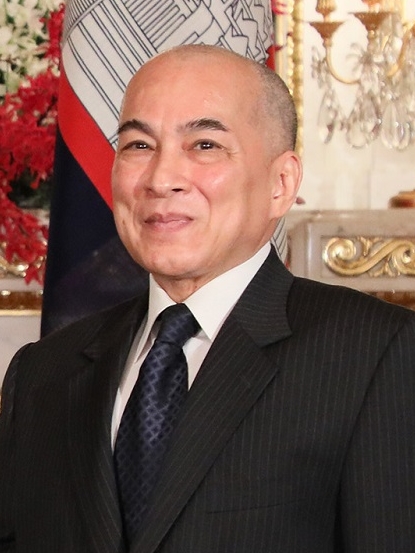
The King of Cambodia is the country's constitutional monarch and ceremonial head of state. As a national symbol, the king represents the unity and continuity of the Khmer nation, presides over formal state ceremonies, and serves as a patron of religion and culture. The royal residence is the Royal Palace in Phnom Penh, and the style traditionally used is "His Majesty."
Image gallery
10 Images



Role and responsibilities
Under the modern constitution the king's powers are mainly formal. Typical duties include promulgating laws, receiving foreign diplomats, presiding over national ceremonies and religious observances, and formally appointing the prime minister and other senior officials according to constitutional procedures. The monarch is widely regarded as a moral and cultural figure rather than a political executive.
Selection and succession
Cambodia's monarchy is hereditary in origin but operates under an elective mechanism established by the constitution. A Royal Council of the Throne—composed of senior political and religious leaders—meets to select a monarch from eligible members of the royal houses. The chosen sovereign holds the position for life unless he voluntarily abdicates.
Historical outline
The institution of kingship in the region stretches back to ancient Khmer polities that built Angkor. Through centuries the throne passed among competing royal lines and adapted under foreign influence, including the French protectorate period. In the 20th century Cambodia experienced monarchy, republic, revolutionary regimes that abolished the crown, and finally restoration of the constitutional monarchy in the early 1990s.
Notable modern figures include Norodom Sihanouk, who played multiple roles in Cambodia's mid-century history, and Norodom Sihamoni, who became king after Sihanouk's abdication. The restoration of the monarchy reintroduced a ceremonial sovereign as part of Cambodia's post-conflict political settlement.
Significance and further reading
While the king in Cambodia does not govern day-to-day politics, the office retains strong cultural, religious and symbolic importance. For a chronological list of individuals who have served as king, head of state or president in various Cambodian regimes, see the compiled list of leaders: Complete list of Kings, Heads of State and Presidents of Cambodia.
- Functions: ceremonial head, signatory of laws, religious patron.
- Selection: chosen by Royal Council of the Throne from royal houses.
- Historical shifts: ancient kings, colonial period, abolition and restoration.
Related articles
Author
AlegsaOnline.com King of Cambodia Leandro Alegsa
URL: https://en.alegsaonline.com/art/53557