
Jidai Matsuri (Festival of the Ages): Kyoto's Annual Historical Parade
Jidai Matsuri, held every October 22 in Kyoto, is a large historical pageant with thousands in period costume reenacting Japan's past. It blends Shinto ritual, civic commemoration and popular spectacle.
The Jidai Matsuri, commonly called the "Festival of the Ages," is an annual celebration held on October 22 in Kyoto. The event is best known for its long, costumed procession in which participants portray figures from many periods of Japanese history. Combining ceremonial Shinto elements with a public historical pageant, the festival attracts local residents, history enthusiasts and visitors who come to see the parade and the rituals that frame it.
Image gallery
5 Images

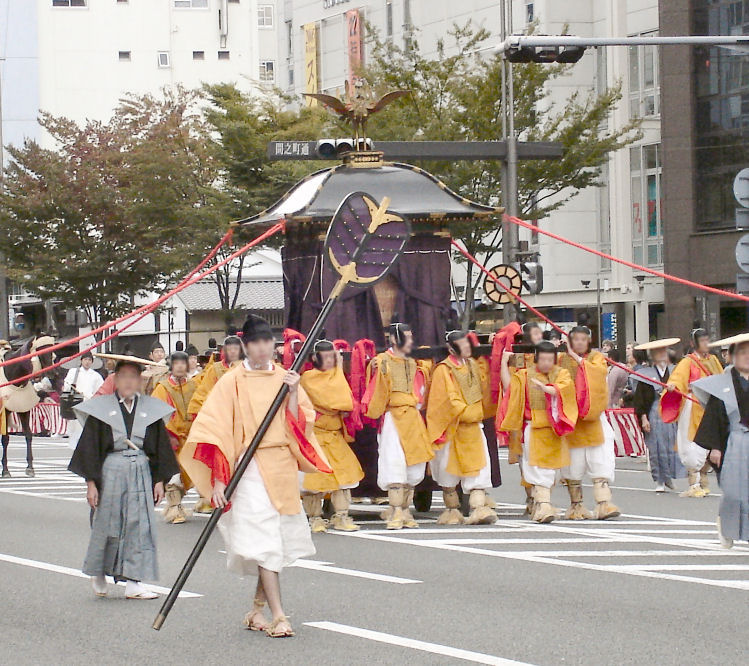


Characteristics and procession
The procession typically lasts several hours and features hundreds to thousands of participants dressed in carefully recreated garments representing court nobles, samurai, commoners, craftsmen and military retainers from eras that span from the founding of Heian-kyō through the Meiji period. Costumes and accoutrements are important: ornate court robes, armor, and everyday clothing are used to evoke each age. The parade is staged like a moving tableau of Japanese history, organized into chronological groups so spectators can follow the development of styles, ranks and social roles.
Rituals, route and schedule
Activities on the day include early-morning rites and the presentation of portable shrines and symbols from the imperial household for public veneration. The procession itself starts in the afternoon and follows a fixed route between key ceremonial sites in the city. The route and timing are arranged to include stops for brief ceremonies and to pass by significant landmarks so that the event connects civic space with historical memory. Observers often gather along the streets early to find vantage points for photography and viewing.
Origins and historical context
The modern Jidai Matsuri dates back to the late 19th century and is closely linked to Kyoto's role in Japan's political transformation. After the imperial household relocated to Tokyo in 1868 during the Meiji Restoration, Kyoto retained deep cultural and historical importance. The festival, first held as a civic commemoration, was organized in part to honor Kyoto's past and to maintain ties to imperial tradition. Over time the pageant grew into a broadly accessible public spectacle that deliberately showcases multiple historical eras, including the medieval samurai periods and the later Meiji changes.
Cultural significance and contemporary practice
Jidai Matsuri serves several functions: it is a form of public history that educates attendees about clothing, social roles and events from different periods; it reaffirms local pride in Kyoto's historical centrality; and it provides continuity for Shinto ritual practices connected with shrines and imperial rites. The festival is distinct from other Kyoto observances by its explicit focus on historical reenactment rather than being primarily a shrine procession. For more on the city's festivals and how they differ, see local festival guides and cultural resources referenced by municipal organizations and cultural institutions.
Notable features and distinctions
- The event is fixed on October 22, a date chosen for its local historical associations and observed each year in the city.
- Participants range from professional reenactors and shrine attendants to volunteers and students, and some groups recreate specific battles, ceremonies or artisan trades.
- While the procession is a public spectacle, it is framed by formal Shinto elements at the imperial and shrine precincts, linking the theatrical aspects with religious observance; see materials published by local shrines for ceremonial details (shrine information).
- Jidai Matsuri is often compared with other major Kyoto festivals such as the Gion and Aoi festivals; its emphasis on chronological representation of history makes it unique among the city's seasonal events (festival comparisons).
For visitors wishing to attend, local tourist offices and cultural centers publish annual schedules, parade routes and viewing recommendations. The festival remains one of Kyoto's most vivid public celebrations, notable for its scale, attention to historical detail and its role in keeping the city's layered past visible to contemporary audiences.
Related articles
Author
AlegsaOnline.com Jidai Matsuri (Festival of the Ages): Kyoto's Annual Historical Parade Leandro Alegsa
URL: https://en.alegsaonline.com/art/50166