
Jewish Publication Society of America Version (JPS 1917)
The JPS 1917 is the first full English translation of the Hebrew Bible produced by an American Jewish committee; based on the Masoretic Text, it became a key reference for English-speaking Jews.
The Jewish Publication Society of America Version, commonly called the JPS 1917, is an English translation of the Hebrew Bible (the Tanakh) prepared and published under the auspices of the Jewish Publication Society of America. Completed and issued in 1917, it represents the first full rendering of the traditional Jewish canon into English by a committee of Jewish scholars rather than by an individual translator. Its formal full title emphasized fidelity to Hebrew sources and consultation with Jewish authorities: The Holy Scriptures According to the Masoretic Text: A New Translation with the Aid of Previous Versions and with Constant Consultation of Jewish Authorities.
Image gallery
2 Images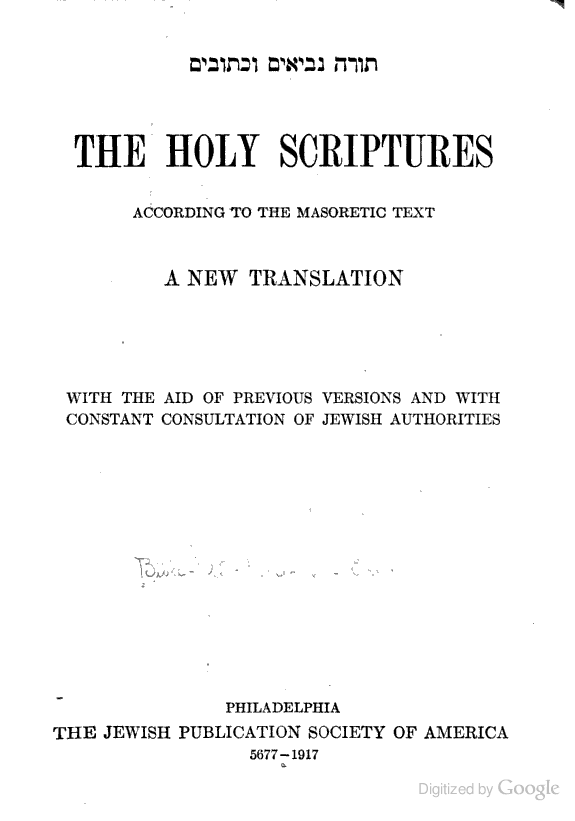

Characteristics and translation approach
The JPS 1917 is grounded in the Masoretic Text and follows a conservative, literary style intended to serve both study and public reading. The translators used earlier versions and traditional Jewish interpretations as aids while striving for a readable English that preserved Hebrew syntax and nuance where possible. Typical features include careful attention to Hebrew names and terms, avoidance of Christian doctrinal language, and a preference for dignified, somewhat elevated English idiom common to early 20th-century scriptural translations.
- Source text: the traditional Masoretic Hebrew base.
- Method: committee work combining scholarly judgment and communal sensitivity.
- Style: formal, literary English suitable for study and liturgical use.
- Supplementary material: notes, variant readings, and cross-references drawn from Jewish sources.
History and development
The project grew from a desire within American Jewish life for an authorized, communal English Bible to serve congregations, students, and readers who did not rely on Christian translations. Published by the Jewish Publication Society, the work was the Society's first full Bible edition (the first JPS Bible) and marked a turning point in Jewish scholarship in English. Its initial release in 1917 (published in 1917) established a widely accepted standard for decades.
Uses, reception, and legacy
For much of the 20th century the JPS 1917 served as a standard for English-speaking Jews in study, sermon preparation, and private reading. Its scholarly but accessible tone made it useful in academic contexts as well. Over time, language changes and evolving translation philosophy led to efforts to produce a more contemporary rendering; these culminated in later revisions and a new JPS translation completed in the latter half of the 20th century, which sought more idiomatic English while retaining Jewish interpretive norms.
Critics and readers have praised the JPS 1917 for its fidelity and coherence, while some have noted its dated language and occasional literalism. Despite that, it remains a historically important translation that reflects early 20th-century Jewish scholarly priorities and communal needs (the first group Jewish English translation).
Earlier individual efforts—most notably translations by figures such as Isaac Leeser—prepared the ground for a communal translation, but the JPS effort stands out as the first comprehensive Jewish-organized English edition of the entire Hebrew canon (Isaac Leeser and predecessors).
Related articles
Author
AlegsaOnline.com Jewish Publication Society of America Version (JPS 1917) Leandro Alegsa
URL: https://en.alegsaonline.com/art/50130