
Japanese saw (nokogiri): design, types and uses
Overview of the Japanese saw (nokogiri), its pull-stroke cutting action, common types, construction features, and typical woodworking uses and advantages.
The Japanese saw, commonly called nokogiri (鋸), is a family of hand saws used in fine woodworking. Its most distinctive feature is that the blade cuts on the pull stroke: the saw removes material as the user pulls it toward the body, rather than pushing away as with most Western saws. This change in cutting direction affects blade design, handling and the kinds of joinery for which the tool is favored. For a general reference see Japanese saw and applications in woodworking.
Image gallery
4 Images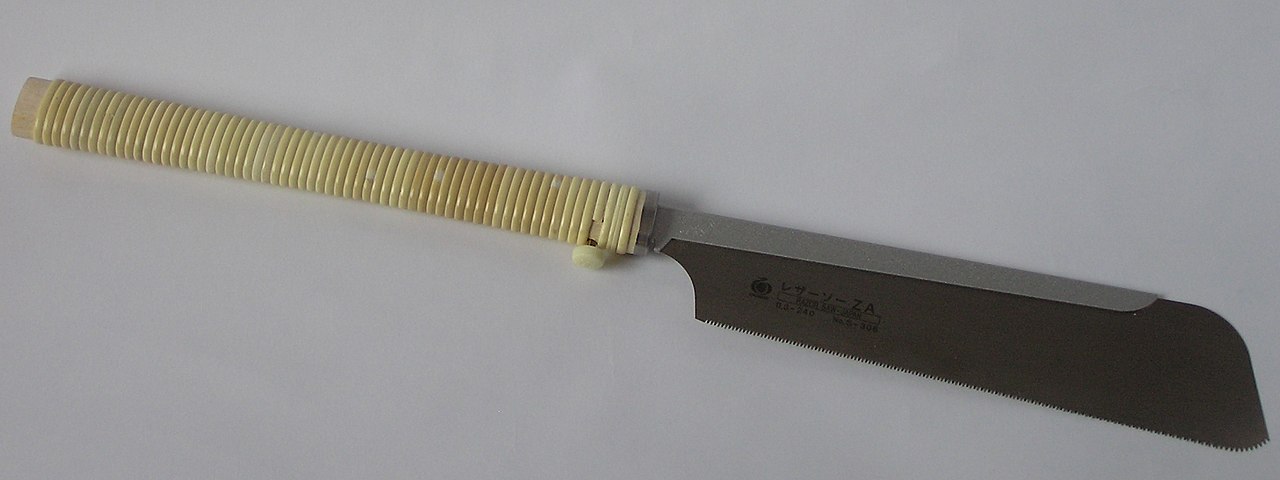


Design and characteristics
Because a pulled blade remains in tension during cutting, Japanese saws can use thinner, more flexible blades that produce a finer kerf and require less effort. Handles are traditionally straight and hollowed to accept the tang of the blade, and tooth geometry varies by purpose. Many modern blades are laminated from harder cutting steel to a softer backing for toughness, and some saws are supplied with replaceable disposable blades.
Common types
- Ryoba: a double-edged saw with rip teeth on one edge and crosscut teeth on the other, useful for general cutting and resawing.
- Dozuki: a backsaw with a reinforced spine that keeps the thin blade rigid for precise tenon and dovetail cuts.
- Kataba: a single-edged saw suited for deeper cuts where a backsaw cannot reach.
- Kugihiki: a flush-cut saw used to trim dowels or protruding tenons clean with a surface.
Each type is optimized by tooth pitch and set for rip (cutting along the grain) or crosscut (across the grain) work. The finer teeth and narrow kerf make Japanese saws especially useful for delicate joinery and cabinetry.
Historically, Japanese saws evolved alongside a broader tradition of hand-tool woodworking and precise joinery in Japan. Craftspeople refined blade shapes and tooth patterns to suit the timber species and techniques in local building and furniture making. In recent decades these saws have been adopted worldwide for tasks that need accuracy and minimal material waste.
Advantages include cleaner cuts, less exertion, and improved control for detailed joinery. Limitations can include blade fragility when used on very dense or nail-containing stock, and a learning curve for workers accustomed to push-stroke saws. Many woodworkers combine Japanese and Western saws to take advantage of the strengths of each style.
Related articles
Author
AlegsaOnline.com Japanese saw (nokogiri): design, types and uses Leandro Alegsa
URL: https://en.alegsaonline.com/art/49542
Sources
- aisf.or.jp : Nokogiri
- dougukan.jp : Nokogiri