
Instar — stage in an insect's post-embryonic development
An instar is a discrete growth stage in insects between successive molts. It applies to larval or nymphal phases, varies by species and conditions, and often precedes pupation or the adult form.
Overview
An insect instar is one of the successive phases an individual passes through after hatching and before reaching sexual maturity. Each instar begins immediately after the animal has shed its old outer covering and ends when it moults again. The term applies both to soft-bodied larval forms of insects with complete metamorphosis (holometaboly) and to the nymphal stages of insects with incomplete metamorphosis (hemimetaboly).
Image gallery
2 Images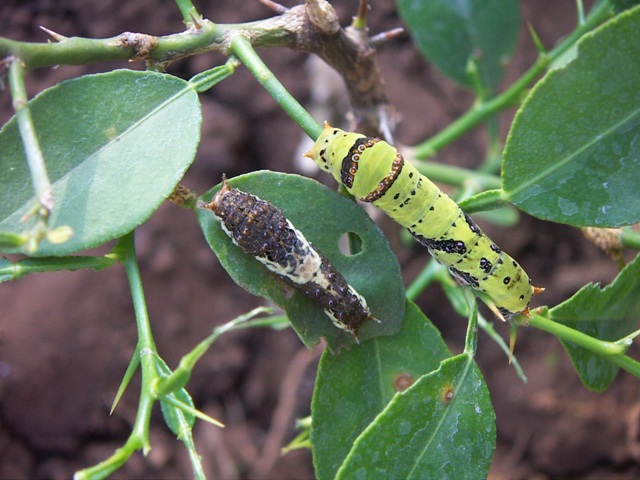

Characteristics and process
During an instar the organism feeds, grows and accumulates resources. Growth is limited by the rigid exoskeleton, so moulting (ecdysis) is necessary for further enlargement. Each moult produces a new instar with slightly different proportions, external features or internal development. The cuticle is shed and replaced by a larger one; this process is repeated until the final larval or nymphal instar, which in many species is followed by pupation or the final moult into the adult.
Variability and physiological control
The number of instars differs among species and sometimes among individuals of the same species. Environmental factors such as temperature, food quality, crowding and day length can influence growth rate and the number of instars. Endocrine signals regulate the transitions: pulses of moulting hormones (ecdysteroids) drive ecdysis, while juvenile hormone levels modulate whether a moult produces another juvenile instar or a metamorphic moult toward the adult or the pupa.
Examples and life-cycle context
In many familiar species the instar sequence is straightforward to observe. For example, the common housefly passes through several larval instars before entering the pupa stage; after pupation the adult or imago emerges. In holometabolous insects most feeding and growth occur during the larval instars, whereas in hemimetabolous insects nymphal instars increasingly resemble the adult form as they proceed. Adults typically have the primary role of dispersal and reproduction.
Identification and measurement
Entomologists and field biologists identify instars by consistent morphological markers. Common methods include counting moults, measuring head capsule width or other sclerotized structures that do not change until the next moult, and observing the presence or absence of wing pads in nymphs. Accurate staging is important for developmental studies, pest management and ecological surveys.
Practical importance
Recognizing instars has direct applications in agriculture, public health and forensic science. In pest control, the susceptibility of an insect to a treatment may depend on its instar; younger larvae can be more vulnerable to some insecticides or biological controls, while later instars may be more mobile or harder to kill. In forensic entomology, the developmental stage of blowfly larvae can be used to estimate minimum post-mortem intervals, because instar timing under given temperatures is reasonably well documented for many species.
Summary and notable distinctions
- An instar is the interval between two successive moults.
- The concept applies to both larvae and nymphs; the final instar may lead to pupation or to the adult form.
- Instar number is species-specific but may vary with environmental conditions and nutrition.
- Understanding instars aids identification, applied control measures and developmental research.
For basic definitions and further reading, see entries on insects, larvae and moulting of the exoskeleton. Examples such as the housefly illustrate how larval instars precede the pupal phase and the emergence of the adult imago, whose primary role is often to reproduce.
Related articles
Author
AlegsaOnline.com Instar — stage in an insect's post-embryonic development Leandro Alegsa
URL: https://en.alegsaonline.com/art/47468