
iBook: Apple's consumer and education laptops (1999–2006)
The iBook was Apple’s consumer and education laptop family sold from 1999 to 2006. Affordable, user‑friendly notebooks that helped popularize integrated Wi‑Fi and approachable industrial design before the MacBook era.
Overview
The iBook was a line of laptop computers marketed by Apple for consumers, students and schools between 1999 and 2006. Positioned below the professional PowerBook, the iBook focused on ease of use, durability, and lower cost rather than the highest performance or expandability. It played a key role in broadening Apple’s market during a period of renewed company growth.
Image gallery
6 Images



Design and hardware
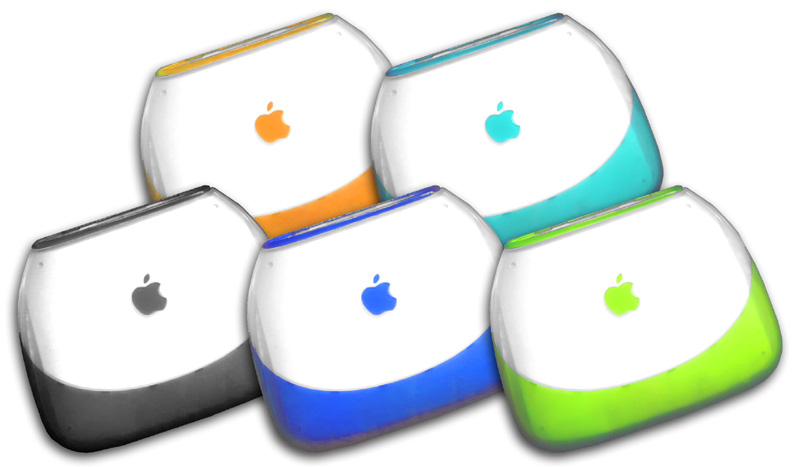
Early iBook models were immediately recognisable for their colorful, rounded "clamshell" cases and handle-like shapes intended to suit classrooms and mobile users. Later generations adopted a more conventional white polycarbonate notebook enclosure with cleaner lines. Internally the iBook used Apple’s PowerPC processors and components shared with the PowerBook family, but with compromises in expandability and high-end options to keep prices accessible.
Connectivity and wireless
One of the iBook’s most influential contributions was popularising easy-to-use wireless networking for mainstream users. Apple made its AirPort wireless system available for iBook models, turning wireless LAN access from a specialist kit into a consumer feature. This emphasis on integrated networking anticipated the increasing centrality of Wi‑Fi in mobile computing.
Models and evolution
The iBook line evolved through several generations that refined the industrial design, display and internal architecture. Early clamshell models gave way to more conventional designs with typical consumer features: integrated displays, optical drives, and consumer-oriented port layouts. Over time the series saw incremental improvements in processing power, battery life and screen quality while remaining an entry-level offering.
Software and intended use
iBooks shipped with Apple’s consumer-oriented Mac OS and bundled applications aimed at education and home use. Typical tasks for iBook owners included web browsing, email, word processing, media playback and basic creative projects. The combination of rugged styling, straightforward configuration and Apple's bundled software made the machines especially suited to schools.
Reception and impact
Reviewers and educators praised the iBook for its design, build quality and the way it made wireless networking approachable. Because it traded some expansion and raw performance for simplicity and price, the iBook helped Apple reach customers who previously considered the company’s products too costly or specialized.
Transition and legacy
When Apple moved its Macintosh line from PowerPC processors to Intel in 2006, the company consolidated and updated its portable lineup. The iBook was discontinued and its consumer role was taken on by the Intel-based MacBook. Elements of the iBook’s philosophy—focus on approachable design, integrated connectivity and suitability for education—continued to influence Apple’s consumer notebooks.
Notable features
- Consumer-first design: simple controls, durable enclosures and approachable styling.
- Wireless accessibility: early adoption of Apple’s AirPort options brought 802.11 networking into mainstream laptop use.
- Education focus: robust construction and straightforward management made the iBook popular in schools.
- Entry-level positioning: fewer expansion options and a lower price point than contemporary PowerBook models.
Although discontinued, the iBook remains notable as a product that helped make modern portable computing and wireless networking more accessible to everyday users and educational institutions, and for shaping Apple’s subsequent approach to consumer laptops.
Related articles
Author
AlegsaOnline.com iBook: Apple's consumer and education laptops (1999–2006) Leandro Alegsa
URL: https://en.alegsaonline.com/art/46381