
Horologium (constellation) — the Clock of the Southern Sky
Horologium is a small southern constellation introduced in the 18th century. Named after a clock, it contains faint stars and notable variables and lies among other southern constellations near the Milky Way.
Horologium is a minor constellation in the southern celestial hemisphere, whose name means "the clock" in Latin. It was created during the 18th century among a group of southern constellations introduced by the French astronomer Nicolas-Louis de Lacaille. Unlike the classical Greco-Roman constellations, Horologium commemorates a scientific instrument rather than a mythological figure, reflecting the period's interest in precision and mechanics.
Image gallery
6 Images



Characteristics and position
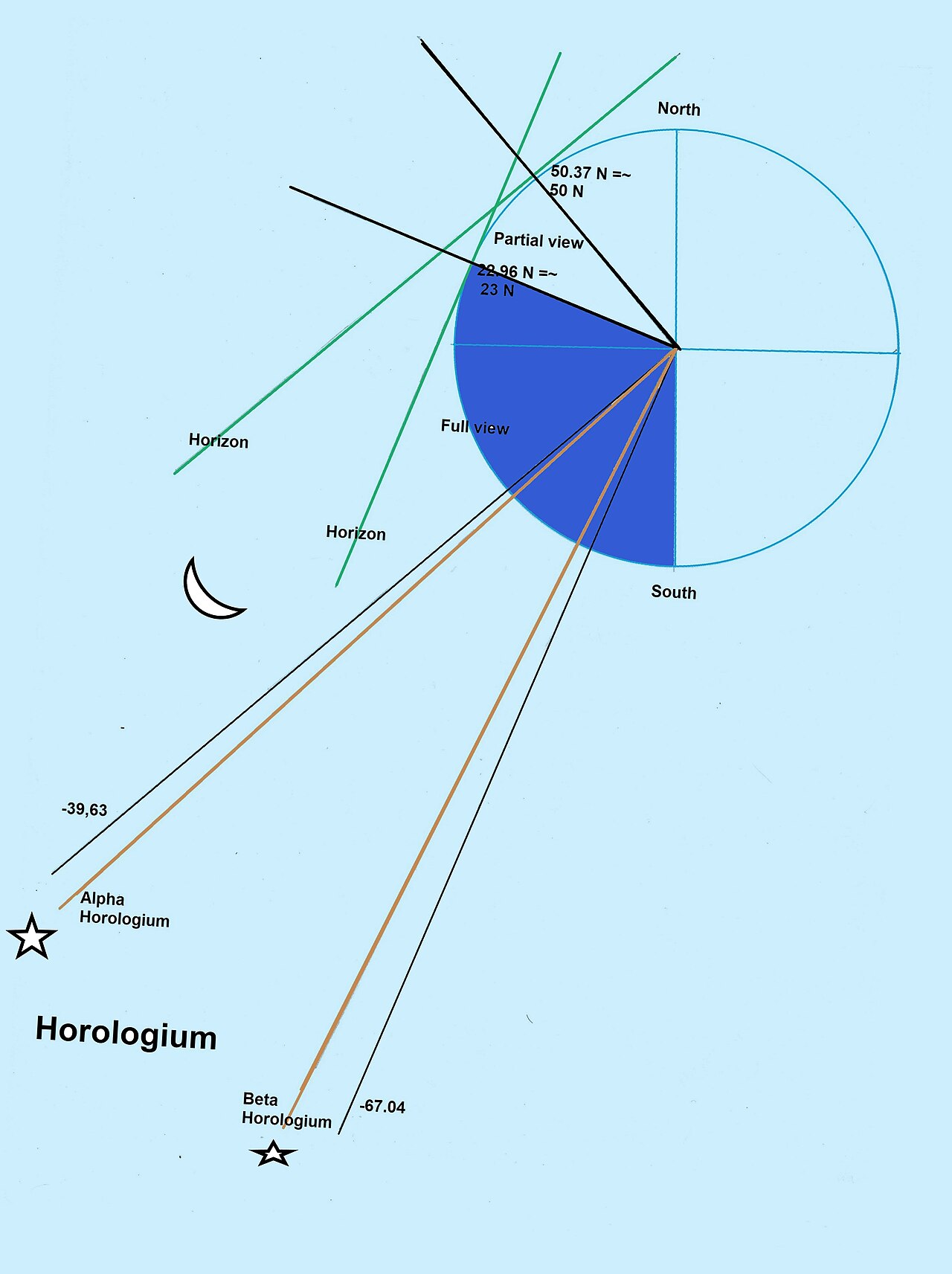
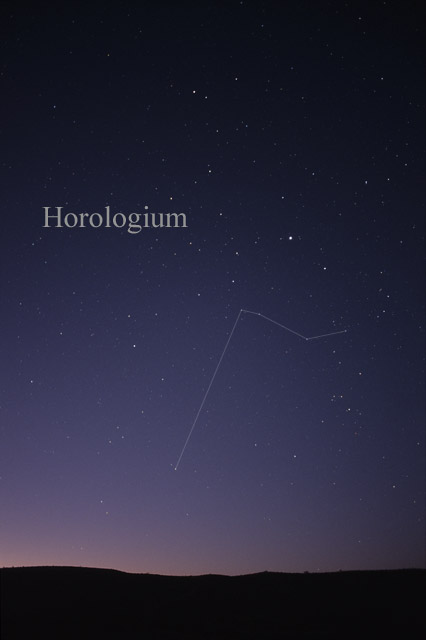
Horologium is faint and covers a modest area of sky; it contains only a few stars visible to the unaided eye from mid- to southern latitudes. Its brightest members are of moderate brightness rather than obvious first-magnitude stars, so the constellation is most easily appreciated with clear, dark skies. It lies among other southern constellations and can be located using nearby, better-known patterns as reference points.
Notable objects
- Alpha Horologii — the constellation's brightest star, a solitary point used as a positional reference.
- R Horologii — a well-known long-period variable of the Mira type, famous for dramatic changes in brightness over its cycle.
- Several faint galaxies and galaxy clusters — the region contains extragalactic objects and belongs to areas of interest for deep-sky surveys, including large-scale structures associated with neighboring constellations.
Amateur astronomers sometimes seek out Horologium to observe its variable stars and faint galaxies. Telescopes and long-exposure photography reveal many objects that are invisible to the naked eye.
History and name
Nicolas-Louis de Lacaille defined Horologium in the mid-1700s when mapping the southern skies from the Cape of Good Hope. He gave it the fuller title often rendered from Latin as Horologium Oscillatorium, an homage to the pendulum-clock work of Christiaan Huygens and the era's advances in timekeeping. The constellation was later adopted into the modern list of 88 constellations recognized by the International Astronomical Union.
For basic star charts and observing guides see additional resources. Horologium remains an example of how modern scientific instruments inspired celestial naming and how the southern sky was catalogued during the age of scientific exploration.
Related articles
Author
AlegsaOnline.com Horologium (constellation) — the Clock of the Southern Sky Leandro Alegsa
URL: https://en.alegsaonline.com/art/45145