
Homestead Acts — U.S. federal land laws that promoted settlement and farming
A summary of the Homestead Acts: a series of U.S. federal laws (mid‑19th to early‑20th century) that granted parcels of public land to applicants who settled and improved them, and their social and geographic effects.
Overview
The Homestead Acts were a collection of federal laws enacted in the United States from the mid‑19th century into the early 20th century, most famously the Homestead Act of 1862. Their purpose was to transfer public domain land into private hands by granting parcels—commonly 160 acres—to individuals who agreed to live on, cultivate, and improve the property. Promoted as a way to encourage westward expansion, agricultural development, and family farming, these laws shaped settlement patterns across large portions of the American West.
Image gallery
4 Images


Key characteristics and requirements
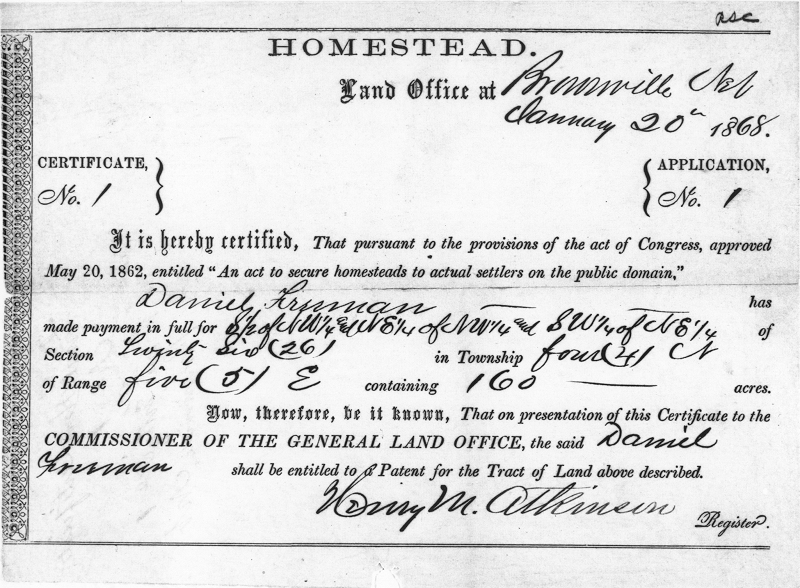
Although details varied between statutes and over time, the core requirements were consistent: applicants filed a claim, made improvements and cultivated the land, and demonstrated residence for a set period (typically five years) before receiving a land patent. Alternative so‑called "prove up" procedures allowed claimants to purchase the tract after a shorter period in some cases. Parcels were most often about 160 acres, an amount considered sufficient at the time for a family farm in many regions.
- Application and filing of claim with local land office
- Continuous residence and cultivation (commonly five years)
- Physical improvements such as dwelling, fencing, or cultivated crops
- Final proof and issuance of a patent (title) after requirements met
History and development
The homestead laws grew from earlier federal land policies and reached their signature form during the Civil War era. The 1862 act is the best known, but related statutes and amendments were enacted before and after, shaping the policy from roughly the 1850s into the early 1900s. While the legal framework remained on the books for many decades, homesteading activity declined substantially after the 1930s, and federal homestead programs were formally ended by mid‑20th century reforms, with the practice effectively concluded by the 1970s.
Social effects and eligibility
One notable aspect of the homestead laws was their formal openness: women, immigrants who declared intent to become citizens, and formerly enslaved people were eligible to file claims. In practice, however, local conditions, racial discrimination, and economic barriers limited equal access. The statutes explicitly excluded certain categories, such as those who had taken up arms against the United States, but overall the laws did open opportunities to a broader range of settlers than many earlier land grants had.
Impacts, examples, and legacy
Homesteading played a large role in populating and developing the Great Plains, the Midwest, and other western lands. Settlements established under homestead laws contributed to agricultural expansion, the spread of towns, and the integration of railway and market networks. At the same time, the policy had complex environmental and social consequences: some land parcels proved marginal for dryland farming, leading to hardship for smallholders and contributing to later ecological problems in fragile areas. Overall, homestead claims accounted for a significant share of private land ownership in the United States—estimated to have encompassed roughly ten percent of the nation’s territory.
Notable facts and distinctions
The Homestead Acts are often remembered both for their role in encouraging frontier settlement and for their mixed record on inclusion and stewardship. They remain a landmark example of a government effort to convert public domain land into small-scale private holdings. For further institutional and historical context, see general references about the United States public land system.
Summary: The Homestead Acts combined a legally straightforward set of rules—file a claim, live on and improve the land, then obtain a patent—with profound long‑term effects on American demography, agriculture, and landscape.
Related articles
Author
AlegsaOnline.com Homestead Acts — U.S. federal land laws that promoted settlement and farming Leandro Alegsa
URL: https://en.alegsaonline.com/art/44911