
House of Alpin (Alpínid dynasty)
Medieval royal family traditionally linked to Kenneth MacAlpin that supplied the kings of the Picts and early Scots from the mid‑9th to the early‑11th century; its origins and continuity are debated.
Overview
The House of Alpin, often called the Alpínids or in Gaelic Clann Chinaeda (the children of Kenneth), is the name applied to a line of rulers traditionally credited with leading the Pictish and early Scottish kingdom from the mid‑9th century into the early 11th century. The dynasty is associated with Kenneth mac Alpin, who is portrayed in medieval sources as the figure who united—or at least brought under single leadership—the various Pictish kingdoms and the Gaelic kingdom of Dál Riata. The precise boundaries of the house, its duration and the nature of its claims are matters of scholarly caution and debate.
Image gallery
2 Images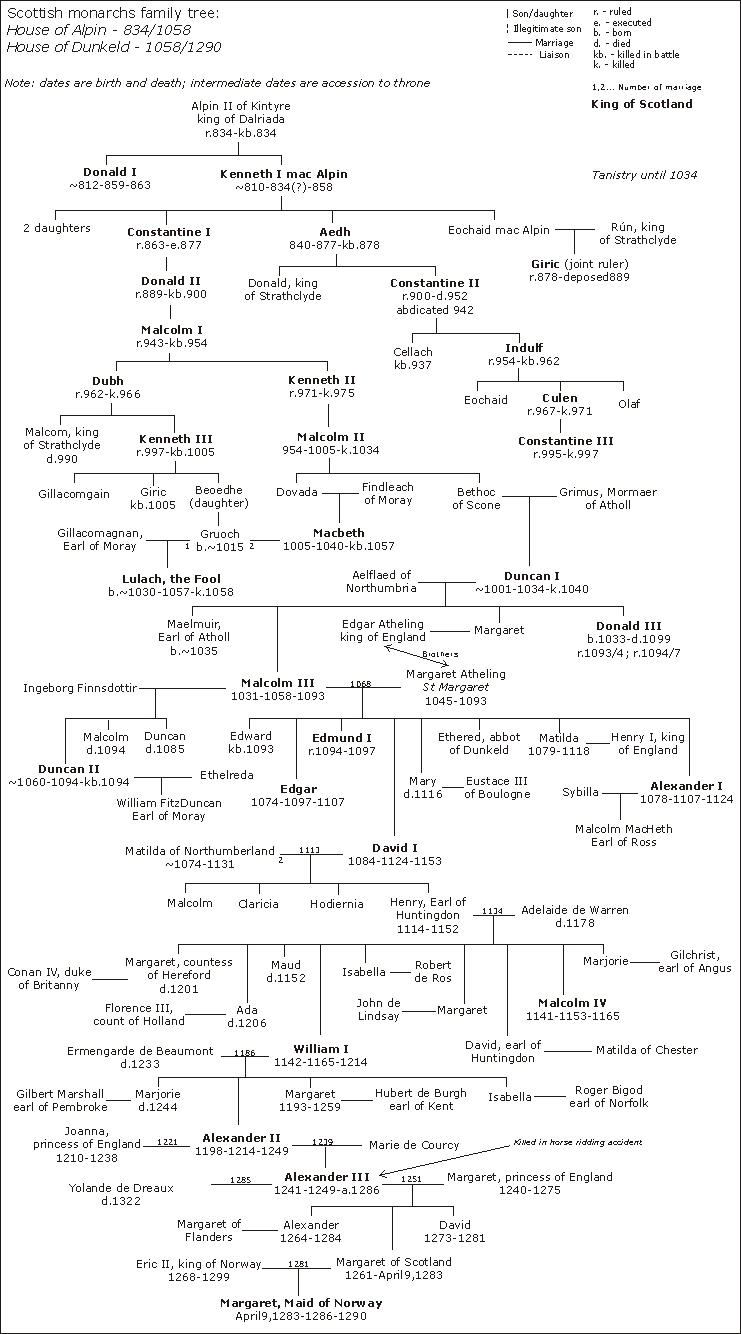
Origins and name
The dynasty’s name derives from Ailpín (Alpin) and from Kenneth (Cináed), the most famous early member. Medieval genealogies and chronicles present the Alpínids as a hereditary family, but modern historians note that these pedigrees were compiled centuries later and may combine fact, family tradition and political construction. Kenneth mac Alpin is conventionally placed in the mid‑9th century; he is remembered as a ruler who advanced Gaelic influence among Pictish elites, though the process of political integration was complex and gradual rather than a single decisive event.
Rulers and succession
Successive kings associated with the House of Alpin include a number of well‑known names from later Scottish tradition. These rulers navigated a landscape of competing kin groups, Viking activity, and shifting alliances with Anglo‑Saxon and Norse powers. Succession in this period did not follow strict primogeniture; instead, systems such as tanistry and claims through maternal lines could determine the next king. The last broadly accepted member of the dynasty is often regarded as Malcolm II, who died in 1034; some sources extend the line to the briefly reigning Lulach (d. 1058), but that extension is contested.
Historical impact
The Alpínids are important for their role in the emergence of the medieval Kingdom of Alba, a political identity that evolved into what later became the kingdom of Scotland. Under these rulers Gaelic language and culture exerted stronger influence across territories formerly described as Pictish, while the monarchy adapted to pressures from Viking settlers and the neighboring Anglo‑Saxon and Norse realms. The dynasty’s reign helped lay institutional and territorial foundations that later Scottish houses would inherit and transform.
Historiography and legacy
Understanding the House of Alpin involves reading later medieval chroniclers alongside archaeological and linguistic evidence. Scholars emphasize caution: royal genealogies were often retrofitted to legitimize later dynasties, and the notion of a neat, unbroken paternal house oversimplifies a fluid early medieval political order. Nevertheless, the Alpínid label remains a useful way to refer to the formative group of rulers associated with Kenneth mac Alpin and the transitional era that produced the Kingdom of Alba and the dynastic patterns of later Scotland.
- Also called: Alpínid dynasty, Clann Chínaeda.
- Core period: mid‑9th to early‑11th centuries (traditionally).
- Significance: consolidation of Pictish and Gaelic polities into the basis of medieval Scotland.
Questions and answers
Q: What is the House of Alpin?
A: The House of Alpin refers to the dynasty of Scottish kings who held the title of "King of the Picts" from the reign of Kenneth MacAlpin I in 843/848 until the death of Malcolm II in 1034.
Q: What were the other names given to the House of Alpin?
A: The House of Alpin was also known as the Alpínid dynasty, Clann Chináeda, and Clann Chinaeda meic Ailpín.
Q: How long did the House of Alpin last?
A: The House of Alpin lasted from the reign of Kenneth MacAlpin I in 843/848 until the death of Malcolm II in 1034, although some sources claim that it lasted until the death of Lulach in 1058.
Q: Who was the first king belonging to the House of Alpin?
A: The first king belonging to the House of Alpin was Kenneth MacAlpin I, who reigned from 843/848.
Q: What was the House of Alpin's main title?
A: The House of Alpin's main title was "King of the Picts."
Q: How many kings belonged to the House of Alpin?
A: Several kings, including Kenneth MacAlpin I and Malcolm II, belonged to the House of Alpin.
Q: What happened to the House of Alpin after the death of Malcolm II?
A: After the death of Malcolm II, the House of Alpin came to an end as a ruling dynasty.
Related articles
Author
AlegsaOnline.com House of Alpin (Alpínid dynasty) Leandro Alegsa
URL: https://en.alegsaonline.com/art/45297