
Hercle: the Etruscan hero-god
Hercle is the Etruscan counterpart of the Greek Herakles, a hero and divine figure popular in Etruscan art. He appears often on mirrors and tombs with attributes of the lion skin and club.
Overview
Hercle (also spelled Heracle or Hercl) is a prominent figure in Etruscan religion and myth, understood as a heroic god rather than merely a mortal hero. He functions as an analogue to the Greek hero Herakles but occupies a distinct place in Etruscan stories and iconography. Classical sources and archaeological finds identify him as a son of the chief Etruscan deity Tinia and the goddess Uni, emphasizing his semi-divine status within the native pantheon.
Image gallery
4 Images


Appearance and attributes
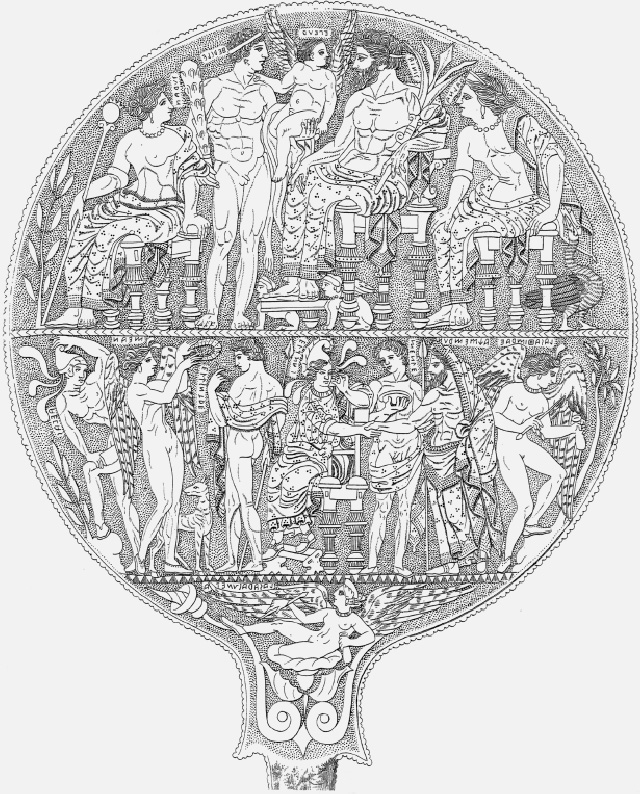
In surviving Etruscan art Hercle is usually shown as a strongly built male wearing a lionskin and carrying a heavy club, visual markers inherited from Greek tradition. Artists sometimes give him local touches—variations in dress, posture, or accompanying figures—that set Etruscan depictions apart from their Mediterranean neighbors. These attributes mark him clearly as a powerful protector and warrior-type figure.
Myths and distinctive traditions
Although Hercle is comparable to Greek Herakles in many respects, the episodes associated with him in Etruscan imagery are not a straightforward copy of the Greek Labors. Etruscan mirrors, engraved bronze work, and tomb paintings present a repertoire of adventures and encounters that appear to reflect regional storytelling traditions. Where Greek narratives often stress the hero’s enmity with Hera, Etruscan representations place him within the local divine family and ritual landscape in different ways.
Artistic and archaeological evidence
Hercle is one of the most frequently depicted figures in Etruscan portable art, especially on bronze mirrors and engraved objects recovered from tombs. These items provide the primary evidence for his iconography and the scenes in which he appears. The mirror scenes often combine mythic episodes with funerary or apotropaic meanings, suggesting that images of Hercle served protective or legitimizing roles for the deceased.
Cult, functions, and legacy
Evidence for formal cultic practices devoted to Hercle is limited compared with major Etruscan deities, but his depiction alongside gods and his presence in funerary contexts indicate a role as guardian, intermediary, or exemplar of heroic virtue. In the later Roman world, elements of Hercle and Herakles overlapped further through cultural exchange and syncretism, contributing to the broader Mediterranean tradition of the lion-skinned hero.
Notable distinctions
- Parentage in Etruscan tradition links Hercle with the native sky-god and mother-goddess rather than with the exact Greek genealogy.
- Iconography borrows Greek motifs but arranges them in scenes and pairings unique to Etruscan art.
- Most surviving information derives from material culture rather than extensive literary records, so interpretations rely heavily on archaeological context.
For introductions to Etruscan religion and the material culture that preserves figures like Hercle, consult collections of Etruscan mirror imagery and studies of Italic iconography. Further reading can help clarify how local beliefs and Mediterranean influences shaped this distinctive hero-god.
Related articles
Author
AlegsaOnline.com Hercle: the Etruscan hero-god Leandro Alegsa
URL: https://en.alegsaonline.com/art/43715