
Heinsberg (district) — North Rhine-Westphalia, Germany
Heinsberg is a district in western North Rhine-Westphalia, Germany, on the Lower Rhine near the Dutch border. It comprises small towns and rural areas, with cross-border ties, agriculture and light industry.
North Rhine-Westphalia and Germany locate the Kreis (district) of Heinsberg in the far west of the country, occupying a section of the Lower Rhine plain adjacent to the Dutch frontier. The administrative seat is the town of Heinsberg. The district's landscape is largely low-lying, with agricultural fields, meadows and a network of small rivers and drainage channels typical of the Rhine lowlands.
Image gallery
1 Image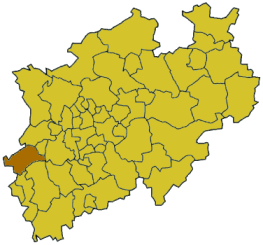
Geography and subdivisions
Heinsberg borders the Netherlands to the west and contains a mixture of small towns and rural communities. One municipality, Selfkant, includes the westernmost point of Germany. Major population centres include Heinsberg (the district seat), Geilenkirchen, Hückelhoven and Wassenberg. The district's setting on the Lower Rhine shapes local land use, flood management and nature conservation.
History and administration
The area has long been part of the historic Rhineland cultural region and was influenced by medieval territorial entities and later Prussian administration. Today's district boundaries and municipal structure were formed through 20th-century administrative reforms. Local government is exercised by an elected district council and a district administrator within the administrative region (Regierungsbezirk) of Cologne.
Economy and transport
Heinsberg's economy is characterised by small and medium-sized enterprises, light industry, logistics and agriculture. Its proximity to the Netherlands promotes cross-border commuting and trade, and the district participates in regional cooperation with Dutch partners. Transport links are principally regional roads and rail services that connect towns to nearby urban centres and larger transport corridors in the Rhine-Ruhr area.
Culture, nature and notable facts
Culturally the district shares Rhineland traditions such as Carnival and local dialects. Nature reserves, river corridors and agricultural landscapes support biodiversity typical of the Lower Rhine. Heinsberg attracted attention in early 2020 as one of the first areas in Germany with a concentrated COVID-19 outbreak, which led to significant local and scientific public-health activity. The combination of border geography, rural character and small towns defines the district's regional role.
Related articles
Author
AlegsaOnline.com Heinsberg (district) — North Rhine-Westphalia, Germany Leandro Alegsa
URL: https://en.alegsaonline.com/art/43283