
Halomonadaceae: salt‑tolerant bacteria of marine and saline environments
Halomonadaceae is a family of mostly halophilic, Gram‑negative bacteria in the Gammaproteobacteria. They occur in saline habitats and have ecological, biotechnological, and bioremediation importance.
Overview
The Halomonadaceae are a family of primarily halophilic bacteria usually placed within the class Gammaproteobacteria. Members are Gram‑negative rods that commonly tolerate or require elevated salt concentrations and are an important component of marine, estuarine and other saline microbial communities. For broader context on their bacterial classification see Proteobacteria.
Image gallery
2 Images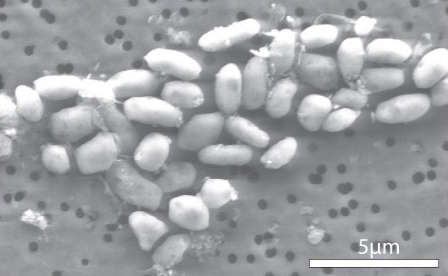

Characteristics
Typical traits shared across many genera in the family include motility (often by polar flagella), a facultatively aerobic metabolism, and biochemical adaptations for osmotic stress. Many species synthesize or accumulate compatible solutes such as ectoine and other osmoprotectants, and several produce exopolysaccharides. Physiological diversity is common: some strains are obligate halophiles, others are more moderately halotolerant, and metabolic capabilities range from heterotrophy to nitrate reduction under low‑oxygen conditions.
Ecology and habitats
Halomonadaceae are widespread in saline environments: coastal seawater, salt marshes, hypersaline lakes, saline soils, and solar salterns. They often participate in nutrient cycling in these ecosystems and can form part of microbial mats and biofilms. Their salt‑adapted enzymes and surface polymers help them persist where freshwater bacteria cannot.
Uses and importance
- Biotechnology: some species are used for industrial production of osmolytes (e.g., ectoine) and salt‑stable enzymes useful in high‑salt processes.
- Bioremediation: several strains can tolerate pollutants and contribute to degradation of hydrocarbons or other organic contaminants in saline sites.
- Scientific research: they serve as models for studying salt adaptation and microbial ecology in extreme environments.
Taxonomy and history
The family was first proposed in the late 1980s to group genera such as Halomonas and Deleya. Since then, molecular methods—particularly 16S rRNA gene analysis—have led to the description of multiple additional genera and refined relationships within the group. Taxonomic revisions continue as new isolates are characterized and genome data accumulate.
Notable distinctions
Although Halomonadaceae are halophiles, they are bacteria and should not be confused with halophilic archaea (often called haloarchaea), which belong to a different domain of life and use distinct molecular strategies for salt tolerance. Within bacteria, Halomonadaceae are distinct from other halophilic lineages by their genetic markers, physiology, and placement within the Gammaproteobacteria.
Related articles
Author
AlegsaOnline.com Halomonadaceae: salt‑tolerant bacteria of marine and saline environments Leandro Alegsa
URL: https://en.alegsaonline.com/art/41976
Sources
- uniprot.org : "Salicola"
- bacterio.net : "List of genera included in families: Halomonadaceae"
- bbc.co.uk : "Arsenic-loving bacteria may help in hunt for alien life"
- nature.com : "Study challenges existence of arsenic-based life"
- doi.org : 10.1038/nature.2012.9861
- retractionwatch.com : "Despite refutation, Science arsenic life paper deserves retraction, scientist argues"