
Helmholtz resonance
Helmholtz resonance is the characteristic low-frequency vibration of air in a cavity with an opening, important in acoustics, instruments, and noise control.
Overview
Helmholtz resonance describes the tendency of air trapped in a cavity to vibrate at a particular frequency when it is coupled to the outside through an opening. This phenomenon is a form of air resonance and is familiar from simple everyday examples such as blowing across the mouth of a bottle or the sound produced by some whistles. The effect produces a single dominant pitch that depends on the cavity volume, the area of the opening, and the geometry of the neck.
Image gallery
5 Images


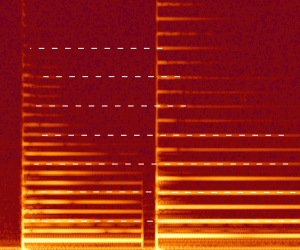

Physical model and formula
Physically, the resonator behaves like a mass–spring system: the plug of air in the neck acts as the mass while the compressibility of the air in the cavity provides the spring. For a basic neck-and-bottle geometry the approximate resonant frequency f can be written as f = (c / 2π)·sqrt(A / (V·L_eff)), where c is the speed of sound, A the cross-sectional area of the neck, V the cavity volume, and L_eff an effective neck length that includes an end correction. This simple expression captures why larger cavities give lower pitches and why narrowing the opening lowers the frequency.
Geometry, parts and practical considerations
A Helmholtz resonator typically has a cavity, a neck (or aperture), and the surrounding walls. The exact pitch is influenced by losses (viscous and thermal) and by how the opening interacts with the outside sound field. The effective length L_eff is often slightly longer than the physical neck because the air at each open end moves with the oscillation; designers account for this end correction when predicting frequencies.
History and terminology
The effect is named after Hermann von Helmholtz, who in the mid-19th century developed a tuned resonator to isolate and study the frequencies present in complex sounds. His work helped identify musical pitches and advanced the scientific study of Helmholtz-style resonators. The same basic mechanism underlies many simple acoustic toys and devices, and the term is now used more broadly in acoustics and engineering.
Uses and examples
Helmholtz resonance appears in musical instruments (some ocarinas and bottle whistles), vehicle cabins (where it can create a noticeable boom at a particular engine speed), architectural acoustics, and intentional noise control devices. Practical examples include blowing across a bottle, the tone of certain whistling toys, and tuned mufflers and cavities used to attenuate unwanted tonal noise.
Distinctions and notable facts
- Unlike standing-wave modes in pipes or rooms, which involve distributed wave patterns, a Helmholtz resonator exhibits a single global mode dominated by the motion of the neck plug of air.
- Resonator arrays and coupled cavities can broaden or shift responses; engineers exploit this in music technology and noise control.
- Because it produces a strong, narrow-band response, the Helmholtz mechanism is useful both as a diagnostic tool in acoustics and as a component in devices that shape or reduce sound.
For introductory demonstrations, try varying the water level in a bottle to see the pitch change; for engineering use, numerical models and measurements account for end corrections and damping to predict real-world behavior.
Questions and answers
Q: What is Helmholtz resonance?
A: Helmholtz resonance is air resonance in a cavity.
Q: What are some examples of Helmholtz resonance?
A: Blowing across the top of an empty bottle and whistling are examples of Helmholtz resonance.
Q: Who created the Helmholtz resonator in the 1850s?
A: Hermann von Helmholtz created the Helmholtz resonator in the 1850s.
Q: What was Helmholtz resonator used for?
A: Helmholtz resonator was used to find the various frequencies or musical pitches in music and other complex sounds.
Q: What is wind throb?
A: Wind throb is another name for Helmholtz resonance.
Q: What happens when air resonance occurs in a cavity?
A: When air resonance occurs in a cavity, there is a Helmholtz resonance or wind throb.
Q: Why is it called Helmholtz resonance?
A: It is called Helmholtz resonance because it was named after Hermann von Helmholtz, who created the Helmholtz resonator.
Related articles
Author
AlegsaOnline.com Helmholtz resonance Leandro Alegsa
URL: https://en.alegsaonline.com/art/43414