
Hairspray (1988 film)
1988 John Waters musical comedy about Tracy Turnblad, a teenager in 1962 Baltimore who pursues a spot on TV and confronts racial segregation; later adapted into a Broadway show and a 2007 film musical.
Overview
Hairspray is a 1988 American musical comedy with strong teen-movie elements, written and directed by John Waters. Set in 1962 Baltimore, Maryland, it follows Tracy Turnblad, a plucky teenager who dreams of dancing on a local television program and uses her newfound visibility to challenge the era's racial segregation on and off the air. Waters combined upbeat 1960s pop rhythms and satirical humor to make a film that is both lighthearted and socially pointed.
Image gallery
1 Image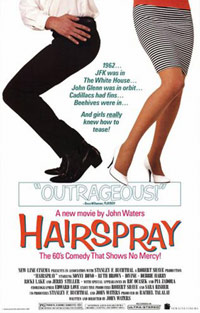
Plot and principal characters
The central narrative centers on Tracy Turnblad, a determined adolescent whose ambition drives the story. Her goal is to join the popular local dance program, and her efforts set off a chain of events that expose social divisions during the early 1960s. The film mixes eccentric side characters with comic antagonists and features the fictional TV program as a focal point for conflict and change.
- Tracy Turnblad — the aspiring dancer and protagonist
- Cast of supporting characters who populate Baltimore's neighborhoods
- The local television show that symbolizes the period's entertainment culture (television)
Production, style and influences
Waters, who had been known for underground and transgressive films, adopted a more mainstream tone in Hairspray while keeping a sharp satirical edge. Producers included Robert Shaye and Rachel Talalay alongside Waters. The film's look, music cues and fashion deliberately evoke early 1960s pop culture in Baltimore, Maryland, and blend nostalgia with pointed commentary.
Themes and cultural significance
Major themes include body image, social acceptance and civil rights. Tracy's popularity challenges beauty norms and her campaign against segregated programming confronts racial barriers, making the story about both personal ambition and collective justice. Critics and audiences have highlighted how Hairspray uses comedy and upbeat pacing to address serious issues without becoming didactic. The film is often cited as a turning point in Waters's career because it reached a wider audience while keeping his distinct voice.
Reception and adaptations
Although Hairspray was made on modest budgetary terms, it developed a lasting reputation and gained new life in later adaptations. In 2002 it was transformed into a successful Broadway musical, which expanded the songs and narrative. That stage production later served as the basis for a 2007 film musical revival. The story's focus on a young protagonist and on social change has kept the original film in cultural conversation; it is studied and enjoyed both as a period piece and as a work that uses entertainment to comment on exclusion and inclusion.
Notable facts and distinctions
Hairspray stands out for mixing upbeat entertainment with pointed social critique. The protagonist's name and her mission are frequently referenced in discussions of media representation and youth-led activism. The film's portrayal of race, television culture and teenage aspiration continue to make it a relevant subject for analysis and adaptation in theatre and popular media. For those researching related topics, see entries on Tracy Turnblad and the film's later musical iterations; for historical context, consult materials on early 1960s American pop culture and civil-rights challenges to segregated broadcasts (Tracy Turnblad, racial segregation).
Further background and production notes are available through retrospective interviews and film histories that document Waters's approach to balancing satire and accessibility in this title. For general reference and additional resources see related pages on film musical history and television's role in 1960s social life (musical, comedy, teen, John Waters, Broadway, Baltimore, Maryland, Tracy Turnblad, television, racial segregation).
Related articles
Author
AlegsaOnline.com Hairspray (1988 film) Leandro Alegsa
URL: https://en.alegsaonline.com/art/41808
Sources
- bbfc.co.uk : "HAIRSPRAY (PG)"