
Half Moon Street (1986 film)
1986 British–American erotic thriller directed by Bob Swain, starring Sigourney Weaver and Michael Caine. Adapted from Paul Theroux's novel Doctor Slaughter and distributed by 20th Century Fox.
Half Moon Street is a 1986 British–American erotic thriller directed by Bob Swain. The film stars Michael Caine and Sigourney Weaver, and was distributed by 20th Century Fox. It is an adaptation of Paul Theroux's 1984 novel Doctor Slaughter. The picture blends suspense, sexuality and political intrigue within an urban setting.
Image gallery
1 Image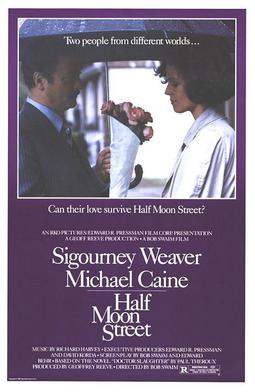
Synopsis and themes
The narrative centers on a professional woman who leads a double life, placing her at the intersection of desire, personal ambition and dangerous power. Rather than focus on explicit plot spoilers, the film is best understood as an exploration of class, gender and the compromises people make when private and public identities collide. Tension builds through personal relationships and the unseen forces of political influence.
Production and context
Adapted from Paul Theroux's novel, the screenplay and production emphasize atmosphere over spectacle. As a co-production between British and American companies, the film employs London locations and interiors to create a cosmopolitan backdrop. The mid-1980s setting contributes to its tone: a period when erotic thrillers frequently examined urban loneliness, shifting social mores and the moral ambiguities of the professional classes.
Reception and legacy
Upon release the film drew attention for its lead performances and its adult themes. Critics and audiences offered mixed responses: some praised the acting and the film's mood, while others found its pacing or narrative choices uneven. Over time it has remained of interest to viewers studying 1980s genre cinema, star vehicles of the era, and adaptations of contemporary novels.
Notable facts
- Based on the novel Doctor Slaughter (1984) by Paul Theroux.
- Distributed by 20th Century Fox and released in 1986.
- Features two prominent lead actors whose careers span decades: Michael Caine and Sigourney Weaver.
- The title evokes a London address and the city’s urban atmosphere plays a significant role in the film’s tone.
Today the film is referenced in discussions of 1980s thrillers and adaptations of contemporary fiction. It is of particular interest to those studying how mainstream cinema of the period handled erotic material alongside political and social commentary.
Related articles
Author
AlegsaOnline.com Half Moon Street (1986 film) Leandro Alegsa
URL: https://en.alegsaonline.com/art/41876