
Gravitropism: how organisms sense and grow in response to gravity
Gravitropism is the directed growth or movement of plants, fungi, and other organisms in response to gravity. It explains why roots grow down and shoots grow up and describes the cellular mechanisms behind that response.
Overview
Gravitropism (sometimes called geotropism) is the directed growth or turning of an organism in response to the pull of gravity. It is most familiar in plants, where roots typically exhibit positive gravitropism (growth toward gravity) and shoots show negative gravitropism (growth away from gravity). The phenomenon also appears in fungi and in a variety of other organisms that detect and respond to gravitational force.
Image gallery
6 Images




Mechanisms and cellular components
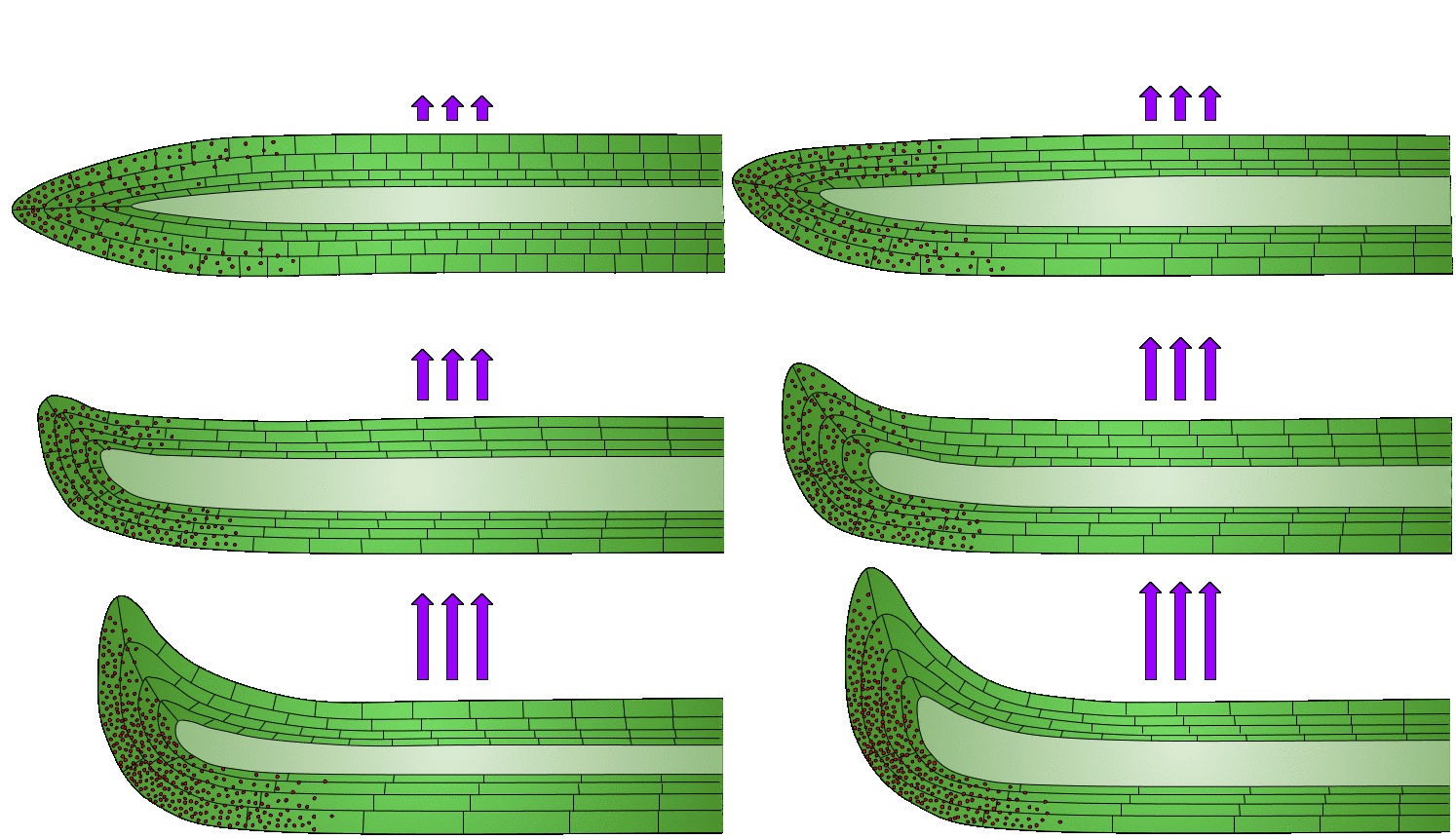
In vascular plants gravisensing is concentrated in specialized cells called statocytes. In root caps and in some shoot tissues dense, starch-filled organelles called amyloplasts (statoliths) settle under the influence of gravity, providing a positional cue. That physical repositioning is thought to trigger biochemical signaling, notably redistribution of the plant hormone auxin, which causes differential cell elongation on opposite sides of an organ. The Cholodny–Went hypothesis summarizes how an asymmetric auxin distribution can bend a root or shoot. Molecular players such as PIN auxin transporters and other signaling components help relocate auxin and translate the gravity signal into growth changes.
Forms, examples and distinctions
Roots (positive gravitropism) slow cell expansion on the lower side in many species, causing downward curvature; shoots (negative gravitropism) often accelerate growth on the lower side, causing upward bending. Gravitropism differs from phototropism (response to light) and thigmotropism (response to touch), but such tropisms can interact to determine overall plant form. Studies show that some fungi and single-celled organisms also orient with respect to gravity; see the role of gravity in fungi here and in other taxa here.
Historical and experimental context
Early work by Charles Darwin and later physiologists established that roots and shoots respond to gravity and that the root tip is important for sensing. Experimental approaches include clinostats (to average out the directional gravity vector), genetic mutants lacking normal starch-filled statoliths, and controlled studies in microgravity aboard spacecraft. These experiments have helped separate the sensing mechanism from downstream growth responses and revealed how gravity shapes plant development.
Importance and applications
Understanding gravitropism matters in agriculture, horticulture and space biology. Manipulating root angle or shoot orientation can improve water and nutrient capture and crop architecture. In microgravity environments, disrupted gravitropic cues alter root and shoot behavior, so researchers study how plants adapt to grow in space. For background on gravity as a physical stimulus see gravity.
Key points
- Gravitropism guides organ orientation: roots down, shoots up.
- Statocytes and amyloplast sedimentation provide a positional signal.
- Auxin redistribution drives asymmetric growth through transport proteins.
- Research spans classical experiments to spaceflight studies for practical applications.
Related articles
Author
AlegsaOnline.com Gravitropism: how organisms sense and grow in response to gravity Leandro Alegsa
URL: https://en.alegsaonline.com/art/40405