
Gram (mythology)
Gram is the legendary sword of the hero Sigurd in Norse myth: forged by Wayland, pulled from a hall-tree, broken and reforged, and used to slay the dragon Fafnir; it appears under other names in German tradition.
Overview
Gram is the name given in Old Norse sources to the sword belonging to the hero Sigurd (Siegfried). It figures prominently in the Völsung legends and related poems as an object of supernatural provenance and as an instrument of vengeance and heroic achievement. The weapon is associated with a number of well-known motifs: a sword that can be drawn only by the rightful owner, a sword broken and later reforged, and a sword used to slay a dragon.
Image gallery
4 Images

Origins and characteristics
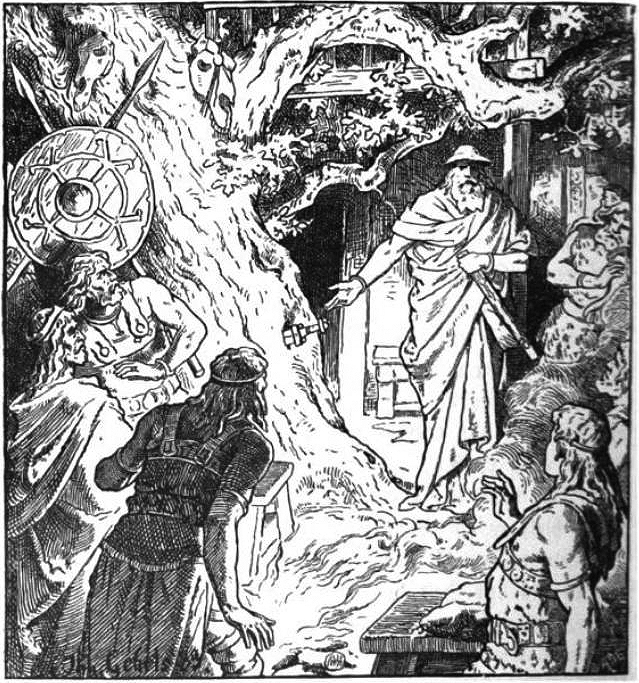
According to the saga tradition, Gram was of exceptional quality and strength. It is said to have been made by the master smith often identified as Wayland (Old Norse Völundr), and to have once belonged to Sigurd's father, Sigmund. The sword’s origin is tied to a dramatic scene in the Völsung hall where a blade, set into a tree or beam by a god, could be drawn only by one man—Sigmund—establishing the weapon as a mark of destiny. The sword later suffered damage and was reforged; after its restoration it displayed extraordinary power, reportedly cleaving an anvil in two as a demonstration of its edge.
Role in the Sigurd legend
Gram is central to the sequence in which Sigurd kills the dragon Fafnir and claims the dragon’s treasure. The sword is presented and re-presented at key moments: as an heirloom that marks rightful lineage, as an instrument reshaped to suit the hero’s need, and finally as the tool by which a monstrous foe is defeated. The saga cycle and the heroic poems preserve the sword as a narrative pivot around which themes of fate, kinship, and retribution circulate.
Names and parallels
The sword appears under different names and forms in continental Germanic tradition. In the Middle High German epic the Nibelungenlied the hero’s blade is called Balmung, while Richard Wagner, drawing on the same material, renamed it Nothung in his 19th-century operatic cycle. These variants show how a single mythic object can be adapted across languages and artistic media. Other culturally related motifs include the idea of a sword fixed in wood or stone and the theme of a weapon handed down through generations.
Sources and literary context
The most complete accounts of Gram’s story are found in Old Norse narrative and poetic sources, especially the Völsunga saga and parts of the Poetic Edda, which preserve the core episodes of lineage, the miraculous drawing of the blade, its breaking and reforging, and the dragon-slaying. Later retellings in medieval German literature and modern adaptations—operatic, literary, and artistic—have reinterpreted the sword while retaining its role as a symbol of heroism.
Notable facts and cultural significance
- The same name “Gram” can be confused with the modern unit of mass; see the distinction between the mythic object and the measurement of weight (gram (unit)).
- Gram’s tale ties into Norse mythic geography and characters; for background on the mythic setting see general treatments of Norse mythology.
- The sword itself is described simply as the hero’s sword and as the decisive weapon in the fight against Fafnir.
- Key episodes include the removal of the blade from a log or beam in the hall (the pulled sword) and the involvement of divine figures such as Odin in marking the chosen warrior.
- Comparative traditions include the German epic Nibelungenlied and Wagner’s operatic retelling by Richard Wagner, where the weapon appears as Nothung or Balmung.
Gram remains a concise example of how a mythic object carries narrative weight: it legitimizes lineage, focuses the hero’s destiny, and acts as the tangible expression of courage and skill. Its presence in multiple traditions attests to the enduring power of the sword-as-symbol in Germanic storytelling.
Related articles
Author
AlegsaOnline.com Gram (mythology) Leandro Alegsa
URL: https://en.alegsaonline.com/art/40110