
Golden Rooster Awards
Major film awards presented in mainland China since 1981 by the China Film Association. Jury-selected honors recognize artistic and technical achievement; they alternate with the popular-vote Hundred Flowers Awards.
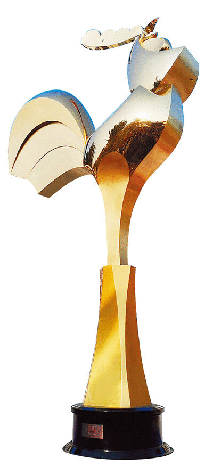
The Golden Rooster Awards are a principal set of film honors in mainland China, established in 1981 and presented by the China Film Association. The awards recognize outstanding achievements in filmmaking — including acting, directing, writing, and technical crafts — and are widely regarded within China as among the most prestigious industry distinctions. The prize takes its name from the Year of the Rooster in which the awards were founded; the awardees receive a statuette fashioned in the form of a golden rooster. For the awards' Chinese name and additional background see Chinese title and pronunciation and a general overview at awards overview.
Image gallery
2 Images
History and development
The Golden Rooster Awards were inaugurated to promote excellence and professionalism in Chinese-language cinema and to provide a formal, juried counterpart to popular-vote honors. In 1992 the Golden Rooster ceremonies were administratively joined with the Hundred Flowers Awards, a separate prize determined by audience ballots. Since that union the two programs have been presented in alternating years: the Golden Rooster in odd-numbered years and the Hundred Flowers in even-numbered years. The Golden Rooster’s focus on peer and expert evaluation contrasts with the Hundred Flowers’ popular mandate; together they are often referred to as a twin awards system. The awards concentrate on films released in mainland China and related Chinese-language productions (mainland China).
Structure and categories
The Golden Rooster Awards span artistic and technical categories intended to reflect the full range of film production. Typical awards include:
- Best Film (or Picture)
- Best Director
- Best Actor and Best Actress
- Supporting Actor/Actress and newcomer categories
- Best Screenplay, Cinematography, Editing, Art Direction, Music and Sound
- Lifetime Achievement and special merit recognitions
Selection process and eligibility
Winners of the Golden Rooster are chosen by a jury composed of film professionals, critics, scholars and industry experts. The selection process emphasizes artistic quality, technical mastery, and contribution to the development of Chinese cinema. Submissions are usually required to meet eligibility rules set by the organizing body and to have been publicly exhibited within a designated time frame. The jury-driven format and the composition of specialists give the Golden Rooster a reputation for rewarding craft and innovation rather than merely box-office success. For notes on the jury and selection framework see a description of the selection panel selection and jury.
Significance and impact
Receiving a Golden Rooster can raise a film’s profile domestically and, increasingly, internationally, helping with distribution, festival invitations, and funding for future projects. The awards also serve as a barometer of industry trends — for example, the growing production values, cross-regional collaborations, and the balance between commercial appeal and artistic ambition. Events around the ceremony often include screenings, industry forums and discussions that contribute to professional exchange and to the wider visibility of Chinese films. For context on the complementary popular awards see the Hundred Flowers Awards Hundred Flowers.
Over decades the Golden Rooster Awards have become an established institution in China’s cinematic life, reflecting the evolving aims of filmmakers, critics and audiences while continuing to highlight individual achievement and collective advances in the national film industry.
Related articles
Author
AlegsaOnline.com Golden Rooster Awards Leandro Alegsa
URL: https://en.alegsaonline.com/art/39511
Sources
- www1.chinaculture.org : "China Golden Rooster and Hundred Flowers Film Festival"