
Mainland China
Mainland China refers to the contiguous territory administered by the People’s Republic of China, commonly excluding Taiwan, Hong Kong, Macau and several outlying islets for administrative and legal purposes.
Overview
The expression Mainland China (often shortened to “the mainland”) is a commonly used geographical and political shorthand for the contiguous landmass administered by the People’s Republic of China (PRC). In everyday, legal and diplomatic contexts it is used to distinguish the PRC’s continental provinces, autonomous regions and centrally administered municipalities from other territories that have distinct administrative arrangements, such as Taiwan, Hong Kong and Macau. The phrase is descriptive rather than a single constitutional term, and its exact boundaries depend on context and the purpose of usage.
Image gallery
1 Image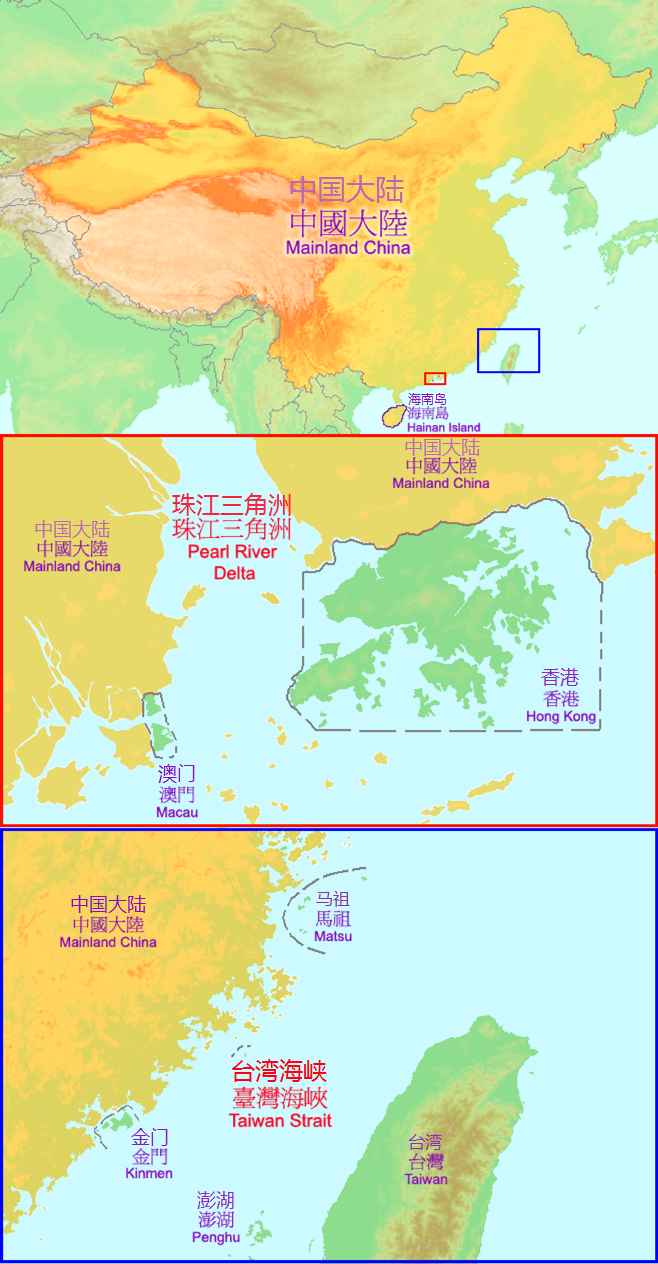
Definition and common usage
In common usage the term excludes the island of Taiwan and nearby islets that are governed by the Republic of China (ROC), such as Kinmen and Matsu. It also typically excludes the two special administrative regions of Hong Kong and Macau, which returned to PRC sovereignty in the late 20th century but continue to operate under separate legal and economic systems. The phrase can also be used in statistical, travel, trade and legal documents to indicate differences in customs, immigration, taxation and regulatory regimes between the mainland and these non-mainland territories.
Geography and administrative composition
Mainland China comprises multiple provinces, autonomous regions and directly administered municipalities that form the PRC’s primary territorial structure. It includes many islands that lie close to the continental coast; the largest of these administered by the PRC is Hainan. Larger nearby polities that are not counted as part of the mainland include the ROC-controlled islands and, historically, regions such as Mongolia, which were once linked to imperial administrations but later developed separate status.
Historical context
The modern mainland/non-mainland distinction arose during the 19th and 20th centuries as imperial, colonial and revolutionary changes transformed China’s territorial and political map. Under the Qing dynasty many of the territories now treated differently were administered within a single imperial framework. Subsequent foreign influence and colonization affected islands and coastal enclaves; for example, Taiwan experienced Japanese rule for a period and Hong Kong and Macau were under British and Portuguese administration respectively. After the end of imperial rule in 1911 and the upheavals of the mid-20th century, the Republic of China and the People’s Republic of China came to administer different territories, a development reflected in current usage of the term.
Political and legal distinctions
The PRC government (People’s Republic of China) views the mainland as its primary territorial base and treats Hong Kong and Macau as special administrative regions operating under a “one country, two systems” framework. This arrangement provides for separate legal systems, currency and immigration controls in those regions, which is why they are ordinarily excluded from references to the mainland. The ROC’s government and political identity (Nationalist and post-1949 developments) continue to shape how Taiwan and associated islands are referenced in cross-strait discussions. Mongolia later emerged as an independent state and is not part of the PRC’s administrative structure.
Economic, social and cultural notes
Mainland China is home to the majority of the PRC’s population and economic activity, including major manufacturing hubs, agricultural regions, financial centers and national infrastructure. Cultural and linguistic diversity is substantial, with numerous ethnic groups recognized within the PRC system. In comparative reporting and everyday discourse, observers often contrast mainland institutions, media and legal norms with those of Hong Kong, Macau and Taiwan to highlight differences in governance, rights, commerce and travel protocols.
Cross-strait and international implications
References to the mainland appear frequently in cross-strait relations, immigration rules, commercial contracts and international communications. Because the term implies jurisdictional and political boundaries that are viewed differently by various actors, its use can be sensitive or contested. Practically, travelers, businesses and officials rely on the mainland/non-mainland distinction to determine which laws, entry documents, trade measures and cultural expectations apply in any given interaction.
Further reading and related topics
- Administrative structure and law in the People’s Republic of China.
- Political history of Taiwan and cross-strait relations.
- The return and governance of Hong Kong and Macau under "one country, two systems".
- Historical ties with Mongolia and the transition to independence.
- Practical distinctions in travel, trade and residency between the continental mainland and adjacent territories.
- Notes on island administration and the role of Hainan in coastal geography.
Questions and answers
Q: What is Mainland China?
A: Mainland China is the part of China that does not include the Republic of China controlling Taiwan, Kinmen, Matsu, and the Pescadores. It also excludes Hong Kong and Macau.
Q: Was all of Mainland China part of the Manchu Empire?
A: Yes, in the Qing Dynasty (Manchu Dynasty), all of Mainland China, Hong Kong, Macau, Taiwan, Kinmen, Matsu, the Pescadores and Mongolia were part of the Manchu Empire.
Q: Who colonized Taiwan, Hong Kong and Macau?
A: Taiwan was colonized by Japaneses forces; Hong Kong was colonized by British forces; and Macau was colonized by Portuguese forces.
Q: When did Nationalist China take control over Taiwan?
A: Nationalist China (the Republic of China) took control over Taiwan in 1945.
Q: What region does Communist China include now?
A: Communist China includes only the part on mainland and some small islands near it (the largest communist island being Hainan).
Q: Are Hong Kong and Macau considered to be a part of Mainland China?
A: No. Even though they were returned to Chinese government later on they are still not thought as a part of Mainland china because they are called "special administrative regions" under a "one country two systems" idea.
Q: When did Mongolia become an independent state?
A: Mongolia became an independent state after Communist (the People's Republic of Chine) took over most parts of mainland china.
Related articles
Author
AlegsaOnline.com Mainland China Leandro Alegsa
URL: https://en.alegsaonline.com/art/60803