
Global cooling (climate hypothesis and context)
The idea, prominent in some 1960s–1970s media, that Earth’s surface temperatures would fall for decades. It was never a sustained scientific consensus; later evidence and models show long‑term warming driven by greenhouse gases.
Overview
Global cooling refers to the hypothesis that average global surface temperatures would decline significantly over a period of decades. Discussion of this possibility was most visible in the 1960s and 1970s, when a mix of observed short‑term downward trends in some temperature records, limited data coverage, and exploration of cooling mechanisms prompted speculation. That line of thinking did not become a sustained scientific consensus. Subsequent accumulation of observations, improved temperature records, and advances in climate understanding have established a long‑term warming trend driven primarily by increasing atmospheric greenhouse gases.
Image gallery
3 Images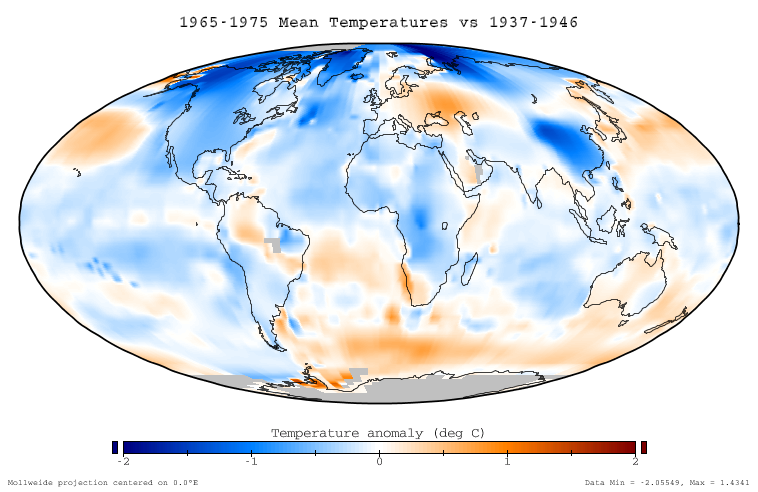


Causes and mechanisms often cited
Proposed drivers that could produce cooling on regional or global scales include both natural and human‑influenced factors. Important mechanisms discussed in the literature are:
- Aerosol forcing: Sulfate and other aerosols from fossil fuel burning and biomass burning reflect sunlight and can produce a transient cooling effect over years to decades.
- Volcanic eruptions: Large eruptions inject ash and sulfur compounds into the stratosphere and can reduce incoming solar radiation for several years.
- Solar variability: Small changes in total solar output or in solar activity modulate Earth’s energy balance on decadal to centennial timescales.
- Ocean variability: Internal climate variability, including multi‑decadal oscillations in ocean circulation, redistributes heat and can cause multi‑year regional coolings.
History and scientific debate
During the mid‑20th century some analyses detected modest cooling in certain datasets and regions, which prompted investigation of possible causes and future trends. A small number of studies and popular articles emphasized a potential longer‑term cooling, but the broader research community continued to examine multiple forcings and natural variability. As data improved and climate models advanced, the warming influence of greenhouse gases emerged as the dominant long‑term driver.
Evidence and resolution
Longer temperature records, better global coverage, and attribution studies have clarified that the mid‑century cooling was temporary and largely a result of competing forcings and internal variability. When aerosol effects, volcanic episodes and natural oscillations are accounted for, the underlying warming from increased greenhouse gases becomes evident. Modern assessments conclude that observed recent decades show a clear warming trend.
Importance and common misconceptions
The global cooling episode is often invoked in discussions of scientific uncertainty and media influence. A common misconception is that scientists broadly predicted an imminent ice age; the historical record shows more nuance, with only limited scientific support for a persistent global cooling trend. Today, understanding of aerosols, feedbacks and variability remains important because these factors can modulate the pace of warming on shorter timescales, even as the long‑term trend is upward.
Related phenomena
- Nuclear winter: A distinct, severe and rapid cooling scenario hypothesized to follow widespread fires after nuclear war.
- Regional or short‑term cooling episodes that occur within an overall warming climate, reflecting variability rather than reversal of the long‑term trend.
Related articles
Author
AlegsaOnline.com Global cooling (climate hypothesis and context) Leandro Alegsa
URL: https://en.alegsaonline.com/art/39222
Sources
- climate.nasa.gov : "Global Climate Change"