
Gneiss: Layered Metamorphic Rock — Formation, Types, and Uses
Gneiss is a coarse, foliated high‑grade metamorphic rock with distinct banding. Covers formation, texture, orthogneiss/paragneiss types, metamorphic grade, field identification, uses, and geologic significance.
Gneiss is a coarse‑grained, foliated metamorphic rock that commonly displays alternating light and dark mineral bands. The term refers to a textural and structural class of rock rather than a single chemical composition. Gneiss forms when preexisting rocks are subjected to elevated temperature and directed pressure, causing minerals to recrystallize and segregate into layers or bands.
Image gallery
10 Images
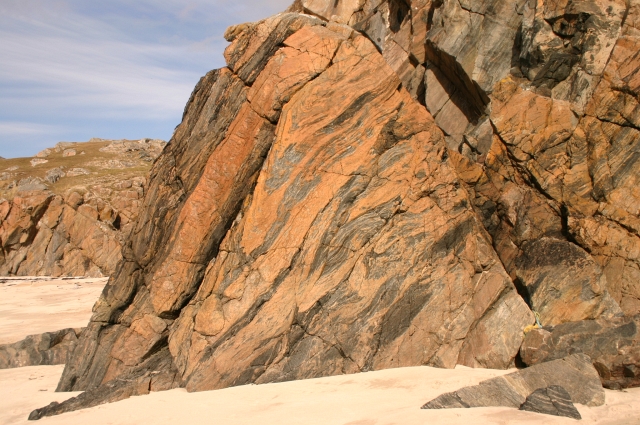


Formation and metamorphic setting
Gneiss typically develops during regional metamorphism associated with mountain building and deep burial, or during contact metamorphism adjacent to intrusions. Heating and deformation drive growth of new mineral assemblages and the migration of compatible elements, producing the coarse, banded fabric. The constituent minerals in gneiss commonly derive from parent rocks that were originally either igneous or sedimentary in origin.
Texture, minerals, and appearance
Gneiss shows pronounced foliation commonly called gneissic banding: light layers usually rich in quartz and feldspar alternate with darker layers containing mafic minerals such as biotite or amphibole. Thin seams may be nearly monomineralic, for example dominated by quartz or sheets of mica. Grain sizes are typically coarse enough to see individual mineral grains with the naked eye, distinguishing gneiss from finer foliated rocks like schist.
Major varieties and origins
Gneiss classifications often reflect the nature of the protolith. Orthogneiss forms from metamorphosed igneous rocks such as granite and commonly preserves feldspar‑rich compositions. Paragneiss forms from metamorphosed sedimentary rocks such as sandstone or mudstone and may show different chemical signatures. Both types record high‑grade metamorphism and can evolve into migmatite where partial melting occurs.
Field identification, uses, and significance
- Field identification: look for coarse foliation, alternating light and dark bands, and visible mineral grains; hand samples may show stretched or folded bands revealing a deformational history.
- Uses: gneiss is a durable dimension stone used for building facades, paving, and decorative stone where its banded appearance is desirable.
- Geologic significance: gneisses commonly form the cores of ancient continental shields and the roots of mountain belts and record conditions of deep crustal metamorphism.
Gneiss occurs worldwide and is an important rock type for interpreting the deep structure and thermal history of the crust. For general background on rock types and metamorphic processes see resources about metamorphic rocks and introductory pages on rock classification. For more on mineralogy and parent rocks consult entries on minerals, contrasts between igneous and sedimentary protoliths, and common constituents such as quartz, mica, granite, and sandstone.
Questions and answers
Q: What is gneiss?
A: Gneiss is a type of metamorphic rock.
Q: Where do the minerals in gneiss come from?
A: The minerals in gneiss may come from rocks which were originally either igneous or sedimentary.
Q: How are the minerals in gneiss formed?
A: They were heated and squeezed, and the minerals recrystallized.
Q: What is orthogneiss?
A: Orthogneiss is gneiss obtained from igneous rock (such as granite).
Q: What is paragneiss?
A: Paragneiss is gneiss obtained from sedimentary rock (such as sandstone).
Q: What is the texture of minerals in gneisses?
A: In gneisses, minerals tend to be foliated: layered and segregated into bands.
Q: What is the composition of a mica schist seam?
A: There are seams of quartz and of mica in a mica schist, very thin, but consisting essentially of one mineral.
Related articles
Author
AlegsaOnline.com Gneiss: Layered Metamorphic Rock — Formation, Types, and Uses Leandro Alegsa
URL: https://en.alegsaonline.com/art/39317