
Giuseppe Piazzi — Italian astronomer who discovered Ceres
Giuseppe Piazzi (1746–1826), a Theatine priest and astronomer, directed Palermo Observatory and discovered Ceres in 1801. He produced a major star catalogue and made lasting contributions to observational astronomy.
Giuseppe Piazzi (7 July 1746 – 22 July 1826) was an Italian priest, mathematician and astronomer best known for discovering the object now called the dwarf planet Ceres. Trained in the Theatine order, Piazzi combined religious duties with careful observational work and rose to direct one of Italy's principal observatories. For a concise biographical overview see biographical notes.
Image gallery
5 Images


Early life and professional role
Piazzi studied mathematics and astronomy while serving in the Catholic clergy, an arrangement common in his era. He became the founding director of the Palermo Observatory, where he organized instruments and systematic observations. Accounts of his early career and his role at Palermo are summarized in contemporary studies and archival material: early career sources.
Discovery of Ceres
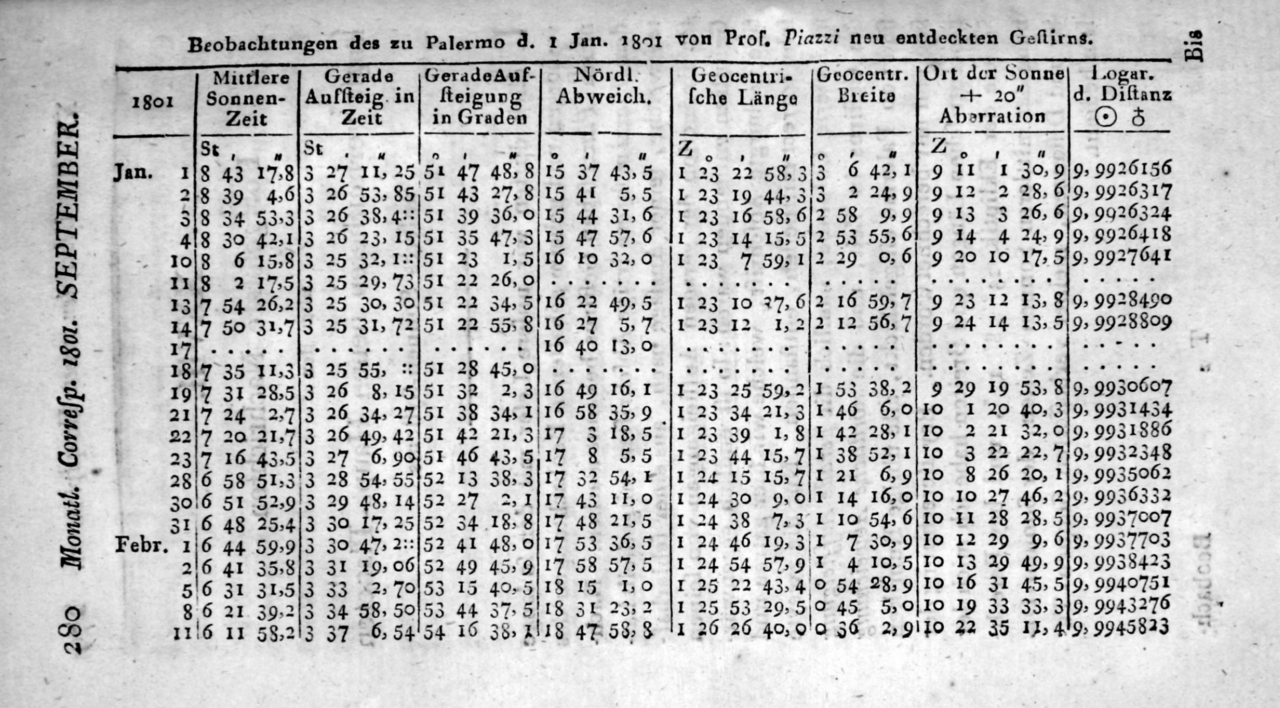
On the night of 1 January 1801 Piazzi recorded a small moving object among the stars. He initially catalogued it as a comet and named it Cerere Ferdinandea in honor of the goddess Ceres and (briefly) a reigning monarch. The object was soon reclassified as an asteroid and, in modern terms, recognized as a dwarf planet. His discovery and the immediate reactions of other astronomers are discussed in historical treatments: discovery details.
Cataloguing the sky
Beyond the single discovery, Piazzi is remembered for his precise positional astronomy. He compiled a major star catalogue while at Palermo that listed thousands of stellar positions with careful error estimates; this work was influential for later astrometry and navigation. Summaries and editions of his catalogue can be found at catalogue resources.
Legacy and influence
Piazzi's careful observational methods helped establish standards for positional measurements in the 19th century. The recovery of Ceres after it was temporarily lost required new orbital methods; Carl Friedrich Gauss's successful orbit prediction highlighted the interplay between Piazzi's observations and mathematical advances. Modern discussions of his scientific legacy are available at legacy reviews and at institutional histories: observatory history.
Notable facts and recognition:
- Dual vocation: a clergyman who made lasting scientific contributions (religious and scientific life).
- Observational skill: established rigorous routines at Palermo that improved star positions (observational methods).
- Commemoration: his name and discoveries are commemorated in astronomical literature and by institutions that preserve his papers (commemorations).
Piazzi died in 1826, leaving a legacy as a careful observer whose discovery of Ceres opened questions about the nature of small Solar System bodies and whose star catalogue remained a resource for generations of astronomers.
Related articles
Author
AlegsaOnline.com Giuseppe Piazzi — Italian astronomer who discovered Ceres Leandro Alegsa
URL: https://en.alegsaonline.com/art/39030