
Ceres: the dwarf planet of the main asteroid belt
Ceres is the largest object in the main asteroid belt and the Solar System's smallest recognized dwarf planet; an ice‑rich, nearly spherical world explored by NASA's Dawn mission.

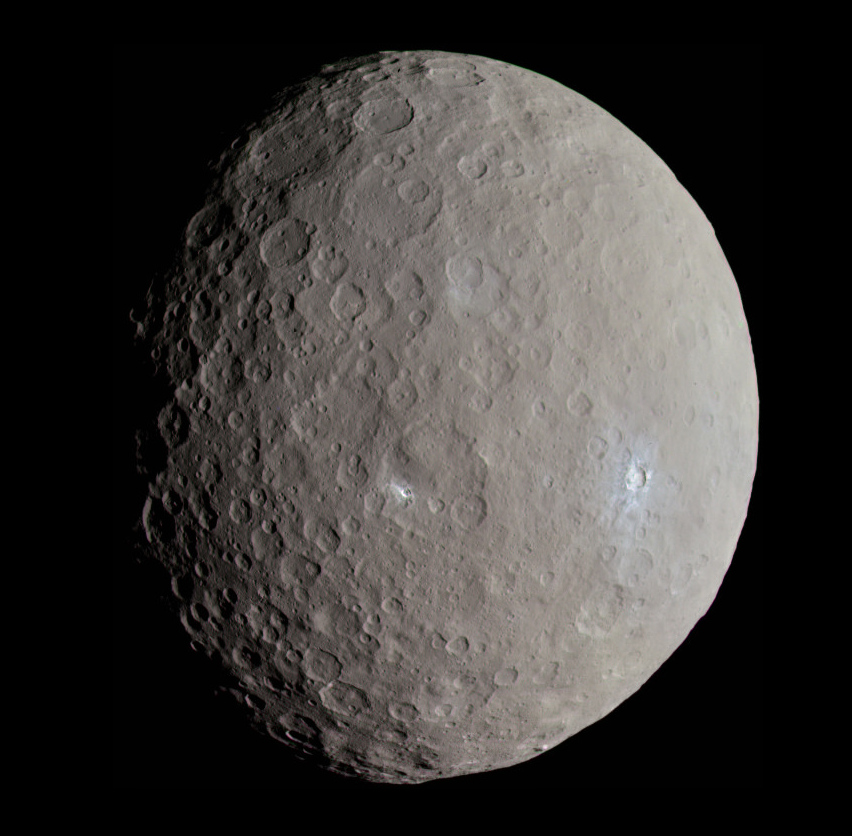
Overview. Ceres (officially 1 Ceres) is the smallest body formally classified as a dwarf planet in the Solar System. It lies in the main asteroid belt between Mars and Jupiter and is the belt's largest and most massive member. At roughly 940–950 kilometres across, Ceres has sufficient gravity to maintain a roughly spherical shape and, unlike many smaller asteroids, it has no natural satellites (moons).
Image gallery
10 Images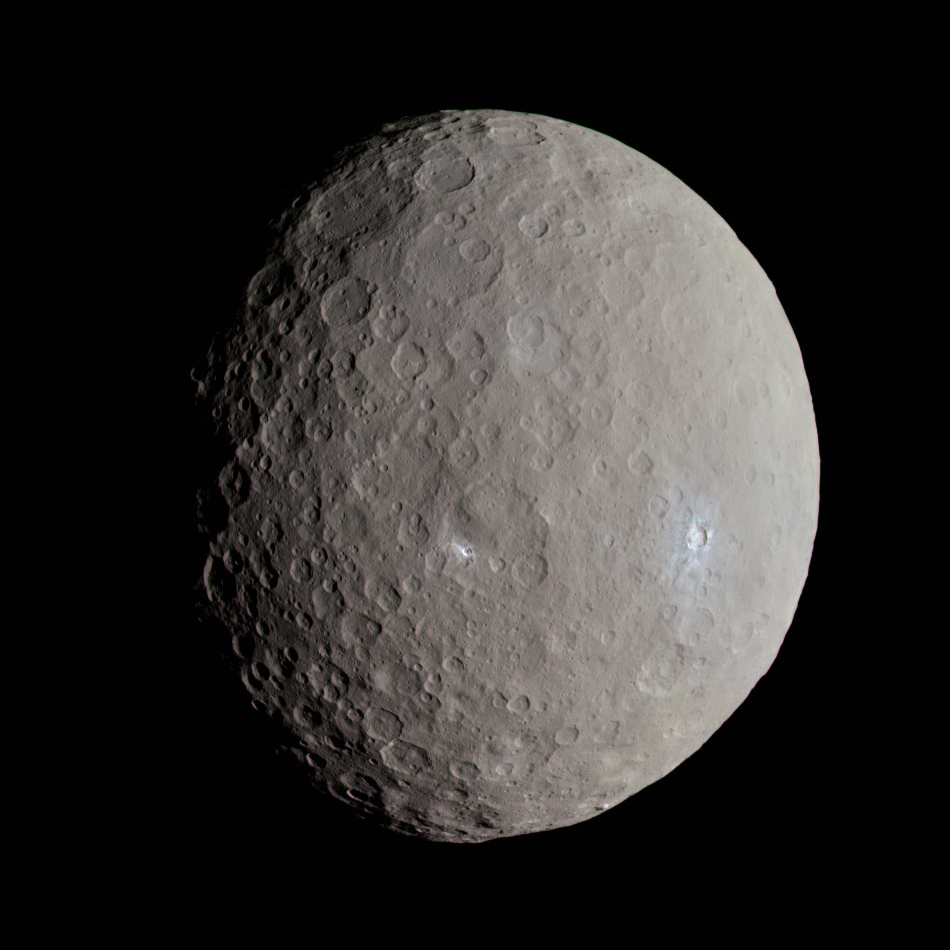




Physical characteristics
Ceres is composed of a mixture of rock and water‑rich materials. Its bulk density and surface features indicate substantial amounts of water ice, and some observations point to hydrated minerals and salts at or near the surface. The dwarf planet rotates relatively quickly for its size, with a day of about nine hours, and contains formations that suggest internal geological activity in the past. Compared with other large belt members such as Vesta, Ceres is darker and less reflective, a result of different surface composition and porosity.
Surface, craters and unique features
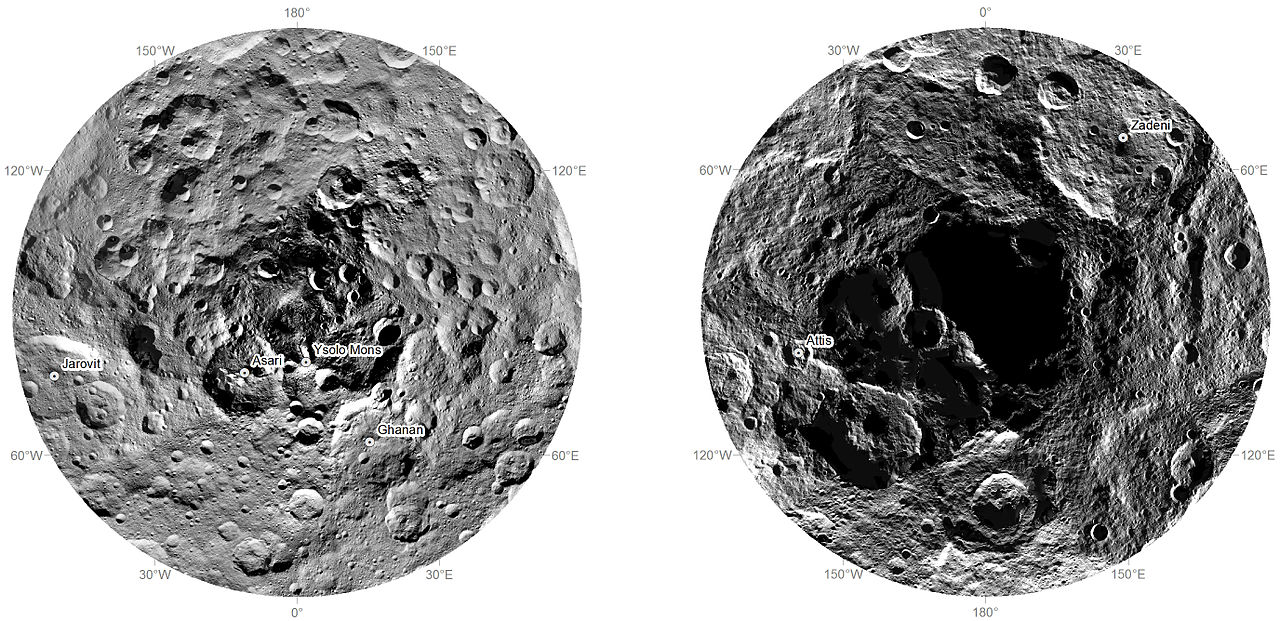
The surface of Ceres is heavily cratered but also shows unusual, young‑looking features. The bright deposits inside Occator crater are among its most striking aspects: they are deposits of salts and hydrated minerals that likely came from subsurface brines that reached the surface and evaporated. Elsewhere on Ceres are smooth domes and lone mountains interpreted as cryovolcanic constructs, indicators that volatile‑driven processes have reshaped parts of the surface. Detailed analysis of surface deposits has revealed sodium carbonates and other evaporitic minerals, evidence for recent transport of liquid or slushy material.
Discovery and naming
Ceres was discovered on 1 January 1801 by the Italian astronomer Giuseppe Piazzi. It was named after the Roman goddess Ceres, protector of agriculture and grain—linked traditionally to the cultivation of growing plants and the harvest. Over the 19th and 20th centuries Ceres was variously catalogued as a planet, then an asteroid or minor planet; in 2006 the International Astronomical Union revised the taxonomy of small bodies and formally designated Ceres as a dwarf planet (2006 decision).
Exploration and observations
Direct exploration of Ceres began with the NASA Dawn spacecraft. Launched in 2007, Dawn entered orbit around Ceres in 2015, becoming the first mission to orbit a dwarf planet and providing the first close‑up maps of its terrain and composition. Dawn's findings guided comparisons with other dwarf planets and small worlds, arriving at Ceres shortly before NASA's New Horizons mission flew past the distant dwarf planet Pluto, highlighting how diverse these small planetary bodies can be.
Importance and ongoing study
Ceres occupies an important place in studies of planetary formation and volatile distribution in the inner Solar System. Its water‑rich composition, surface salts, and relatively young deposits make it a natural laboratory for understanding how water, organics and heat interact on small worlds. Continued telescopic monitoring and data reanalysis seek to refine our knowledge about transient phenomena (for example, localized outgassing), internal structure and the history of possible subsurface liquids. Future missions or instruments may test whether Ceres once harboured a global or regional ocean and what that implies for habitability and the evolution of the early Solar System.
- Key facts: largest object in the main belt, classified as a dwarf planet, discovered by Piazzi.
- Notable features: Occator bright deposits, cryovolcanic domes and diverse hydrated minerals.
- Explored by: NASA's Dawn mission; contrasted with visits such as New Horizons to Pluto.
Questions and answers
Q: What is Ceres?
A: Ceres is the smallest dwarf planet in the Solar System and the only one located in the main asteroid belt.
Q: Who discovered Ceres?
A: Giuseppe Piazzi discovered Ceres on 1 January 1801.
Q: What is the diameter of Ceres?
A: The diameter of Ceres is about 950 km.
Q: How far away from the Sun is Ceres located?
A: Ceres is located at 2.8 AU (257 million miles) from the Sun, which makes it the closest dwarf planet to the Sun.
Q: Does Ceres have any moons?
A: No, it does not have any moons.
Q: What space probe was launched to explore Vesta and Ceres?
A: On September 27, 2007, NASA launched Dawn space probe to explore Vesta and Cerea.
Q: What unusual crater does Cerea contain? A; Occator crater contains bright salts.
Related articles
Author
AlegsaOnline.com Ceres: the dwarf planet of the main asteroid belt Leandro Alegsa
URL: https://en.alegsaonline.com/art/18184
Sources
- asteroid.lowell.edu : "Asteroid Observing Services"
- ssd.jpl.nasa.gov : "1 Ceres"
- webcache.googleusercontent.com : "05. Dawn Explores Ceres Results from the Survey Orbit.pptx"
- iau-comm4.jpl.nasa.gov : "High-Precision Ephemerides of Planets—EPM and Determination of Some Astronomical Constants"
- doi.org : 10.1007/s11208-005-0033-2
- lpi.usra.edu : Asteroids III
- adsabs.harvard.edu : "Differentiation of the asteroid Ceres as revealed by its shape"
- doi.org : 10.1038/nature03938
- psi.edu : "Asteroid Lightcurve Derived Data. EAR-A-5-DDR-DERIVED-LIGHTCURVE-V8.0"
- psi.edu : "IRAS Minor Planet Survey. IRAS-A-FPA-3-RDR-IMPS-V6.0"
- psi.edu : "Asteroid Taxonomy.EAR-A-5-DDR-TAXONOMY-V5.0"
- adsabs.harvard.edu : "Ceres surface properties by high-resolution imaging from Earth"
- doi.org : 10.1006/icar.1993.1125
- solarviews.com : Ceres at Solarviews.com
- wikidata.org : wikidata.org/wiki/Q596