
Germanic languages
Branch of the Indo-European family that includes English, German, Dutch and the Scandinavian languages; descended from Proto‑Germanic and divided into East, North and West groups.
The Germanic languages form a branch of the larger Indo‑European family. They derive from a common ancestor, Proto‑Germanic, which is generally reconstructed as having been spoken in parts of northern Europe, especially southern Scandinavia and nearby regions; archaeological and linguistic evidence links its emergence to the later Iron Age—sometimes described in relation to movements within Scandinavia during the Iron Age. As a group today they are spoken natively by several hundred million people worldwide, with estimates often placed around the figure cited by surveys of global language use (speaker estimates). English is the largest single member of the family by native speaker numbers (English).
Image gallery
7 Images


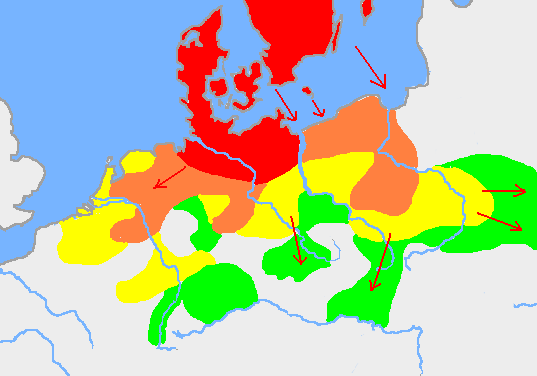
Classification and major branches
Traditionally the Germanic family is divided into three branches:
- East Germanic — now extinct; represented historically by languages such as Gothic (extinction and records summarized under East Germanic).
- North Germanic — the Scandinavian group that includes modern Icelandic, Faroese, Norwegian, Swedish and Danish.
- West Germanic — a diverse cluster including German, English, Dutch, Afrikaans and Yiddish, among others.
Linguistic characteristics
Several shared features identify the Germanic branch: systematic sound changes separating it from Proto‑Indo‑European (notably the shift summarized by Grimm’s law), characteristic verb classes (strong vs. weak), patterns of vowel mutation (umlaut), and historically rich inflectional morphology. Over time many Germanic languages have reduced case and gender systems and simplified verb morphology; word order and periphrastic constructions vary across the branch.
History and development
Proto‑Germanic split from Proto‑Indo‑European and then diversified into regional dialects that became the recorded Germanic languages of antiquity and the Middle Ages. Contact with Latin, Celtic, Baltic and Slavic languages, as well as later borrowings through trade and colonization, shaped each branch differently. Written records begin in the early centuries CE for some languages (runic inscriptions, Gothic texts) and later for others.
Geography, use and influence
Germanic languages are concentrated in northern and central Europe but achieved global reach chiefly through colonial expansion and migration—English and Dutch in particular spread to many continents, while Afrikaans developed in southern Africa. They serve as official or national languages in numerous states and play major roles in commerce, science and culture.
Notable distinctions and facts
Mutual intelligibility varies: Scandinavian languages show a dialect continuum with partial mutual understanding, whereas West Germanic varieties display complex continuities and divergences. East Germanic languages are known only from historical records and are extinct. For further reading on comparative reconstruction and sound laws see linked summaries and resources: Indo‑European overview, Scandinavian origins, Iron Age context, speaker data, English, East Germanic, Proto‑Indo‑European and Grimm’s law.
Related articles
Author
AlegsaOnline.com Germanic languages Leandro Alegsa
URL: https://en.alegsaonline.com/art/38477