
Proto-Indo-European language (PIE)
Proto-Indo-European (PIE) is the reconstructed common ancestor of the Indo-European languages. This article summarizes its reconstruction, sounds and grammar, chronology, homeland theories, and legacy.
The Proto-Indo-European language (PIE) is the hypothetical ancestral tongue from which the family of Indo-European languages descends. It is not directly attested by writing but has been reconstructed by comparing later languages and applying well-established methods of historical linguistics. PIE underlies the diverse branches that include Sanskrit, Greek, Latin and its Romance descendants, the Germanic languages, Celtic, Slavic, Baltic, Armenian, Albanian, Anatolian and Tocharian. For an overview of that family see Indo-European languages.
Image gallery
3 Images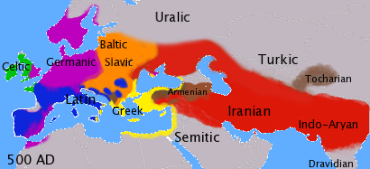

Reconstruction and methods
Scholars reconstruct PIE using the comparative method and internal reconstruction to infer regular sound correspondences, ancestral word forms and grammatical patterns. Because many daughter languages preserve complementary evidence, PIE is among the best-understood proto-languages. Accessible summaries of this status are available via general linguistic resources (further reading) and technical introductions to methodology can be found through sources on historical linguistics (see methods).
Phonology and morphology
Reconstructed PIE had a rich consonant system including voiced, voiceless and voiced aspirated stops, a series of resonants and a set of theorized "laryngeal" sounds. Vowel alternation called ablaut (e.g., e ~ o ~ zero) played a central role in word formation. Grammatically, PIE was highly inflected: nouns were marked for case (nominative, accusative, genitive, dative and others), number (singular, plural, and often dual) and sometimes gender; verbs showed tense/aspect distinctions (present, aorist, perfect), mood and person. These patterns are visible across many daughter languages.
Chronology, homeland and split
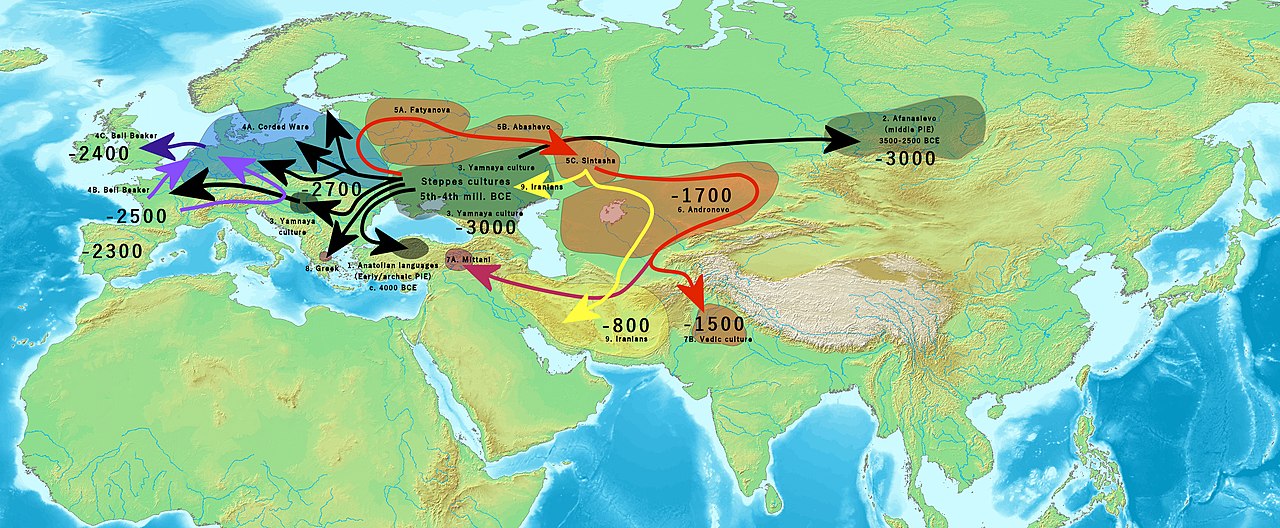
Date and homeland remain subjects of research and debate. Many specialists place PIE in the late Neolithic to early Bronze Age; popular estimates range roughly within the 5th–3rd millennia BCE. The Steppe (or Kurgan) hypothesis, which locates the homeland on the Pontic–Caspian steppe, is widely supported by linguistic and recent genetic evidence, while the Anatolian hypothesis posits an earlier spread from Anatolia. Different branches—such as Anatolian and Tocharian—show early divergences that inform these models.
Examples, legacy and significance
Commonly cited reconstructed forms include simple kinship and natural-world roots that produced familiar words across languages, for example forms often written as *pater ("father"), *mater ("mother") and *h₂éwsōs ("dawn"). The study of PIE illuminates how grammar and vocabulary change, helps date cultural contacts, and contributes to archaeology and population genetics when combined with non-linguistic evidence.
Notable features and further research
- Ablaut and morphological alternation explain many verb and noun paradigms across Indo-European languages.
- The laryngeal theory, once controversial, now explains irregular vowel patterns and certain consonant correspondences.
- Research remains active: refinements come from better comparative data, new archaeological findings, and ancient DNA studies that test dispersal models.
Related articles
Author
AlegsaOnline.com Proto-Indo-European language (PIE) Leandro Alegsa
URL: https://en.alegsaonline.com/art/79532
Sources
- psych.auckland.ac.nz : Russell D. Gray and Quentin D. Atkinson, Language-tree divergence times support the Anatolian theory of Indo-European origin, Nature 426 (27 November 2003) 435-439