
Indo-European languages: origin, structure, branches, and global influence
A concise overview of the Indo-European language family: its origins in Proto-Indo-European, characteristic features, major branches, historical spread, and contemporary importance.
Overview
The Indo-European languages form one of the world's largest and most widely spoken language families. Linguists treat them as a related group that descended from a single ancestral tongue, commonly called Proto-Indo-European. That ancestral language is thought to have been spoken in parts of Eurasia and to have given rise, over millennia, to several hundred related varieties and dialects; the grouping is often described simply as a language family. Evidence for relationships among its members comes from systematic similarities in sound systems, grammar, and basic vocabulary.
Image gallery
8 Images


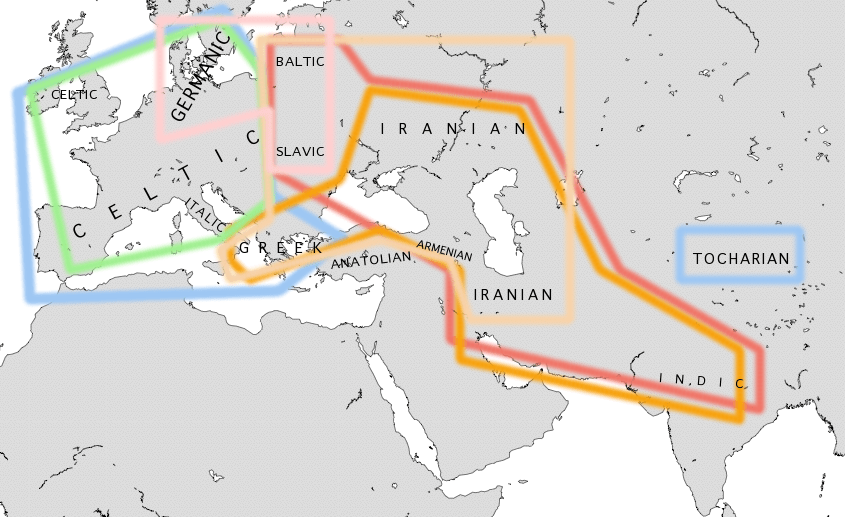
Characteristics and common features
Members of the family share a number of characteristic features inherited from their ancestor. These include comparable systems of verb inflection and noun cases, cognate basic vocabulary, and similar patterns of sound change that can be traced using the comparative method. The family contains several hundred related languages and dialects, ranging from conservative, highly inflected languages to modern analytic varieties. Typological profiles vary widely: for example, some branches preserve complex case systems while others have simplified morphology.
History and development
Scholars reconstruct Proto-Indo-European by comparing later languages and working backwards to infer earlier forms. The earliest written records identified as Indo-European date to the Bronze Age, including inscriptions from Anatolia and syllabic records such as Mycenaean Greek. Archaeological and linguistic evidence suggests that the language family expanded after technological and social changes like the invention of farming and later migrations. Historically important regions for the family include much of Europe, the Iranian plateau, and South Asia, with earlier attestations in Anatolia and movements into parts of Central Asia. Many branches show evidence of Bronze Age or Iron Age divergence; for example, Anatolian varieties are among the earliest to be attested in writing (Bronze Age sources).
Main branches and geographic distribution
- Indo-Iranian: the largest branch, now dominant in South Asia and parts of the Iranian plateau.
- Balto-Slavic: languages of Eastern and Northern Europe with shared historical features.
- Germanic: including English and German, widespread in Europe and beyond.
- Romance: descended from Latin and spoken across Western and Southern Europe and former colonies.
- Celtic, Hellenic (Greek), Armenian, Albanian, Anatolian (extinct), Tocharian (extinct) and others.
These branches are distributed globally today, partly because of historical migrations and partly due to colonial expansion and cultural influence.
Contemporary importance and examples
Although the number of distinct Indo-European languages is smaller than in some other families, the group contains the largest share of native speakers worldwide — numbering roughly two to three billion people in contemporary estimates. Among the most widely spoken individual languages are English, Spanish, Hindi, Portuguese, Bengali, Russian, German, Sindhi, Punjabi, Marathi, French, and Urdu. Four of the six official languages of the United Nations — English, Spanish, French, and Russian — belong to this family, reflecting its global cultural and political reach.
Notable facts and distinctions
The family is central to historical linguistics because its members preserve a rich record of change that makes reconstruction possible. Important methods include the comparative method and internal reconstruction. Some branches, like Anatolian and Tocharian, are extinct and known only from ancient sources; others continue to diversify. The family’s spread results from a combination of prehistoric migrations, social contact, and more recent processes such as conquest, trade, and colonization. For readers seeking further reading, introductory surveys and comparative grammars provide accessible pathways into the subject; online resources and specialist literature treat individual branches and languages in depth (overview resources).
Questions and answers
Q: What language family is the most spoken in the world?
A: The Indo-European languages are the most spoken language family in the world.
Q: Where was Proto-Indo-European originally spoken?
A: Linguists believe that Proto-Indo-European was originally spoken somewhere in Eurasia.
Q: What are some of the major languages and dialects included in this language family?
A: The Indo-European languages are a family of several hundred related languages and dialects, including most major languages in Europe, the Iranian plateau, and South Asia. Historically, it has also been important in Anatolia and Central Asia.
Q: When did writing first appear for this language family?
A: The earliest known writing for this language family is from the Bronze Age in Anatolian and Mycenaean Greek.
Q: What is believed to be the origin of Proto-Indo-European?
A: It is believed that Proto-Indo-European originated after the invention of farming since some of its words have to do with farming.
Q: How many native speakers does this language family have?
A: This language family has about 2.7 billion native speakers.
Q: Which four out of six official UN languages are Indo European?
A: Four out of six official United Nations Languages are Indo European - English, Spanish, French, and Russian
Related articles
Author
AlegsaOnline.com Indo-European languages: origin, structure, branches, and global influence Leandro Alegsa
URL: https://en.alegsaonline.com/art/47189
Sources
- ethnologue.com : "Ethnologue list of language families"
- ethnologue.com : ethnologue.com/subgroups/indo-european
- ethnologue.com : ethnologue.com/guides/largest-families
- glottolog.org : glottolog.org/glottolog/family
- indo-european.eu : indo-european.eu/
- ethnologue.com : ethnologue.com/subgroups/albanian
- ethnologue.com : ethnologue.com/subgroups/armenian
- ethnologue.com : ethnologue.com/subgroups/balto-slavic
- ethnologue.com : ethnologue.com/subgroups/celtic
- ethnologue.com : ethnologue.com/subgroups/germanic
- ethnologue.com : ethnologue.com/subgroups/greek
- ethnologue.com : ethnologue.com/subgroups/indo-iranian
- ethnologue.com : ethnologue.com/subgroups/italic
- glottolog.org : glottolog.org/resource/languoid/id/indo1319